The First Burial
The two sons of Adam and the burying crow (Q 5:27-31)
Time of Adam (peace be upon him)
 Educational historical reconstruction
Where
Primeval earth, the first death (by tradition the slope of Mount Qasiyun above Damascus)
33.5460, 36.2810 · View on OpenStreetMap
Background
The Qur'an records the first wrongful death among mankind in Surat al-Ma'ida (Q 5:27-32): the two sons of Adam each offered a sacrifice (qurban), and it was accepted from one and not from the other. The one whose offering was rejected threatened to kill his brother; the God-fearing brother answered that if his brother stretched out his hand to kill him, he would not stretch out his own hand in return, for he feared Allah, the Lord of the worlds (Q 5:28). The killer's soul prompted him to murder his brother, and he became one of the losers (Q 5:30). Then Allah sent a crow scratching in the ground to show him how to hide the body of his brother; he cried out in regret, asking whether he was unable even to be like this crow and to bury his brother, and so he became of the regretful (Q 5:31). It is upon this account that the Qur'an founds the sanctity of human life: that whoever kills a soul, unless for a soul or for corruption in the land, it is as if he had killed all mankind, and whoever saves a life, it is as if he had saved all mankind (Q 5:32). The Qur'an does not name the two sons; the names Habil and Qabil (Abel and Cain) and many narrative details belong to the later Sunni qisas al-anbiya' tradition (Ibn Kathir, al-Tabari), which carries some material from earlier Isra'iliyyat and is reported with due caution. Nor does the Qur'an fix a place; a late local tradition associates the killing with the slope of Mount Qasiyun above Damascus (the so-called cave of blood), used here only as a symbolic locator. This scene depicts the aftermath in a bare primeval land: the two offerings on the stone, the freshly raised grave, and the crow scratching the earth. No figure is shown and the killing itself is not depicted.
What you see
Bare, unworked land at the dawn of the world, no city and no field, only open ground and rock under a wide sky. This is a place before settlement, the earth still young.
Two offerings have been laid out on the bare stone, one of the produce of the ground and one a fine animal. These are the qurban, the sacrifices of the two sons of Adam, of which one was accepted and one was not (Q 5:27).
A single grave has just been scratched into the soft earth, a low mound freshly raised. It is the first death among the children of men and the first burial.
A black crow scratches at the ground beside the grave. By the Qur'an, Allah sent a crow scratching the earth to show the survivor how to bury the body of his brother (Q 5:31).
The first wrongful killing and the first burial, told soberly through the offerings, the fresh grave and the crow. No person is shown. The survivor became of the regretful (Q 5:31), and the verse on the sanctity of every soul follows (Q 5:32).
The narrative is Q 5:27-32 (Surat al-Ma'ida). The names Habil and Qabil and the choice of place come from the later Sunni qisas tradition (Ibn Kathir), not from the Qur'an itself.
Primary sources
The Qur'an, Surat al-Ma'ida (Q 5:27-32): The account of the two sons of Adam, the accepted and rejected sacrifice, the killing, the burying crow, and the verse on the sanctity of life. The primary source.
Ibn Kathir, Qisas al-Anbiya' and Tafsir al-Qur'an al-'Azim (14th c.): Standard Sunni narrative and exegesis of the episode; the source of the names Habil and Qabil and the qisas detail, drawn in part from earlier traditions and reported with caution.
al-Tabari, Tarikh al-Rusul wa-al-Muluk and Jami' al-Bayan: Standard Sunni history and tafsir for the story of the two sons of Adam.
Further reading & cross-references
The names and place as qisas / Isra'iliyyat: The Qur'an names neither son nor the place. The names (Habil, Qabil) and the Mount Qasiyun tradition come from the qisas literature and local lore and are not authoritative points of creed.
Material and topographic evidence: There is no datable site for the first burial; the primeval setting is symbolic, and the Damascus cave-of-blood tradition is late and local.
Questions & answers
- Where is The First Burial?
- Primeval earth, the first death (by tradition the slope of Mount Qasiyun above Damascus)
- When did it happen?
- Time of Adam (peace be upon him)
- What is the story of The First Burial?
- The Qur'an records the first wrongful death among mankind in Surat al-Ma'ida (Q 5:27-32): the two sons of Adam each offered a sacrifice (qurban), and it was accepted from one and not from the other. The one whose offering was rejected threatened to kill his brother; the God-fearing brother answered…
Related places
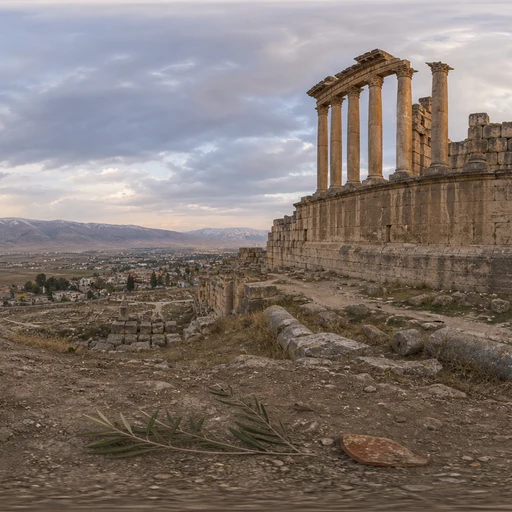
Ilyas at Baalbek
Time of Ilyas (peace be upon him)

The Table and the Disciples
The ministry of 'Isa (peace be upon him), Roman-period Galilee

Sulayman's Temple and Throne
The reign of Sulayman (peace be upon him)

Zakariyya in the Sanctuary
The time of Zakariyya (peace be upon him), late Second Temple period

The Birthplace under the Palm
The time of the birth of 'Isa (peace be upon him)

Dawud and the Valley of the Duel
The time of Dawud (peace be upon him), before his kingship
Guess places like this in GeoSiyer
Drop into a 360° scene from Islamic history and pin where, and when, it happened.
Play GeoSiyer