The Alaeddin Mosque of Konya
The royal mosque of the Seljuks of Rum, c. 1220 CE
617 AH / c. 1220 CE
 Educational historical reconstruction
Where
The Alaeddin Hill, Konya, in central Anatolia
37.8716, 32.4925 · View on OpenStreetMap
Background
The Alaeddin Mosque stands on the flat top of the Alaeddin Hill, the ancient citadel mound that rises in the middle of Konya, the city that was the capital of the Seljuk Sultanate of Rum, the state of the Seljuk Turks in Anatolia. It is the chief and oldest of the great congregational mosques of the city, built and enlarged over the reigns of several sultans across the late twelfth and early thirteenth centuries and completed about 1220, in or near the reign of Alaeddin Kayqubad I, the greatest of the Anatolian Seljuk sultans, whose name it bears. The mosque is a long, low building of stone in the sober and massive early Anatolian Seljuk manner, and its wide prayer-hall is carried on a forest of columns of many different kinds and ages, plainly gathered and reused from the older Greek and Roman ruins of the region, supporting a flat wooden roof; it has a richly carved stone portal and a fine inlaid wooden pulpit. Beside the mosque, on the same mound, stand the domed turbes, the mausolea, in which a line of the Seljuk sultans of Rum were buried, so that the hill was at once the royal mosque, the dynastic burial-place and, together with the palace that once crowned it and has since vanished, the very heart of the Seljuk capital. Konya in this age was a brilliant centre of Islamic art, learning and mysticism, the city of the great mystic-poet Jalal al-Din Rumi. The monument’s reused columns and wooden minbar belong to its architectural history. This exterior panorama does not provide a full view of the hall or a readable minbar.
What you see
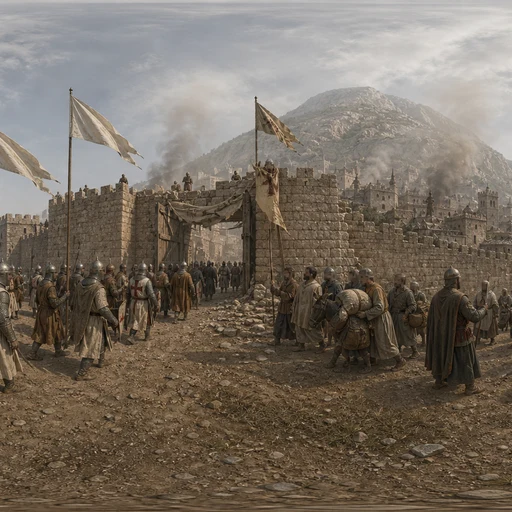
The view is outside: a long, low stone prayer hall faces a courtyard with dynastic tomb structures nearby.
The monument’s reused columns and wooden minbar belong to its architectural history. This exterior panorama does not provide a full view of the hall or a readable minbar.
This is the Alaeddin Mosque, the chief congregational mosque of Konya, the capital of the Seljuk Sultanate of Rum, raised on the citadel mound over several reigns and completed about 1220 in the time of the greatest of the Seljuk sultans of Anatolia.
Beside the mosque stand domed tombs, the turbes in which the Seljuk sultans of Rum were buried; the mound is at once the royal mosque, the dynastic mausoleum and, with the vanished palace, the heart of the Seljuk capital.
The city lies on the high central plain of Anatolia, a place of mosques, madrasas and the shrines of saints, the seat of the Seljuk court and, in this age, of the mystic and poet Rumi.
Stone walls and tomb structures put worship beside dynastic memory; the courtyard setting is more useful here than unseen interior furnishings.
Further reading & cross-references
The Alaeddin Mosque, Konya (extant building and inscriptions): The primary monument. Used for the columned hall, the portal, the pulpit and the royal tombs. Confidence high.
Histories of the Seljuk Sultanate of Rum and its capital Konya: Used for the mosque's building over several reigns, the sultans and the city as the Seljuk capital. Confidence high.
Studies of Anatolian Seljuk architecture: Used for the early Seljuk style, the reuse of antique columns and the royal turbes. Confidence high.
Medieval Konya (material/geographic context): The citadel mound, the city and the central Anatolian plain constrain the depiction.
Questions & answers
- Where is The Alaeddin Mosque of Konya?
- The Alaeddin Hill, Konya, in central Anatolia
- When did it happen?
- 617 AH / c. 1220 CE
- What is the story of The Alaeddin Mosque of Konya?
- The Alaeddin Mosque stands on the flat top of the Alaeddin Hill, the ancient citadel mound that rises in the middle of Konya, the city that was the capital of the Seljuk Sultanate of Rum, the state of the Seljuk Turks in Anatolia. It is the chief and oldest of the great congregational mosques of…



Guess places like this in GeoSiyer
Drop into a 360° scene from Islamic history and pin where, and when, it happened.
Play GeoSiyer