The Khilji Reach into the Deccan
The conical fortress of Devagiri and the power of Delhi, c. 1307 CE
707 AH / c. 1307 CE
 Educational historical reconstruction
Where
Devagiri (later Daulatabad), in the Deccan, northern Maharashtra
19.9417, 75.2719 · View on OpenStreetMap
Background
Under Sultan Ala al-Din Khilji (reigned 1296-1316), the Delhi Sultanate reached the height of its power and extended its reach far to the south, across the Deccan plateau and into the deep peninsula, through the great campaigns of his general Malik Kafur in the years around 1307-1311. The gateway to the south was Devagiri, a fortress crowning a steep, almost conical hill of rock that rises sheer from the Deccan plain, its sides scarped smooth and its single ascent spiralling up through the living rock, reckoned one of the strongest hill-forts in all India; the Yadava rulers of Devagiri were made tributary, and the campaigns pressed on to the rich temple-cities of the far south. The reign is recorded by the poet Amir Khusraw and by the historian Ziya al-Din Barani in the Tarikh-i Firuz Shahi. Alauddin is remembered not only for conquest but for the apparatus of a strong centralised state: to sustain a great standing army against the threat of Mongol invasion and to extend his power, he imposed a famous system of market control at Delhi, fixing by decree the prices of grain, cloth and other goods, with measures, registers and strict inspection. This scene sets the two faces of his rule side by side: the near-impregnable conical fortress of Devagiri that marked the sultanate's southward reach, and the measures and price-lists of the controlled markets that paid for its armies. It depicts the fortress and the apparatus of rule rather than a battle; the Deccan that Delhi touched here would in time become a Muslim political world of its own.
What you see
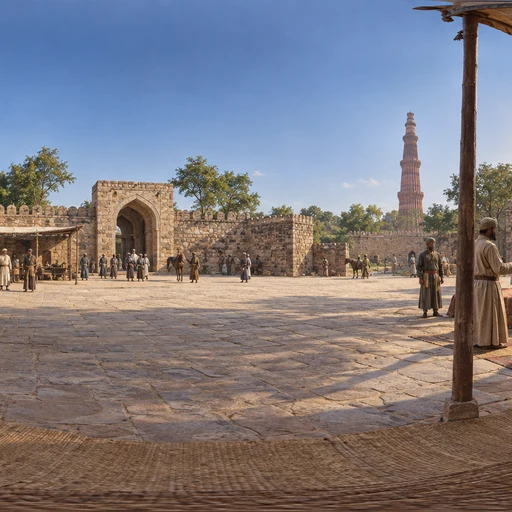
A great fortress crowning a steep, near-conical hill of rock that rises sheer from a Deccan plain, its sides scarped smooth and a single spiralling ascent cut through the rock; one of the strongest hill-forts in all India.
The dry, rolling uplands of the Deccan plateau spread around the fortress-hill, the country of the peninsula south of the northern plains, far from Delhi and reached only by long campaign.
This is Devagiri, the gateway of the Deccan, brought under the reach of the Delhi Sultanate by the campaigns of Sultan Alauddin Khilji and his general Malik Kafur, who carried the sultanate's power deep into the southern peninsula.
Set against the fortress is the other face of Alauddin's rule: the measures, weights and price-lists of his famous controlled markets at Delhi, by which he fixed the prices of grain and goods to sustain a great standing army; a state of both conquest and regulation.
The high-water mark of the Delhi Sultanate's southward reach, when the power of a Muslim state in the north first stretched across almost the whole subcontinent; the Deccan it touched here would become a Muslim political world of its own.
The Khilji campaigns and Alauddin's market controls are recorded by Amir Khusraw and by Ziya al-Din Barani (Tarikh-i Firuz Shahi). The depiction is of the fortress and the apparatus of rule, not of a battle.
Further reading & cross-references
Ziya al-Din Barani, Tarikh-i Firuz Shahi (14th c.): The principal Indo-Persian Muslim history of the Khilji and Tughluq sultans; Alauddin's reign, the Deccan campaigns and the market controls.
Amir Khusraw of Delhi (late 13th-early 14th c.): The poet and chronicler of the Khilji court; contemporary witness to the campaigns and the reign.
Modern histories of the Delhi Sultanate (academic): Used for the chronology of Malik Kafur's southern campaigns and the working of Alauddin's price controls. Non-confessional cross-reference.
The fortress of Devagiri / Daulatabad (extant, material): The conical scarped hill, the spiral rock-cut ascent and the fortifications constrain the depiction; later works were added under the Tughluqs and after.
Questions & answers
- Where is The Khilji Reach into the Deccan?
- Devagiri (later Daulatabad), in the Deccan, northern Maharashtra
- When did it happen?
- 707 AH / c. 1307 CE
- What is the story of The Khilji Reach into the Deccan?
- Under Sultan Ala al-Din Khilji (reigned 1296-1316), the Delhi Sultanate reached the height of its power and extended its reach far to the south, across the Deccan plateau and into the deep peninsula, through the great campaigns of his general Malik Kafur in the years around 1307-1311. The gateway…
Related places

The Migration to Daulatabad
727 AH / c. 1327 CE

The Pepper Port of Calicut
743 AH / c. 1342 CE

The Qutb Complex of Early Delhi
587-602 AH / 1191-1206 CE
The Court of Razia Sultan
c. 1236-1240 CE

The Battle of Tarain
588 AH / 1192 CE

Mahmud of Ghazna's Indian Campaigns
Ghaznavid campaigns (388-421 AH / 998-1030 CE)
Guess places like this in GeoSiyer
Drop into a 360° scene from Islamic history and pin where, and when, it happened.
Play GeoSiyer