The Battle of Badr
Yawm al-Furqan at the wells of Badr, 17 Ramadan 2 AH
17 Ramadan 2 AH / 13 March 624 CE
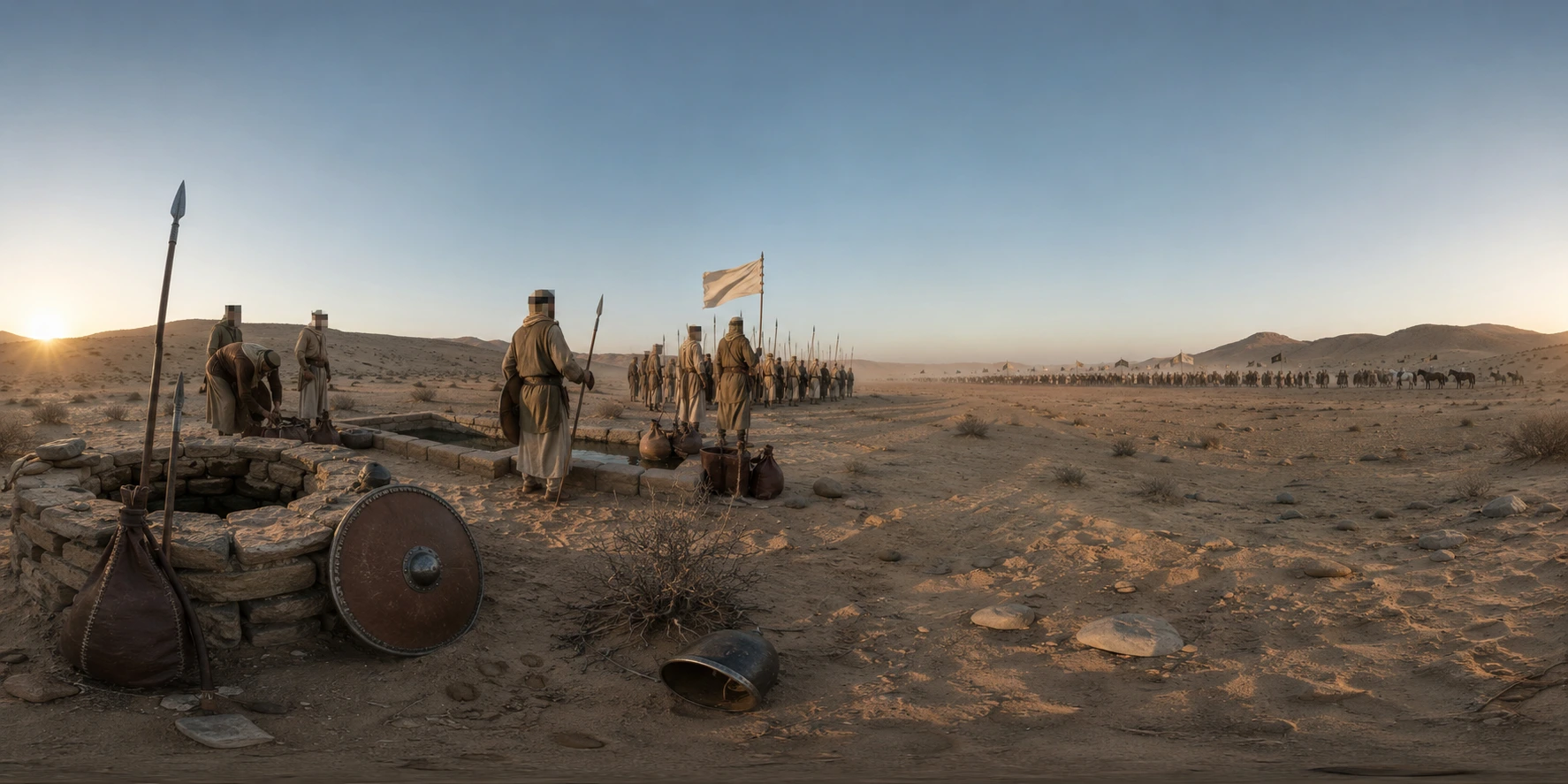 Educational historical reconstruction
Where
Wells of Badr, on the Madinah-Makkah caravan road
23.7782, 38.7832 · View on OpenStreetMap
Background
The Battle of Badr was fought on the 17th of Ramadan in the second year of the Hijrah (13 March 624 CE) at the wells of Badr on the caravan road between al-Madinah and Makkah. The Sunni Sirah sources (Ibn Hisham's al-Sira al-Nabawiyya, al-Waqidi's al-Maghazi, Ibn Sa'd's al-Tabaqat al-Kubra, al-Tabari, Ibn Kathir, al-Mubarakpuri) record the sequence: the Prophet (peace and blessings be upon him) led three hundred and thirteen Companions out from al-Madinah to intercept the trade caravan of Abu Sufyan returning from al-Sham; Abu Sufyan, learning of the Muslim approach, diverted his caravan along the coast; meanwhile a Quraysh relief army of approximately one thousand under Abu Jahl marched out of Makkah and met the Muslim force at Badr. The Prophet (peace and blessings be upon him) is recorded as having made the famous du'a in the 'arish: Allahumma anjiz li ma wa'adtani, 'O Allah, fulfill for me what You promised me' (Sahih Muslim 1763). The Qur'an addresses the engagement directly in Surat al-Anfal (Q 8) and refers to the descent of the angels in support of the Muslims (Q 3:124-125, Q 8:9-12). Fourteen Muslim Companions were martyred at Badr; the Quraysh dead included Abu Jahl and seventy of their leading men, with seventy taken prisoner. The names of the Companions present at Badr, the Ahl Badr, are preserved in the Sunni Sirah tradition and constitute a foundational group of revered Companions; the Prophet's (peace and blessings be upon him) saying about the people of Badr, 'Perhaps Allah has looked upon the people of Badr and said: Do what you wish; I have forgiven you' (Sahih al-Bukhari 3007, Sahih Muslim 2494), frames the standing Sunni reverence for them. The engagement is the Yawm al-Furqan (Q 8:41), the Day of Discrimination between truth and falsehood. This scene depicts the moments before the engagement on the morning of the 17th of Ramadan: the two armies in position across the open ground, the Muslim camp at the upper wells, the Quraysh camp at the lower ground.
What you see
A shallow sandy valley between two ranges of low basalt hills on the western Arabian caravan road between Yathrib and Makkah. A line of springs and wells runs along the valley floor, the abar Badr, the only watering point for a full day's march in any direction.
Two armies face one another across the open ground. To the north, the small Muslim force of three hundred and thirteen Companions, the first army of Islam. To the south, the Quraysh army of approximately one thousand under Abu Jahl, marching to relieve the trade caravan of Abu Sufyan that had eluded the Muslims by changing route.
The Muslims have taken position at the upper wells and stopped the lower wells with sand, depriving the Quraysh of water. The Companions' camp is in the higher ground; the 'arish (a shelter of palm branches) has been built for the Prophet (peace and blessings be upon him) on a hillock overlooking the field.
Sunni tradition records the angels descending to fight alongside the Muslims (Q 3:124-125); the Prophet (peace and blessings be upon him) is recorded as having made the famous du'a Allahumma anjiz li ma wa'adtani before the engagement (Sahih Muslim 1763). The day is the Yawm al-Furqan, the Day of Discrimination (Q 8:41), between truth and falsehood.
The first major military engagement of Islam; a small, undersupplied force prevailed over a larger one through divine support. The names of the fourteen Companions martyred at Badr are preserved in the Sunni Sirah tradition; the Ahl Badr (People of Badr) are a foundational group of revered Companions.
The light is the high light of late winter in western Arabia. The day in the Arabic calendar is the 17th of Ramadan in the second year of the Hijrah, corresponding to 13 March 624 CE. The engagement was concluded by mid-afternoon; the spoils were distributed (Q 8:1).
The Sunni Sirah preserves Badr in detail: Ibn Hisham, al-Waqidi (Maghazi, with substantial treatment), Ibn Sa'd, al-Tabari, Ibn Kathir. The Qur'an addresses the engagement directly in Surat al-Anfal (Q 8) and Surat Al 'Imran (Q 3).
Primary sources
The Qur'an, Surat al-Anfal (Q 8): The principal Qur'anic treatment of the engagement, including the descent of the angels (Q 8:9-12), the name Yawm al-Furqan (Q 8:41), and the distribution of spoils (Q 8:1).
The Qur'an, Surat Al 'Imran 3:123-127: Refers to the engagement and the angelic support.
Sahih al-Bukhari 3007, Sahih Muslim 2494: The hadith on the standing of the Ahl Badr: 'Perhaps Allah has looked upon the people of Badr...', the foundational Sunni framing.
Sahih Muslim 1763: The hadith preserving the Prophet's (peace and blessings be upon him) du'a in the 'arish at Badr.
Ibn Hisham, al-Sira al-Nabawiyya (early 9th c., transmitting Ibn Ishaq): The principal early Sunni biography. Preserves the engagement in extensive detail: the march, the position, the day-of-battle sequence, the names of the martyrs and the prisoners.
al-Waqidi, Kitab al-Maghazi (early 9th c.): Early Sunni Maghazi with the most detailed treatment of Badr in the early Sirah corpus.
Ibn Sa'd, al-Tabaqat al-Kubra (early 9th c.): Sunni biographical compendium; preserves the order of events and the names of the Companions present.
al-Tabari, Tarikh al-Rusul wa-al-Muluk (early 10th c.): Standard early Sunni history; cross-reference on chronology and detail.
Ibn Kathir, al-Bidaya wa al-Nihaya (14th c.): Standard major Sunni history; synthesises the Sirah treatment of Badr.
Questions & answers
- Where is The Battle of Badr?
- Wells of Badr, on the Madinah-Makkah caravan road
- When did it happen?
- 17 Ramadan 2 AH / 13 March 624 CE
- What is the story of The Battle of Badr?
- The Battle of Badr was fought on the 17th of Ramadan in the second year of the Hijrah (13 March 624 CE) at the wells of Badr on the caravan road between al-Madinah and Makkah. The Sunni Sirah sources (Ibn Hisham's al-Sira al-Nabawiyya, al-Waqidi's al-Maghazi, Ibn Sa'd's al-Tabaqat al-Kubra,…
Related places


Guess places like this in GeoSiyer
Drop into a 360° scene from Islamic history and pin where, and when, it happened.
Play GeoSiyer