The Battle of Manzikert
The Seljuks open Anatolia, 463 AH
Dhul Qa'da 463 AH / 1071 CE
 Educational historical reconstruction
Where
Manzikert (Malazgirt), near Lake Van, eastern Anatolia
39.1460, 42.5400 · View on OpenStreetMap
Background
In Dhul Qa'da 463 AH (August 1071 CE) the Seljuk sultan Alp Arslan rahimahu Allah met the army of the Byzantine emperor Romanos IV Diogenes on the upland plain near Manzikert, north of Lake Van in eastern Anatolia, and won one of the most consequential battles of the Middle Ages. The Seljuks were a Sunni Turkic dynasty whose horsemen had been raiding deep into Byzantine Asia Minor; the emperor marched east with a large but mixed army of Greeks and mercenaries to drive them back and secure the frontier. On the open grassland the Seljuk horse-archers used the classic tactics of the steppe, mobility, archery, the feigned retreat, and encirclement, to wear down and then break the heavier imperial line, and in the rout the emperor himself was captured and brought before the sultan, an almost unheard-of humiliation for Byzantium. Alp Arslan rahimahu Allah treated his captive with ceremony and released him on terms, but the damage to the empire was beyond repair: the defeat, followed by civil war in Constantinople, removed the imperial army from the eastern frontier and left Anatolia open. In the decades that followed, Turkish groups settled across the peninsula, the Sultanate of Rum was founded at its heart, and the long process began by which Anatolia became Turkish and Muslim, the ground from which, centuries later, the Ottomans would rise. The Muslim historian Ibn al-Athir records the campaign, the battle, and the capture of the emperor in his al-Kamil fi al-Tarikh, and Sibt ibn al-Jawzi in his Mir'at al-Zaman preserves the Muslim memory of the day; from the other side the Byzantine writers Michael Attaleiates and Michael Psellos and the Armenian chronicler Matthew of Edessa confirm the date, the place, and the imperial defeat. This scene depicts the field rather than the slaughter, caught at the moment the lines are drawn: the dry golden steppe of the eastern Anatolian upland under a high open sky, a wedge of Seljuk horse-archers riding out with one rider drawing his bow at the gallop, and the great imperial army massed under its standards to meet them, on the day that turned a frontier raid into the opening of a new Turkish and Muslim Anatolia.
What you see
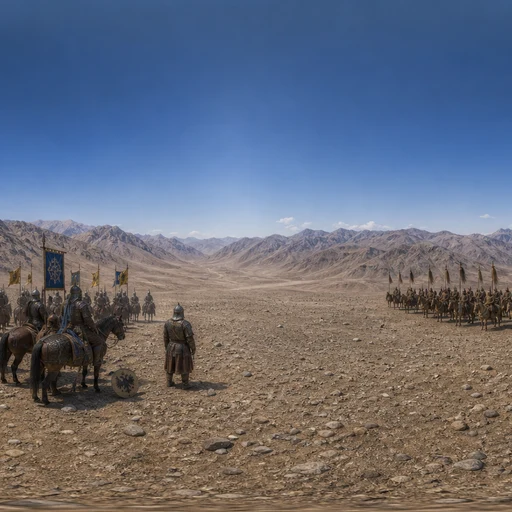
A wide, treeless plain of dry golden steppe grass runs to a line of low brown hills under a high, open sky. This is upland country, the cold grasslands of eastern Anatolia near Lake Van, not the lowland river plain of Iraq nor an Arabian desert.
Two hosts face off across the open ground: a small wedge of light Turkic horsemen rides out on the left toward a long, dense array of cavalry and infantry massed on the right. This is the field of a pitched battle between a steppe power and an empire, caught at the moment the lines are drawn.
The lead Turkic rider stands in his stirrups and draws a recurved composite bow at the gallop, a fur-edged lamellar helmet on his head. These are mounted archers of the steppe, whose archery and feigned retreats will pull apart the heavier line ranged against them.
Tall standards crowd the far ranks: gold and yellow pennons and darker banners raised above a wall of horsemen, while a heavily mail-clad rider on the right carries a large field standard at the head of his cavalry. The banners and the armour mark the great imperial army drawn up to meet the Seljuks.
This is the day the emperor himself was taken: the Byzantine ruler captured on the field by the Seljuk sultan, a catastrophe that shattered the empire's defence of its eastern frontier.
Dust drifts low across the plain as the cavalry move, a battle of manoeuvre and envelopment rather than a static shoving match, fought in the open near a frontier fortress town as horse-archers wheel around a great infantry and cavalry array.
The day opened Anatolia to Turkish settlement: from this defeat would flow the Turkification and Islamisation of Asia Minor, the Sultanate of Rum, and in the long run the rise of the Ottomans centuries later.
Primary sources
Ibn al-Athir, al-Kamil fi al-Tarikh (early 13th c.): Sunni historical synthesis. A principal narrative source for the campaign of Alp Arslan, the battle, and the capture of the emperor. Confidence high for the sequence.
Further reading & cross-references
Sibt ibn al-Jawzi, Mir'at al-Zaman / al-Husayni, Akhbar al-Dawla al-Saljuqiyya: Sunni and Seljuk-state histories. Used for the Muslim account of the battle and its aftermath. Confidence medium-high.
Michael Attaleiates and Michael Psellos (11th c., Byzantine Greek): Contemporary Byzantine historians. Non-Muslim cross-references confirming the date, the place, the imperial army, and the capture of Romanos IV. Used for date and place, not religious framing. Confidence high as witnesses.
Matthew of Edessa (12th c., Armenian): Armenian chronicle of the eastern frontier. Cross-reference for the campaign in the region of Lake Van. Confidence medium.
Carole Hillenbrand, Turkish Myth and Muslim Symbol: The Battle of Manzikert (2007): Modern non-confessional academic study. Used for the critical reconstruction of the battle and the disentangling of the event from its later legend. Confidence high.
Questions & answers
- Where is The Battle of Manzikert?
- Manzikert (Malazgirt), near Lake Van, eastern Anatolia
- When did it happen?
- Dhul Qa'da 463 AH / 1071 CE
- What is the story of The Battle of Manzikert?
- In Dhul Qa'da 463 AH (August 1071 CE) the Seljuk sultan Alp Arslan rahimahu Allah met the army of the Byzantine emperor Romanos IV Diogenes on the upland plain near Manzikert, north of Lake Van in eastern Anatolia, and won one of the most consequential battles of the Middle Ages. The Seljuks were a…



Guess places like this in GeoSiyer
Drop into a 360° scene from Islamic history and pin where, and when, it happened.
Play GeoSiyer