The Battle of the Great Zab
The last Umayyad caliph falls, 132 AH
Jumada II 132 AH / Jan 750 CE
 Educational historical reconstruction
Where
The Great Zab river, near its confluence with the Tigris, northern Iraq
35.9500, 43.3500 · View on OpenStreetMap
Background
In Jumada II 132 AH (January 750 CE), on the banks of the Great Zab, a tributary of the Tigris in northern Iraq, near its confluence below Mosul, the Abbasid revolution won the battle that ended the Umayyad caliphate. The Abbasid army, the black-bannered host that had marched out of Khurasan, was commanded by Abdullah ibn Ali, an uncle of the newly proclaimed caliph al-Saffah. Against it stood the last Umayyad caliph, Marwan II (called Marwan al-Himar for his tenacity), with a larger army drawn from Syria and the Jazira. The river ran swollen with winter rain, and Marwan crossed it on a bridge of boats to give battle. But his troops' morale was broken and his coalition fractured, while the Abbasid infantry held in disciplined ranks, receiving the Umayyad cavalry on a wall of planted spears. The Umayyad line collapsed; in the rout, men crowded back onto the pontoon bridge, and when it gave way great numbers drowned in the flooded Zab. Marwan fled the field. The road to Syria lay open: Damascus fell within months, and Marwan was pursued across Palestine and into Egypt, where he was killed at Busir later the same year. The Umayyad family was hunted down, and one surviving prince, Abd al-Rahman, escaped westward across North Africa to found, six years later, an independent Umayyad realm in distant Cordoba. The Battle of the Zab is thus the hinge between two dynasties: the death of the first ruling house of Islam and the consolidation of the second, which would soon move the capital to a new city of its own, Baghdad. The Sunni historical tradition preserves the battle in al-Tabari, al-Baladhuri, al-Dinawari, Ibn al-Athir, and Ibn Kathir in al-Bidaya wa al-Nihaya. This scene depicts the hour before the engagement at the river: the swollen Zab under a heavy winter sky, the black-bannered host of the revolution massed and mounted on the near bank with its torn standards over the riders, the line of boats lashed at the water's edge to bridge the flood, and the opposing army of Syria and the Jazira drawn up as a distant line along the far shore, the last stand of the house of Umayya in the east.
What you see
A wide river lies grey and swollen with winter rain across a flat, treeless northern Mesopotamian plain under a heavy overcast sky; low ground and the bare foothills of the eastern highlands fade into the far bank, a Tigris tributary in deep January, not a desert wadi or a Mediterranean shore.
Tall black banners rise over the foreground host, one large standard torn and weathered on its pole with more black flags massed behind it, the rayat al-sud of the army that marched out of the east; their colour, not the white of the ruling house, marks whose army crowds this bank.
At the water's edge a line of long, low boats has been lashed together and worked into place to bridge the flood, a pontoon of joined hulls, the crossing the contending army will use to give battle and the death-trap it would become when the rout crowded back upon it.
The foreground is packed with mailed horsemen, riders in iron coats on armoured mounts carrying round shields, spears and slung bows, the cavalry arm of the eastern host drawn up close by the river bank, period arms of the mid-eighth century with no firearm anywhere.
Across the grey water a long, thin line of distant figures and small banners stretches along the far bank, the opposing host arrayed beyond the flood; the two armies stand on the two sides of the river before the decisive engagement of a dynasty's fall.
This is the field where a ruling house makes its last stand: the larger army of Syria and the Jazira under the last caliph of the old line will break here, and its defeat will open the road to Damascus and end five generations of rule from the east.
Beyond the far bank the roads run west and south toward Syria, the line along which the victory would carry the black banners to Damascus within months and on to the hunting-down of the old dynasty across Palestine and into Egypt.
Primary sources
al-Tabari, Tarikh al-Rusul wa-al-Muluk (early 10th c.): Principal Sunni narrative history. The fullest account of the Battle of the Zab: the armies, the bridge of boats, the disciplined Abbasid infantry, the rout, and Marwan II's flight. Confidence high for the sequence.
al-Baladhuri, Ansab al-Ashraf (9th c.): Sunni genealogical-historical compilation. Used for the Umayyad and Abbasid leadership at the battle and the pursuit of Marwan II to Egypt. Confidence high.
Ibn al-Athir, al-Kamil fi al-Tarikh (early 13th c.): Sunni historical synthesis. Consolidates the earlier accounts of the battle and the collapse of the Umayyad dynasty. Confidence high.
Ibn Kathir, al-Bidaya wa al-Nihaya (14th c.): Sunni narrative history. Records the Zab under the year 132, Marwan II's crossing and flight, and the end of Umayyad rule, in the careful register of the tradition. Confidence high.
Further reading & cross-references
al-Dinawari, al-Akhbar al-Tiwal (9th c.): Sunni history with strong eastern coverage. Used for the course of the revolution's final campaign and the battle. Confidence medium-high.
al-Mas'udi, Muruj al-Dhahab (10th c.): Used as a cross-reference for the geography and aftermath of the battle. (al-Mas'udi is treated as an acceptable Sunni cross-reference for historical and geographical detail.) Confidence medium.
Hugh Kennedy, The Early Abbasid Caliphate / The Prophet and the Age of the Caliphates (modern): Modern non-confessional academic synthesis. Used for the strategic reading of the battle and its place as the hinge between the Umayyad and Abbasid eras. Confidence high.
Questions & answers
- Where is The Battle of the Great Zab?
- The Great Zab river, near its confluence with the Tigris, northern Iraq
- When did it happen?
- Jumada II 132 AH / Jan 750 CE
- What is the story of The Battle of the Great Zab?
- In Jumada II 132 AH (January 750 CE), on the banks of the Great Zab, a tributary of the Tigris in northern Iraq, near its confluence below Mosul, the Abbasid revolution won the battle that ended the Umayyad caliphate. The Abbasid army, the black-bannered host that had marched out of Khurasan, was…
Related places

The Malwiya at Samarra
241 AH / 855-856 CE
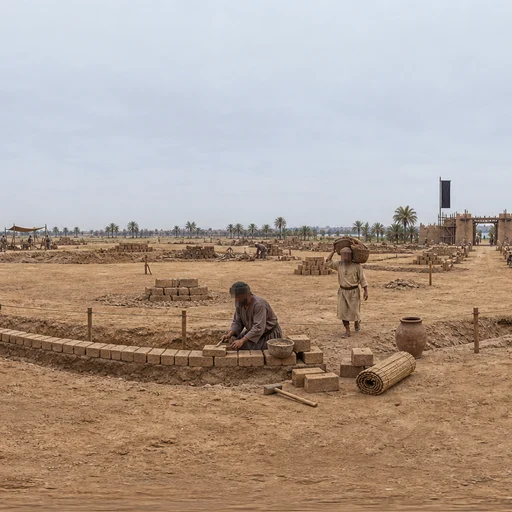
The Founding of the Round City of Baghdad
145 AH / 762 CE

Tigris Shore After the Sack of Baghdad
656 AH / 1258 CE

The Mustansiriyya Madrasa
631 AH / 1234 CE

The Mihna and the Stand of Imam Ahmad
The Mihna (218-234 AH / 833-848 CE)

The House of Wisdom
c. 215 AH / 830 CE
Guess places like this in GeoSiyer
Drop into a 360° scene from Islamic history and pin where, and when, it happened.
Play GeoSiyer