The Battle of the Three Kings
The Saadian victory at Wadi al-Makhazin, 1578 CE
986 AH / 1578 CE
 Educational historical reconstruction
Where
Wadi al-Makhazin, near Ksar el-Kebir, northern Morocco
35.0500, -5.8500 · View on OpenStreetMap
Background
The battle of Wadi al-Makhazin, fought near Ksar el-Kebir in northern Morocco in 1578 and remembered as the Battle of the Three Kings (Ma'rakat al-Wadi al-Makhazin, or Alcacer Quibir), was one of the decisive battles of the western Mediterranean. The young and zealous king Sebastian of Portugal, drawn into the dynastic quarrels of the Saadian sultanate of Morocco, landed a large army to restore a deposed Saadian claimant, al-Mutawakkil, against the reigning sultan Abd al-Malik. The Saadian army met the invaders on the low, marshy ground by the Makhazin river and, by superior numbers, cavalry and firearms, broke the Portuguese host and pinned it against the water, where it was destroyed or captured almost entirely. The battle takes its name from the death of three rulers in a single day: King Sebastian, who was killed and whose body was lost, ending the male line of his house; al-Mutawakkil, the claimant, who drowned in flight; and the reigning sultan Abd al-Malik, who was already gravely ill and died during the battle, his death concealed until the victory was won, so that his brother Ahmad succeeded as al-Mansur. The consequences were vast: Portuguese power in Morocco was ended, Portugal, drained of its king and much of its nobility, soon fell under the crown of Spain, and the Saadian sultanate entered the golden age of Ahmad al-Mansur, enriched by ransoms and by the gold of the Sudan. This scene depicts the field and the trapped invading army on the marshy river-meadow, without any graphic depiction of the slaughter; the arrayed forces and the ground carry the event.
What you see
A green river meadow in the hills of northern Morocco, a marshy watercourse winding across it; the kind of low, wet ground on which an army can be trapped against the water.
Two armies are arrayed: a large Moroccan host of cavalry and arquebusiers with the banners of a Maghribi sultanate, and a foreign army of European infantry and knights, far from home and pinned with their backs to the river.
This is the battle of Wadi al-Makhazin, where the Saadian sultanate of Morocco destroyed an invading Portuguese army that had landed to place a deposed claimant on the throne; the foreign army was broken and trapped against the river.
It is remembered as the Battle of the Three Kings, for three rulers died that day: the young Portuguese king who had led the invasion, the deposed Saadian claimant who had brought him, and the reigning Saadian sultan, who was already dying and passed during the fight. The scene shows the field and the trapped army, not the slaughter.
The field lies near Ksar el-Kebir in the north of Morocco, the Maghrib al-Aqsa, on the Atlantic flank of the Muslim west where Portugal had long pressed its coastal forts.
The victory ended Portuguese ambitions in Morocco, drained Portugal of its king and nobility (and led to its absorption by Spain), and opened the golden age of the Saadian sultan Ahmad al-Mansur. Recorded by the Moroccan and European sources alike.
Further reading & cross-references
Moroccan histories of the Saadian dynasty (e.g. al-Ifrani, Nuzhat al-Hadi): The Sunni Moroccan account of the battle, the three kings, and the rise of Ahmad al-Mansur.
Portuguese and European accounts of Alcacer Quibir (cross-reference): Used for the invading army, the death of King Sebastian and the consequences for Portugal. Non-Muslim cross-reference for the foreign side.
Modern histories of the Saadians and the battle (academic): Used for the dynastic background, the course of the battle and its strategic consequences. Non-confessional cross-reference.
Topography of the Wadi al-Makhazin field near Ksar el-Kebir: The marshy river-ground that trapped the invaders constrains the depiction; the precise site is regional.
Questions & answers
- Where is The Battle of the Three Kings?
- Wadi al-Makhazin, near Ksar el-Kebir, northern Morocco
- When did it happen?
- 986 AH / 1578 CE
- What is the story of The Battle of the Three Kings?
- The battle of Wadi al-Makhazin, fought near Ksar el-Kebir in northern Morocco in 1578 and remembered as the Battle of the Three Kings (Ma'rakat al-Wadi al-Makhazin, or Alcacer Quibir), was one of the decisive battles of the western Mediterranean. The young and zealous king Sebastian of Portugal,…
Related places
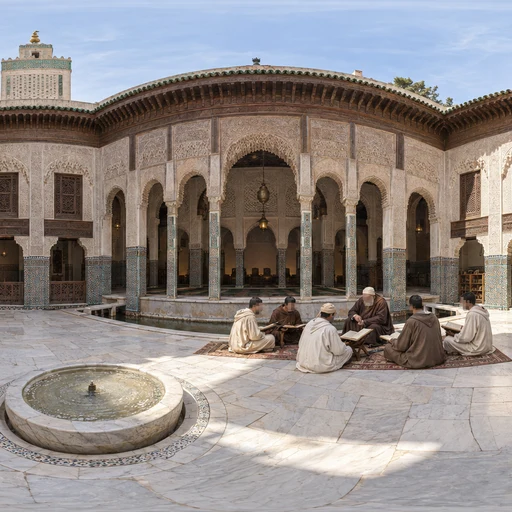
The Bou Inania Madrasa, Fez
c. 756 AH / 1355 CE

The Alhambra of Nasrid Granada
c. 772 AH / c. 1370 CE

The Generalife Garden
731 AH / c. 1330 CE

The Fall of Cordoba and Seville
633-646 AH / 1236-1248 CE
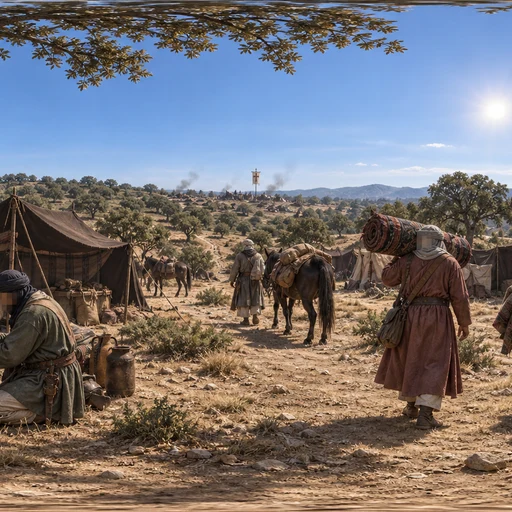
The Battle of Las Navas de Tolosa
Safar 609 AH / 1212 CE

The Koutoubia of Marrakesh
c. 550s-590s AH / 1150s-1190s CE
Guess places like this in GeoSiyer
Drop into a 360° scene from Islamic history and pin where, and when, it happened.
Play GeoSiyer