The Loss of Antioch
The First Crusade holds the great city, 1098 CE
491 AH / 1098 CE
 Educational historical reconstruction
Where
Antioch (Antakiya), on the Orontes, in northern Syria
36.2021, 36.1604 · View on OpenStreetMap
Background
Antioch, the great and ancient city of northern Syria on the Orontes, walled in a vast circuit that climbed from the river over the flank of Mount Silpius to a citadel on the heights, was one of the strongest fortresses of the East and, under the Seljuk Turks, a chief city of Muslim Syria, held in the 1090s by its governor Yaghi-Siyan. When the armies of the First Crusade, having crossed Anatolia, came down upon it in the autumn of 1097, they found it too strong to storm and were forced into a long and miserable siege through the winter, in which both sides suffered greatly from hunger and cold. The Damascene chronicler Ibn al-Qalanisi, in his Dhayl Tarikh Dimashq, and Ibn al-Athir in al-Kamil fi al-Tarikh, record that the city held for some eight months until, on the night of the 2nd to the 3rd of June 1098, it was taken: not by assault alone but by treachery, a captain of one of the towers, named in the sources as Firuz, being persuaded to let a party of the Franks climb the wall by night, after which they opened the gates and took the city amid much slaughter. Yaghi-Siyan fled and was killed, though the citadel on the height still held out under his son. The Aleppan historian Ibn al-Adim, in his Zubdat al-Halab fi Tarikh Halab, sets the loss in the wider tale of Frankish encroachment on the cities of Syria. No sooner had the Crusaders taken Antioch than a great Muslim army, gathered from Mosul and the Jazira and beyond under Kerbogha, the atabeg of Mosul, arrived and besieged them within the walls they had just won, so that the starving conquerors were nearly destroyed in their turn. But the Muslim host was a coalition of rival princes, divided in counsel and distrustful of its commander, and when the desperate Franks sallied out at the end of June it broke and fled, and was defeated. The disunity of the Muslim powers, more than the strength of the invaders, allowed the Crusaders to keep Antioch and to found there a Frankish principality that would endure for over a century and a half, until the Mamluk sultan Baybars took the city in 1268. The loss of Antioch was one of the first and heaviest blows of the Crusading invasion, and a bitter lesson in the cost of Muslim division, the very lesson that Zengi, Nur al-Din and Saladin (rahimahum Allah) would later answer. This scene shows not the assault but its aftermath: the conquered city with a Frankish banner flying above the gate, western knights posted as sentries, and the townsfolk driven out along the road. In keeping with the project's ethics any figure is anonymous and at a distance, and the violence is not graphically shown.
What you see
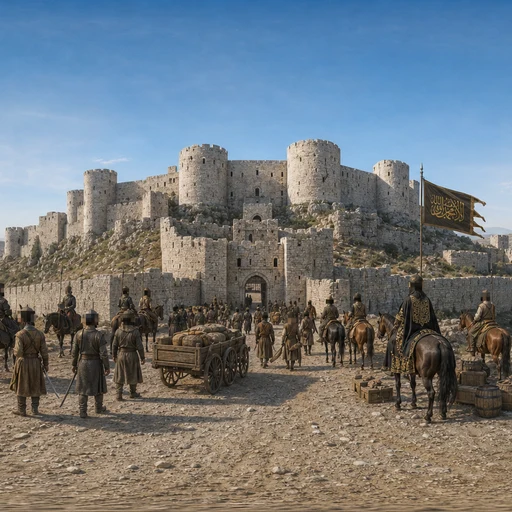
A monumental twin-towered gatehouse with a tall arched passage stands at the centre of a long stone curtain wall studded with square towers; the masonry is the heavy ashlar of one of the strongest fortress-cities of the medieval East, its circuit running for miles from the river up onto the high ground.
Tall standards bearing the dark cross pattee fly from the gate, and mailed men-at-arms in conical nasal helms stand sentry over the road: the city has changed hands, and a Frankish, not a Muslim, banner now hangs above the gate.
The fighting is over. The streets are quiet, the assault past; this is the morning after the storm, with the conquerors posted at the gate and no battle left to fight.
Along the road out of the gate a ragged column of townsfolk and a laden pack-mule move away from the walls, women and children among them carrying bundles: the inhabitants of a great Muslim city driven from their homes after its fall.
The garrison are western knights: long mail hauberks, kite and round shields, straight swords and spears, the equipment of the First Crusade rather than of a Seljuk Turkish askari with bow and lamellar.
Dry hills and olive groves ring the city under a hard bright sky, with field-walls of dressed stone across the slope; this is the parched country of northern Syria around the Orontes, not the desert of Arabia nor the green of Anatolia.
This is the aftermath of the loss of Antioch in 1098 to the armies of the First Crusade, the great walled city of northern Syria, held by its Seljuk Turkish governor and taken by treachery after a siege of many months: an early and grievous blow of the Frankish invasion of the Muslim East.
Scarcely had the Franks taken the city when a great Muslim relief army arrived under the lord of Mosul and besieged them in their turn; but the host was a coalition of rival princes, divided in counsel, and was beaten outside these walls, so that the disunity of the Muslims let the invaders keep their conquest.
Primary sources
Ibn al-Athir, al-Kamil fi al-Tarikh (13th c.): The standard Sunni narrative of the First Crusade; used for Yaghi-Siyan, the betrayal by the tower-captain Firuz, and the disunity of the Muslim princes. Confidence high.
Further reading & cross-references
Ibn al-Qalanisi, Dhayl Tarikh Dimashq (12th c.): Contemporary Damascene chronicle; the nearest Muslim source in time to the siege, used for the course of the siege, the fall by treachery and the defeat of Kerbogha's relief army. Confidence high.
Ibn al-Adim, Zubdat al-Halab fi Tarikh Halab (13th c.): Aleppan local history; sets the loss of Antioch within the rivalries of the Syrian Seljuk princes (Ridwan of Aleppo, Duqaq of Damascus) and the Frankish advance on the cities of the north. Confidence high.
Latin accounts of the siege of Antioch (cross-reference): Crusader chronicles (Gesta Francorum and the like), used only to cross-check the date, the conduct of the siege and the entry into the city. Cross-reference, not for framing. Confidence high.
Medieval Antioch and its walls (material/geographic context): The great circuit of walls climbing Mount Silpius, the Orontes and the citadel constrain the depiction; the standing remains and topography confirm the fortress-city setting.
The cost of Muslim disunity (historical motif): The reading of Antioch's loss as a fruit of the division of the Syrian princes is the through-line of the Sunni historians and of the later counter-crusade; treated here as an interpretive thread, not a single sourced fact.
Questions & answers
- Where is The Loss of Antioch?
- Antioch (Antakiya), on the Orontes, in northern Syria
- When did it happen?
- 491 AH / 1098 CE
- What is the story of The Loss of Antioch?
- Antioch, the great and ancient city of northern Syria on the Orontes, walled in a vast circuit that climbed from the river over the flank of Mount Silpius to a citadel on the heights, was one of the strongest fortresses of the East and, under the Seljuk Turks, a chief city of Muslim Syria, held in…
Related places




Guess places like this in GeoSiyer
Drop into a 360° scene from Islamic history and pin where, and when, it happened.
Play GeoSiyer