The Khan's Palace at Bakhchysarai
The court of the Crimean Khanate, 16th-17th century
16th-17th c. CE
 Educational historical reconstruction
Where
Bakhchysarai, the Khan's Palace, Crimea
44.7486, 33.8806 · View on OpenStreetMap
Background
The Crimean Khanate was the longest-lived of the Muslim Tatar states that emerged from the breakup of the Golden Horde, a khanate of the northern Black Sea ruled by the house of Giray, descendants of Chinggis Khan, from the later fifteenth century until its annexation by Russia at the end of the eighteenth. From 1475 the khanate stood under the protection and suzerainty of the Ottoman sultan, to whom the Crimean Tatars were close allies and from whom they took much of their high culture, while remaining a power in their own right on the steppe, where their cavalry ranged far to the north. Their capital was Bakhchysarai, whose name means the garden-palace, in a sheltered valley of the Crimean uplands, and the heart of the capital was the Khan's Palace, the Hansaray, a low complex of painted wood and stone set among gardens and courts, with its mosque and slender minarets, its divan hall, its harem quarters and its celebrated marble fountain, the so-called fountain of tears, which lets fall slow single drops from basin to basin. The architecture follows Ottoman models but on an intimate, residential, garden scale rather than the monumental scale of the imperial mosques, the cultivated centre of a steppe power rather than a fortress. This scene depicts the Khan's Palace and its gardens in the days of the khanate: the painted halls and shaded courts, the minarets of the palace mosque, and the quiet fountain, the court of a Muslim Turkic people in the northern Black Sea lands, far from the older heartlands of Islam. In keeping with the project's visual ethics no individual is shown by likeness.
What you see
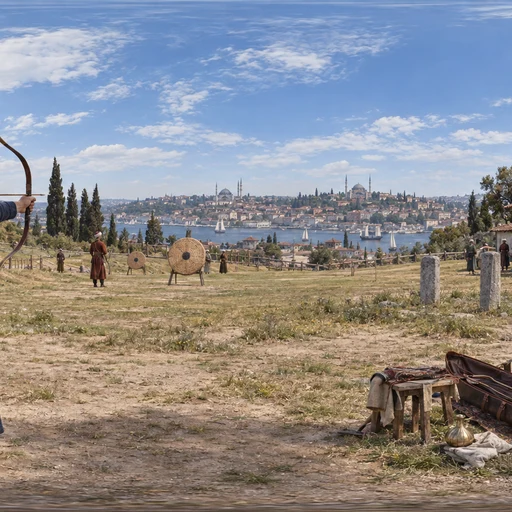
A low, garden-set palace of painted wood and stone in a green river valley, slender minarets rising over its mosque, tiled roofs and shaded courts; the seat of a Muslim Turkic court in a northern land.
In a quiet courtyard a marble fountain lets fall single slow drops of water from basin to basin, the famous fountain of tears; the ornament is Ottoman in manner but on an intimate, garden scale.
The palace lies in a sheltered valley of the Crimean uplands above the northern Black Sea, far from the Arab and Persian heartlands, in the steppe-and-mountain country of a Tatar people.
This is the court of the Crimean Khanate, the longest-lived of the Muslim successor-states of the Golden Horde, a Tatar khanate of the northern Black Sea that held its own for three centuries under the protection of the Ottoman sultan.
Garden courts, a divan hall and the quarters of the khan's household make a palace built for residence and rule rather than for war, the cultivated centre of a steppe power.
Bakhchysarai (the garden-palace) was the capital of the Crimean Khanate; its Khan's Palace (the Hansaray) and its fountain are the surviving heart of that court. The scene depicts the palace and its gardens.
Further reading & cross-references
Histories of the Crimean Khanate and the house of Giray: Used for the khanate as a Golden Horde successor, the Giray dynasty, and the Ottoman protectorate. Confidence high.
Evliya Celebi, Seyahatname (17th c.): The Ottoman traveller's account of the Crimea and Bakhchysarai; a contemporary Muslim description of the khanate and its capital.
Architectural studies of the Khan's Palace (Hansaray) at Bakhchysarai: Used for the garden-palace, the mosque and minarets, the divan hall and the fountain of tears in the Ottoman-influenced Crimean manner.
The standing Khan's Palace (extant, material): The surviving palace and fountain constrain the depiction, though parts were rebuilt after the khanate's end.
Questions & answers
- Where is The Khan's Palace at Bakhchysarai?
- Bakhchysarai, the Khan's Palace, Crimea
- When did it happen?
- 16th-17th c. CE
- What is the story of The Khan's Palace at Bakhchysarai?
- The Crimean Khanate was the longest-lived of the Muslim Tatar states that emerged from the breakup of the Golden Horde, a khanate of the northern Black Sea ruled by the house of Giray, descendants of Chinggis Khan, from the later fifteenth century until its annexation by Russia at the end of the…




Guess places like this in GeoSiyer
Drop into a 360° scene from Islamic history and pin where, and when, it happened.
Play GeoSiyer