The Defence of the Dardanelles
Ottoman trenches at Gallipoli, 1915
1333 AH / 1915 CE
 Educational historical reconstruction
Where
The Gallipoli peninsula and the Dardanelles
40.2000, 26.2800 · View on OpenStreetMap
Background
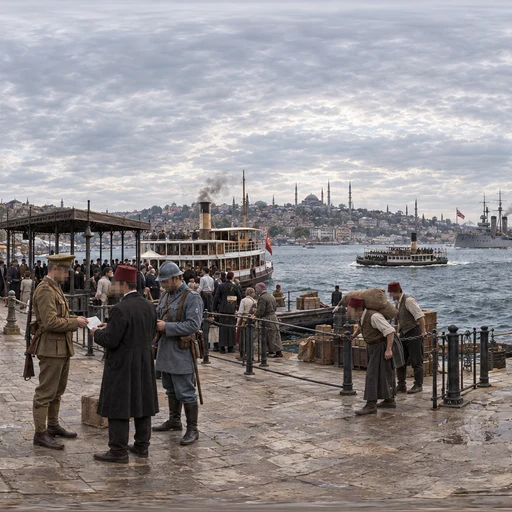
In 1915, in the midst of the First World War, the Allied powers attempted to force the Dardanelles, the narrow strait guarding the sea approach to the Ottoman capital, in order to knock the Ottoman Empire out of the war and open a supply route to Russia. A great naval assault on 18 March 1915 failed with the loss of several battleships to Ottoman guns and mines, and the Allies then landed armies, British, French, Australian and New Zealand, on the Gallipoli peninsula in April. There followed nine months of brutal trench warfare on the steep ridges above the straits, an early and terrible example of the industrialised stalemate of the Great War, fought with machine guns, artillery, periscopes and field telephones in summer heat and winter cold, at enormous cost to both sides. The Ottoman defenders, in whom the young commander Mustafa Kemal rose to prominence on the heights of Anafartalar, held their ground, and at the end of 1915 and the start of 1916 the Allies evacuated, leaving the peninsula in Ottoman hands. The victory, remembered in Turkish as Canakkale, with the saying that the strait would not be passed, was a rare success for an empire that was otherwise being defeated and dismembered, and it is honoured as a defence of the heartland and as the graveyard of a generation. This scene depicts the Ottoman trench line on the ridges above the Dardanelles, with the Allied fleet in the narrows below.
What you see
Steep scrub-covered ridges drop to a narrow sea-strait where the water is pinched between two shores. This is a defended strait between a peninsula and the mainland, the gateway from the Aegean toward the imperial capital.
The hillsides are scored with deep trench lines, sandbag parapets and dugouts, the entrenched front of industrial trench warfare, fought from holes in the ground rather than in the open.
A trench periscope and a field telephone line show this is a twentieth-century war of observation and wire, machine guns and artillery, not of cavalry charges.
Out in the strait lie modern battleships, low grey steel hulls with heavy gun turrets, the fleet that tried and failed to force the narrows by sea before the land campaign began.
An entrenched defence holding the heights above the straits against a great seaborne invasion marks a rare and costly victory for a hard-pressed empire in a world war it was otherwise losing.
Further reading & cross-references
Ottoman and Turkish accounts and memoirs of the Canakkale campaign (early 20th c.): Ottoman military records and memoirs of the defence; used for the trench warfare, the command and the experience of the defenders. Confidence high.
Edward J. Erickson, Ordered to Die / Gallipoli: The Ottoman Campaign (2001-2010): Standard modern military history of the Ottoman army at Gallipoli. Used for the order of battle, the trench lines and the chronology. Confidence high.
Peter Hart, Gallipoli (2011) and standard campaign histories: Used for the naval assault of 18 March, the landings and the evacuation. Confidence high.
The Gallipoli battlefields, trenches and memorials (extant, material): The surviving trench lines, terrain and fortifications of the peninsula constrain the depiction of the front and the straits.
Questions & answers
- Where is The Defence of the Dardanelles?
- The Gallipoli peninsula and the Dardanelles
- When did it happen?
- 1333 AH / 1915 CE
- What is the story of The Defence of the Dardanelles?
- In 1915, in the midst of the First World War, the Allied powers attempted to force the Dardanelles, the narrow strait guarding the sea approach to the Ottoman capital, in order to knock the Ottoman Empire out of the war and open a supply route to Russia. A great naval assault on 18 March 1915…





Guess places like this in GeoSiyer
Drop into a 360° scene from Islamic history and pin where, and when, it happened.
Play GeoSiyer