The Gevher Nesibe Hospital
A Seljuk hospital and medical school at Kayseri, c. 1206 CE
602 AH / c. 1206 CE
 Educational historical reconstruction
Where
Kayseri, in central Anatolia
38.7225, 35.4889 · View on OpenStreetMap
Background
At Kayseri, in the heart of Anatolia, there stands a great twinned monument of the Seljuk Sultanate of Rum, the Gevher Nesibe complex, built about 1206 and made up of two stone buildings joined side by side: a hospital (a dar al-shifa or maristan) and, beside it, a school of medicine. It was endowed, the tradition holds, by the Seljuk princess Gevher Nesibe, sister of the sultan Ghiyath al-Din Kaykhusraw I, who built it in her memory; and it is celebrated as one of the earliest institutions in the world to join the care of the sick and the teaching of medicine in a single foundation, so that physicians treated patients and trained their students in the same place. Like the other great hospitals of the Islamic world it was a charitable endowment, a waqf, open to the sick without charge, with wards and cells, a pharmacy and running water, and provision for the treatment of bodily illness and, it is said, of disorders of the mind. The building is a fine example of Anatolian Seljuk architecture, of massive cut stone with a carved portal, pointed arches and vaulted halls around its courtyards, sober and powerful. It served as a hospital and medical school for centuries and survives today. Its founding by a princess, and its dedication to the free care of the sick and the teaching of healing, make it a witness to the place of charity, learning and medicine in the civilisation of the Anatolian Seljuks. This scene depicts the Gevher Nesibe hospital and medical school at Kayseri. In keeping with the project's ethics any figure is anonymous and at a distance.
What you see
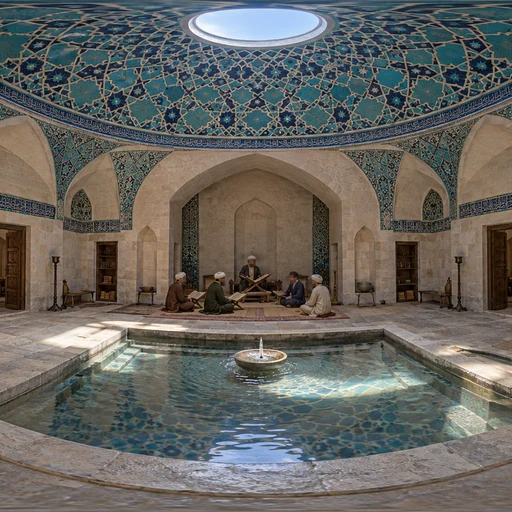
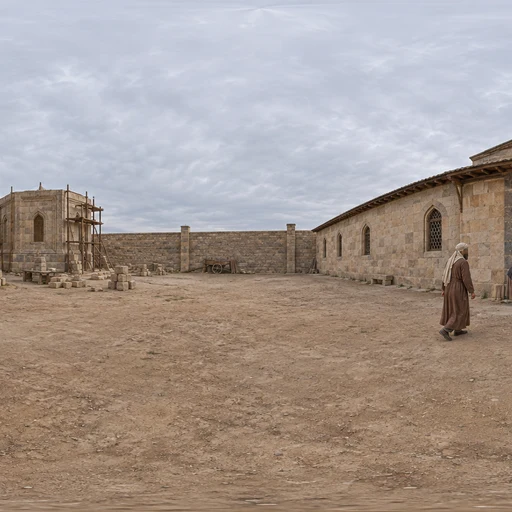
A pair of stone buildings joined side by side around open courtyards, with a tall carved portal, pointed arcades and vaulted halls; the sober, massive stonework of the Anatolian Seljuks rather than brick or tile.
One court is a hospital, with wards and cells opening off the arcade, a place for the treatment of the sick of body and of mind; the other is a school of medicine, where physicians taught their students beside the patients they treated.
This is the hospital and medical school built at Kayseri by the Seljuk princess Gevher Nesibe and her brother the sultan, one of the earliest places in the world where the healing of the sick and the teaching of medicine were joined under one foundation.
The city stands on a high inland plain of Anatolia beneath a great snow-capped mountain, on the caravan roads of the Seljuk sultanate of Rum.
An inscription over the gate names the lady whose endowment built it and the sultan her brother, and dedicates it as a charity for the care of the sick; the building is itself a work of mercy.
The Gevher Nesibe complex at Kayseri is an extant Seljuk monument. The scene depicts the building and its courts; no individual is shown by likeness.
Further reading & cross-references
The Gevher Nesibe complex at Kayseri (extant building and inscriptions): The primary monument. Used for the architecture, the twin hospital and school and the dedication. Confidence high.
Histories of Anatolian Seljuk architecture and of Islamic hospitals: Used for the building's place in Seljuk architecture and in the tradition of the dar al-shifa. Confidence high.
Accounts of the foundation by Gevher Nesibe and Kaykhusraw I: Used for the endowment and the joining of hospital and medical school; the foundation tradition. Confidence medium-high.
Studies of the waqf hospital and medical teaching in the Islamic world: Used for the charitable hospital, free care and bedside teaching as context. Confidence high.
Questions & answers
- Where is The Gevher Nesibe Hospital?
- Kayseri, in central Anatolia
- When did it happen?
- 602 AH / c. 1206 CE
- What is the story of The Gevher Nesibe Hospital?
- At Kayseri, in the heart of Anatolia, there stands a great twinned monument of the Seljuk Sultanate of Rum, the Gevher Nesibe complex, built about 1206 and made up of two stone buildings joined side by side: a hospital (a dar al-shifa or maristan) and, beside it, a school of medicine. It was…



Guess places like this in GeoSiyer
Drop into a 360° scene from Islamic history and pin where, and when, it happened.
Play GeoSiyer