Mahmud of Ghazna's Indian Campaigns
The army on the upper Punjab
Ghaznavid campaigns (388-421 AH / 998-1030 CE)
 Educational historical reconstruction
Where
The upper Punjab, on the route of the Ghaznavid campaigns into India
32.5000, 74.0000 · View on OpenStreetMap
Background
Across his long reign (388-421 AH / 998-1030 CE) Mahmud of Ghazna led repeated campaigns from his Afghan capital down into northern India, a series of expeditions that the later tradition counts at about seventeen. The Ghaznavids were a Sunni Turkic dynasty, risen from the Turkic slave-soldiers of the Samanids, who built an empire over Khurasan, Afghanistan, and the eastern Iranian world; Mahmud held his titles from the Abbasid caliph, who named him Yamin al-Dawla, and he presented himself as a champion of Sunni Islam. His Indian campaigns reached down the Punjab and into the Gangetic plain, striking the wealthy temple-cities of the subcontinent, the most famous being the raid on the great temple of Somnath around 416 AH (1025 CE), and bringing the Punjab under lasting Ghaznavid rule. The campaigns were proclaimed as jihad, and they were also expeditions for the immense wealth of the Indian sanctuaries and for empire; modern historians read them as both, and the Somnath raid in particular has carried heavy and contested meaning in later memory. The Ghaznavid court was a brilliant centre of Persian letters, and travelling in the orbit of these campaigns was the polymath al-Biruni, who learned Sanskrit and composed his Kitab al-Hind, a study of Indian religion, science, and society of unmatched care and curiosity, the intellectual counterpoint to the violence of the raids. This scene depicts not a battle or a sack but the army on the march through the upper Punjab: the green monsoon plains of the country of the five rivers, an intact temple-city with its tall shikhara spires rising in the distance, a column of Turkic and Khurasani cavalry with war elephants crossing the land, and a Hindu village along the route. The framing is sober, the army moving through a settled and populous country, the wealth and the danger of India ahead of it, the scholar's book the quiet shadow of the soldier's road.
What you see
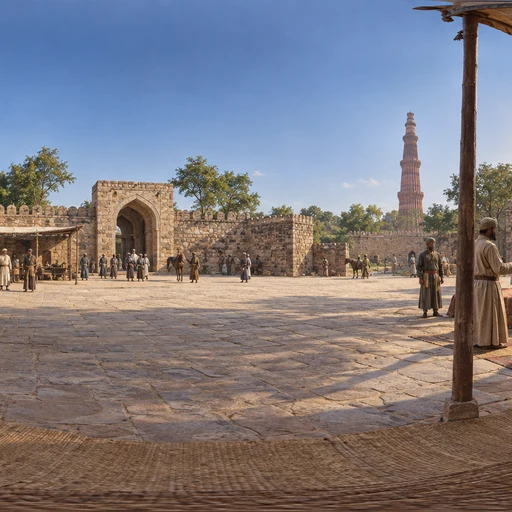
Fertile, well-watered river plains of green monsoon fields stretch under a humid sky, the country of the five rivers of the upper Punjab. It is utterly unlike the dry Iranian plateau or the Afghan highlands of Ghazna from which the army has descended.
In the middle distance an Indic temple-city stands intact, its tall tapering shikhara spires rising over a walled town. It is unsacked, the wealthy sanctuary kind that drew the campaigns, a subcontinental skyline, not a minaret or a mosque.
A long column of the army is on the march across the plain rather than in battle: Turkic and Khurasani cavalry, baggage, and a few war elephants, the seasonal expedition moving through the country toward the rich towns ahead.
The soldiers carry the arms of the Central Asian east, composite recurve bows and the equipment of Khurasani and Turkic horsemen, distinct from the arms of the Indian kingdoms whose land they are crossing.
An ordinary Hindu village lies along the route, its houses and shrine and fields the human landscape the army passes through, a reminder that the campaigns moved through a settled and populous country.
The standards are those of a Sunni Turkic sultan who ruled from Ghazna and held his titles from the Abbasid caliph in the distant west; the campaigns were proclaimed as jihad and were also expeditions for plunder and for empire over the Punjab.
Travelling with such a campaign was the scholar al-Biruni, who learned Sanskrit and wrote his great and careful study of India, the intellectual counterpoint to the raids and one of the finest works of medieval scholarship.
Primary sources
Ibn al-Athir, al-Kamil fi al-Tarikh (early 13th c.): Sunni historical synthesis. Places the Ghaznavid campaigns in the wider history of the Islamic east. Confidence high.
Further reading & cross-references
al-Utbi, Tarikh al-Yamini (early 11th c.): The court history of Mahmud of Ghazna by his secretary, in Arabic. The principal contemporary Sunni source for the reign and the Indian campaigns, written from the dynasty's own vantage and panegyric in tone. Confidence high for the events, partisan in framing.
al-Biruni, Kitab fi Tahqiq ma li-l-Hind (early 11th c.): The great Sunni polymath's study of India, written from direct knowledge in the orbit of the campaigns. Used for the Indian religious and cultural world the army crossed and for a measured contemporary Muslim view of it. Confidence high.
Bayhaqi, Tarikh-i Bayhaqi / Gardizi, Zayn al-Akhbar (11th c., Persian): Ghaznavid court histories in Persian. Used for the administration, the army, and the conduct of the campaigns. Confidence high for the Ghaznavid framework.
C. E. Bosworth, The Ghaznavids (modern): Standard modern non-confessional academic study of the dynasty. Used for the chronology, the army, and the assessment of the campaigns. Confidence high.
Questions & answers
- Where is Mahmud of Ghazna's Indian Campaigns?
- The upper Punjab, on the route of the Ghaznavid campaigns into India
- When did it happen?
- Ghaznavid campaigns (388-421 AH / 998-1030 CE)
- What is the story of Mahmud of Ghazna's Indian Campaigns?
- Across his long reign (388-421 AH / 998-1030 CE) Mahmud of Ghazna led repeated campaigns from his Afghan capital down into northern India, a series of expeditions that the later tradition counts at about seventeen. The Ghaznavids were a Sunni Turkic dynasty, risen from the Turkic slave-soldiers of…
Related places



Guess places like this in GeoSiyer
Drop into a 360° scene from Islamic history and pin where, and when, it happened.
Play GeoSiyer