Medical Learning at Jundishapur
Medical Learning at Jundishapur
c. 148 AH / 765 CE
 Educational historical reconstruction
Where
Jundishapur (Gundeshapur), in Khuzistan
32.2755, 48.5247 · View on OpenStreetMap
Background
Jundishapur in Khuzistan is associated with physicians who helped transmit medical knowledge into the early Abbasid court. A specific hospital reference occurs in accounts of 765, when the physician Jurjis was summoned to Caliph al-Mansur. Evidence for a large continuous academy, its buildings and an unbroken institutional path to later teaching hospitals is much less secure. The books, medical materials and anonymous readers in this scene evoke that scholarly milieu around 765. They do not establish a known campus plan, identify the people present at a particular consultation or prove that all traditions met in one institution.
What you see
Books and medical materials evoke the study of healing.
Readers gather in a reconstructed scholarly interior, whose original layout is unknown.
The setting represents Khuzistan in south-western Persia and its physicians around 765.
Further reading & cross-references
Research qualification: Jundishapur in Khuzistan is associated with physicians who helped transmit medical knowledge into the early Abbasid court. A specific hospital reference occurs in accounts of 765, when the physician Jurjis was summoned to Caliph al-Mansur. Evidence for a large continuous academy, its buildings and an unbroken institutional path to later teaching hospitals is much less secure. The books, medical materials and anonymous readers in this scene evoke that scholarly milieu around 765. They do not establish a known campus plan, identify the people present at a particular consultation or prove that all traditions met in one institution.
Questions & answers
- Where is Medical Learning at Jundishapur?
- Jundishapur (Gundeshapur), in Khuzistan
- When did it happen?
- c. 148 AH / 765 CE
- What is the story of Medical Learning at Jundishapur?
- Jundishapur in Khuzistan is associated with physicians who helped transmit medical knowledge into the early Abbasid court. A specific hospital reference occurs in accounts of 765, when the physician Jurjis was summoned to Caliph al-Mansur. Evidence for a large continuous academy, its buildings and…
Related places

The Zanj Rebellion in the Marshes
Zanj Rebellion (255-270 AH / 869-883 CE)

The Battle of the Camel
10 Jumada al-Akhira 36 AH / 7 December 656 CE
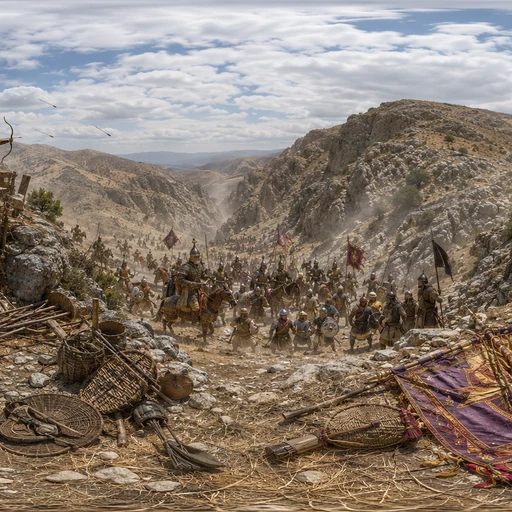
Nahavand, The Victory of Victories
c. 21 AH / 642 CE

The Fall of Ctesiphon
16-21 AH / 637-642 CE

The Founding of Kufa
17 AH / 638 CE

The Surrender of al-Hira
12 AH / 633 CE
Guess places like this in GeoSiyer
Drop into a 360° scene from Islamic history and pin where, and when, it happened.
Play GeoSiyer