Khandaq, The Night of the Wind
The cold storm that broke the Confederate siege of Madinah
5 AH / 627 CE
 Educational historical reconstruction
Where
Northern approach to Madinah, near Jabal Sala'
24.4776, 39.6028 · View on OpenStreetMap
Background
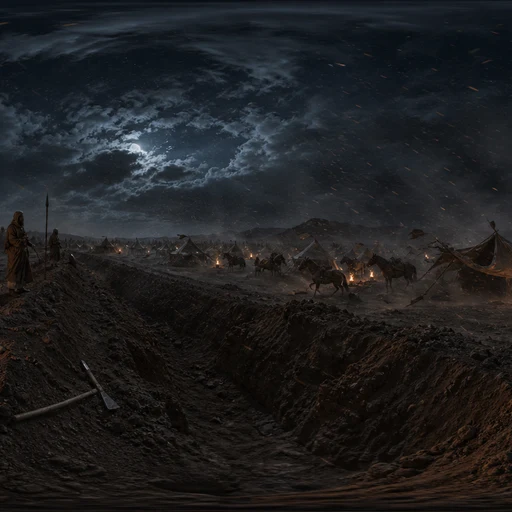
On a cold winter night near the end of the siege of Madinah by the Confederate (al-Ahzab) coalition in the month of Shawwal of the fifth year after the Hijrah, conventionally placed around February 627 CE, a sudden hard storm of cold wind from the north struck the besieging camp on the open plain north of the city. The early Sirah sources, Ibn Ishaq, al-Waqidi, and the hadith collections, describe the storm as the final external pressure on a Confederate coalition that had already been worn down by twenty-some days of stalemate at the trench, dissension within the alliance worked on by the Madinian convert Nu'aym ibn Mas'ud, the lack of progress against a defense that the steppe cavalry could not cross at speed, and dwindling supplies. The Qur'anic Sura al-Ahzab refers explicitly to the night in verse 33:9. By morning, parts of the Confederate army had begun to withdraw; over the following days the rest of the coalition broke up and went home. The Khandaq, never fought as a decisive battle in the conventional sense, was the strategic turning point of the broader Madinah-Makkah conflict; the Quraysh and their allies effectively abandoned their long campaign to destroy the Muslim community at Madinah after this engagement. This scene depicts the besiegers' encampment on the windward side of the trench at the height of the storm, with tents collapsing, fires extinguished, and the first movement of withdrawal beginning at the back of the camp.
What you see
A flat plain bounded on two sides by jagged black volcanic basalt, the Harrat al-Madinah lava flows. The same battlefield as the defensive trench depicted on the other Khandaq scene, now seen at night, with the trench cutting darkly across the foreground.
A hard, raw wind sweeps the plain from the north. Sand and small basalt grit are visibly airborne. The wind is from the wrong direction for the season, the early sources record it as a sudden cold storm that struck the besieging army on a winter night near the end of the siege.
On the far side of the trench, in the Confederate encampment, tent ropes have been torn loose. Several large tents have collapsed inward; smaller goat-hair shelters are flattened. Camp pots and pans are being blown across the ground; a cooking pot lies on its side; a draught animal is breaking its tether.
Across the camp, fires are out. There is no cookfire smoke. The wind has put out the watch braziers, the camp lights, the small lamps in tent doorways. The only light is moonlight and the faint glow of one or two protected fires inside leeward shelters.
Movement is visible at the back of the camp, men leading horses and camels back from the picket lines, baggage being lashed onto saddles. The line of the army is starting to thin from the rear. The withdrawal of the Confederate coalition began on a night like this, as recorded in Ibn Ishaq and al-Waqidi.
On the Muslim side of the trench, in contrast, a few small braziers are still burning on the leeward inner lip, sheltered by the spoil rampart from the worst of the wind. The defenders' watch is small and still in position.
The Qur'anic Sura al-Ahzab (33:9) refers to this night directly: 'O you who have believed, remember the favor of Allah upon you when armies came to you and We sent upon them a wind and forces that you did not see.' The scene reads that verse against the topography and the documented sequence of events.
The basalt outcrop of Jabal Sala' rises in the middle distance to the south, dark against the slightly less dark sky. The trench is still in its position, the defensive earth rampart still in place; the besieging army has done nothing to bridge it, and after this night they will not have the chance.
Primary sources
Qur'an 33:9 (Surat al-Ahzab): Direct reference: 'O you who have believed, remember the favor of Allah upon you when armies came to you and We sent upon them a wind and forces that you did not see, and ever is Allah, of what you do, Seeing.' The textual anchor for the night-of-wind episode.
Ibn Ishaq / Ibn Hisham, Sirat Rasul Allah (compiled 8th-9th c.): Foundational biographical compilation. Source for the broader narrative of the siege and the night of withdrawal: the wind, the collapsed camp, the role of Hudhayfa ibn al-Yaman who scouted the Confederate camp on the orders of the Prophet and returned reporting that the besiegers had begun to break up.
al-Waqidi, Kitab al-Maghazi (early 9th c.): The most militarily detailed early account. Provides the strength estimates (~10,000 Confederates), the duration of the siege (~27 days), and the specific sequence of the night storm and the morning withdrawal.
Sahih al-Bukhari and Sahih Muslim (9th c.): Hadith reports include the long Hudhayfa ibn al-Yaman narrative of being sent on a scouting mission to the Confederate camp during the night of the storm. The episode is preserved in multiple chains.
al-Tabari, Tarikh al-Rusul wa-al-Muluk (early 10th c.): Cross-references the earlier material and supports the conventional dating in Shawwal 5 AH / ~February 627 CE.
Further reading & cross-references
W. Montgomery Watt, Muhammad at Medina (Oxford, 1956): Used for the strategic framing of the Khandaq as the turning point of the Madinah-Makkah conflict and for the analysis of why the Confederate coalition could not sustain the siege.
Standing topography of Madinah (extant): Jabal Sala' and the harrah lava flows on the north-central edge of historic Madinah are extant. Modern urban development has built over parts of the historic terrain but the basic geography of the open northern approach between the lava fields is reconstructible.
Questions & answers
- Where is Khandaq, The Night of the Wind?
- Northern approach to Madinah, near Jabal Sala'
- When did it happen?
- 5 AH / 627 CE
- What is the story of Khandaq, The Night of the Wind?
- On a cold winter night near the end of the siege of Madinah by the Confederate (al-Ahzab) coalition in the month of Shawwal of the fifth year after the Hijrah, conventionally placed around February 627 CE, a sudden hard storm of cold wind from the north struck the besieging camp on the open plain…
Related places


Guess places like this in GeoSiyer
Drop into a 360° scene from Islamic history and pin where, and when, it happened.
Play GeoSiyer