The Khilafat Movement
Indian Muslims rally to save the caliphate, c. 1920
c. 1338 AH / 1920 CE
 Educational historical reconstruction
Where
A maidan in northern India
28.6500, 77.2300 · View on OpenStreetMap
Background
As the First World War ended in the defeat and dismemberment of the Ottoman Empire, the Muslims of India launched one of the largest mass movements in their history, the Khilafat Movement, to defend the institution of the caliphate, which the Ottoman sultan held and which Indian Muslims revered as the symbol of the unity and leadership of the worldwide Muslim community. From 1919 leaders such as the brothers Muhammad Ali and Shaukat Ali, Abul Kalam Azad and others organised vast meetings, petitions, fund drives and a press campaign demanding that Britain, which ruled India and now dominated the Ottoman lands, preserve the caliph's position and the integrity of the Muslim holy places. The movement allied with Gandhi and the Indian National Congress in the non-cooperation campaign against British rule, making it for a few years a powerful engine of joint Hindu-Muslim anti-colonial politics. Its hopes were dashed from an unexpected quarter: it was not the British but the Turks themselves who, in building their secular republic, abolished the sultanate in 1922 and the caliphate in 1924, leaving the movement without an object. The Khilafat Movement faded soon after, but it had been a landmark, the moment Indian Muslims became a mobilised modern political community, and its energies fed into the politics that would later lead toward Pakistan. A crowd faces a speaking platform with political placards; bicycles and a period car supply early-twentieth-century street clues.
What you see
An open urban meeting ground and colonial-era facades suggest a public rally in South Asia.
A crowd faces a speaking platform with political placards; bicycles and a period car supply early-twentieth-century street clues.
Banners and placards in Urdu and English are held up across the crowd, and a draped platform carries the speakers; the cause is being argued in the language of modern mass politics.
The bicycle and motorcar beside the gathering place the campaign in an age of modern urban travel and mass communication.
The Khilafat cause linked Indian Muslim support for the Ottoman caliphate with anti-colonial non-cooperation. The image illustrates a meeting, not the movement’s total attendance.
Further reading & cross-references
Khilafat Movement records, speeches and the Urdu press (1919-1924): The movement's own meetings, resolutions and press; used for the rallies, the leaders and the demands. Confidence high.
Gail Minault, The Khilafat Movement: Religious Symbolism and Political Mobilization in India (1982): The standard modern academic study. Used for the mass mobilisation, the alliance with non-cooperation, and the movement's decline after 1924. Confidence high.
Histories of the Indian national movement and Hindu-Muslim politics (1920s): Used for the alliance with Gandhi and Congress and the place of Khilafat in colonial Indian politics. Confidence high.
Contemporary photographs of Khilafat rallies (cross-reference): Period photographs of the mass meetings constrain the depiction of the crowds, platforms and banners.
Questions & answers
- Where is The Khilafat Movement?
- A maidan in northern India
- When did it happen?
- c. 1338 AH / 1920 CE
- What is the story of The Khilafat Movement?
- As the First World War ended in the defeat and dismemberment of the Ottoman Empire, the Muslims of India launched one of the largest mass movements in their history, the Khilafat Movement, to defend the institution of the caliphate, which the Ottoman sultan held and which Indian Muslims revered as…
Related places

The Fall of Delhi and the End of the Mughals
1274-1275 AH / 1857-1858 CE
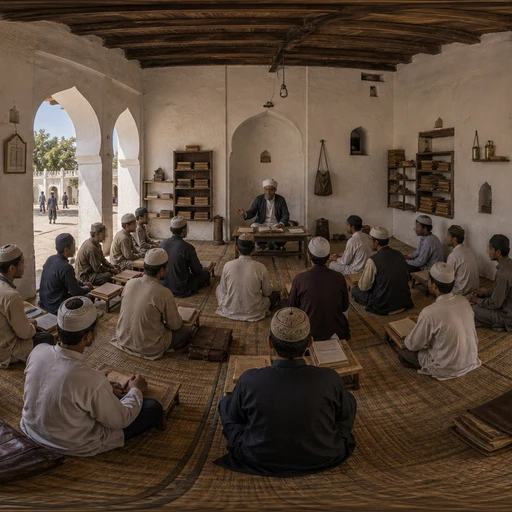
Deoband Style Classroom
c. 1900 CE

The Beginnings of the Tablighi Jamaat
1345 AH / c. 1926 CE

Aligarh: the Modernist Response
1292 AH / 1875 CE

The Founding of Dar al-Ulum Deoband
1283 AH / 1866 CE
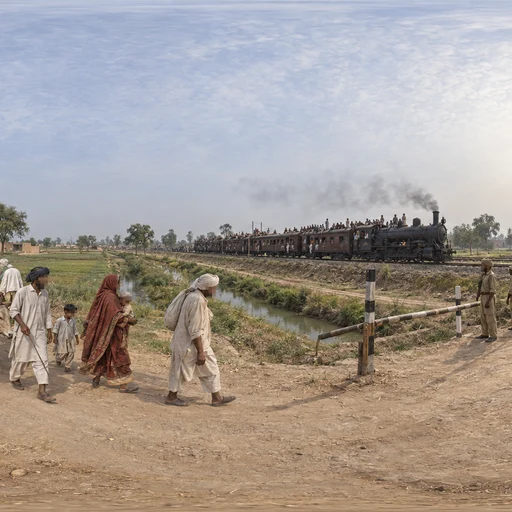
Partition and the Birth of Pakistan
1366 AH / 1947 CE
Guess places like this in GeoSiyer
Drop into a 360° scene from Islamic history and pin where, and when, it happened.
Play GeoSiyer