The Koutoubia of Marrakesh
The great Almohad mosque and its minaret, c. 1158 CE
c. 550s-590s AH / 1150s-1190s CE
 Educational historical reconstruction
Where
Marrakesh, in the Maghrib, below the Atlas
31.6238, -7.9933 · View on OpenStreetMap
Background
The Koutoubia, the Mosque of the Booksellers, is the great congregational mosque of Marrakesh and one of the masterworks of the architecture of the Muslim West. It was built in the twelfth century, over two campaigns, by the Almohads, the great Berber dynasty that rose in the mountains of the Maghrib on a movement of religious reform and went on to rule North Africa from Tripoli to the Atlantic and Muslim Spain beyond, with Marrakesh, the city below the snow-capped Atlas that they had taken from the Almoravids, as their capital. The mosque is built in the sober, powerful and disciplined manner of western Islamic architecture, with a wide many-aisled prayer-hall and an arcaded court; but it is famed above all for its minaret, a tall, square tower of warm stone rising high over the city, its faces articulated with broad panels of interlacing blind arches and the net-like lozenge ornament called sebka, and crowned by a smaller lantern-turret and a finial of gilded copper orbs. The Koutoubia minaret is the elder and the model of a famous family of towers: it set the pattern for the Giralda, the minaret of the great mosque of Seville (now the bell-tower of its cathedral), and for the unfinished Hassan Tower of Rabat, and through them for the religious architecture of the whole Maghrib and al-Andalus for centuries to come. It remains the chief landmark of Marrakesh. This scene depicts the Koutoubia mosque and its minaret. In keeping with the project's ethics any figure is anonymous and at a distance.
What you see
A tall, square tower of warm red-brown stone rises high above a city of low roofs and palm-gardens, its faces decorated with broad panels of interlacing blind arches and a net-like lozenge pattern, crowned by a smaller lantern-turret and a finial of golden orbs.
At the foot of the great minaret spreads a vast congregational mosque, its many-aisled prayer-hall and arcaded courtyard built in the sober, powerful and restrained manner of the western Muslim style.
This is the Koutoubia, the chief mosque of Marrakesh, built in the twelfth century by the Almohads, the great Berber dynasty that ruled the Maghrib and Muslim Spain, its minaret the model from which the Giralda of Seville and the tower of Rabat were raised.
The city stands on a plain at the foot of high snow-capped mountains, the capital that the Almohads inherited from the Almoravids and made the seat of an empire stretching from Spain to the edge of the Sahara.
The minaret was built to call the faithful to prayer over a great imperial capital, and its proportions and ornament set the pattern for the religious architecture of the whole Muslim West for centuries.
The Koutoubia mosque and minaret are extant monuments. The scene depicts the mosque and its tower; no individual is shown by likeness.
Further reading & cross-references
The Koutoubia mosque and minaret, Marrakesh (extant monument): The primary monument. Used for the minaret, the sebka ornament, the prayer-hall and the court. Confidence high.
Histories of the Almohad dynasty and Marrakesh: Used for the Almohads, their empire and Marrakesh as their capital. Confidence high.
Studies of western Islamic (Maghribi-Andalusi) architecture: Used for the minaret's design and its influence on the Giralda and the Hassan Tower. Confidence high.
Marrakesh below the Atlas (geographic context): The plain, the mountains and the city constrain the depiction.
Questions & answers
- Where is The Koutoubia of Marrakesh?
- Marrakesh, in the Maghrib, below the Atlas
- When did it happen?
- c. 550s-590s AH / 1150s-1190s CE
- What is the story of The Koutoubia of Marrakesh?
- The Koutoubia, the Mosque of the Booksellers, is the great congregational mosque of Marrakesh and one of the masterworks of the architecture of the Muslim West. It was built in the twelfth century, over two campaigns, by the Almohads, the great Berber dynasty that rose in the mountains of the…
Related places

The Kutubiyya Minaret of Marrakesh
Almohad (581-595 AH / 1185-1199 CE)
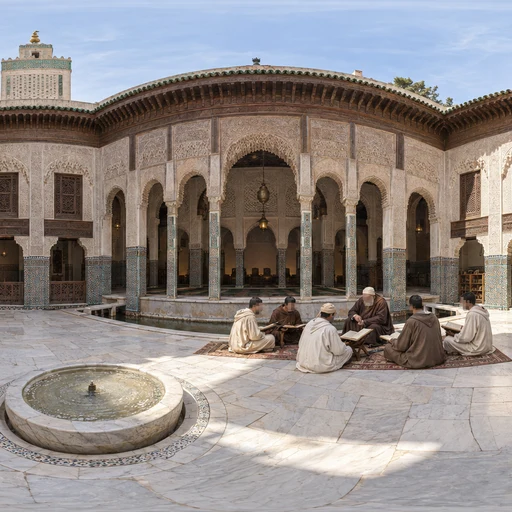
The Bou Inania Madrasa, Fez
c. 756 AH / 1355 CE

The Battle of the Three Kings
986 AH / 1578 CE

The Alhambra of Nasrid Granada
c. 772 AH / c. 1370 CE

The Generalife Garden
731 AH / c. 1330 CE

The Fall of Cordoba and Seville
633-646 AH / 1236-1248 CE
Guess places like this in GeoSiyer
Drop into a 360° scene from Islamic history and pin where, and when, it happened.
Play GeoSiyer