The Fall of Hisn al-Akrad
Baybars takes Crac des Chevaliers, 1271 CE
669 AH / 1271 CE
 Educational historical reconstruction
Where
Hisn al-Akrad (Crac des Chevaliers), in Syria
34.7568, 36.2944 · View on OpenStreetMap
Background
Hisn al-Akrad, the Castle of the Kurds, which the Crusaders rebuilt and called the Crac des Chevaliers, stands on a high hill in the gap between the coastal mountains and the interior of Syria, guarding the road from the sea to Homs. Held and vastly strengthened by the Knights Hospitaller, who made it the chief of their castles and the centre of their power in the region, it became the most famous and one of the most formidable fortresses of the whole Crusader enterprise, a concentric stronghold of two great rings of walls, round towers, a massive sloping glacis and a moat, garrisoned and provisioned to withstand any siege. In 1271 the Mamluk sultan al-Zahir Baybars (rahimahu Allah), who had made it his work to drive the Crusaders out of Syria stronghold by stronghold, brought his army and siege engines against it. After a siege of about a month his miners and mangonels breached the outer ward, and the surviving defenders withdrew into the inner castle; they were induced to surrender, the chroniclers say, by a letter, perhaps forged in the name of their own grand master, ordering them to give up the castle, and were allowed to depart in safety. The fall of the Crac, long thought impregnable, was a heavy blow to the Crusader cause and a signal step in the Mamluk reconquest of the Syrian coast that would end, twenty years later, with the fall of Acre. The castle, taken intact, was repaired and held by the Mamluks, and survives today as the best-preserved Crusader castle in the world. This scene depicts the siege of 1271, with the great fortress on its hill and Baybars's army below. In keeping with the project's ethics any figure is anonymous and at a distance. For players, the decisive clue remains the hilltop Crusader fortress set in the Syrian corridor, shown at the moment its Ayyubid-era frontier role gives way to Mamluk control.
What you see
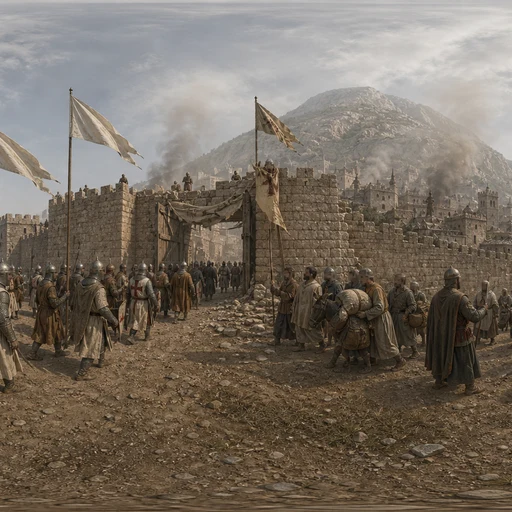
A mighty concentric castle of pale stone crowns a high hill, with two great rings of walls one inside the other, round towers, a sloping stone glacis and a moat; the most famous and formidable of the Crusader strongholds.
A Muslim army encamps below the walls with siege engines and miners at work; the banners are not those of the Franks who hold the castle but of the sultan of Egypt and Syria who has come to take it.
This is the siege of Hisn al-Akrad, the Castle of the Kurds, the great fortress the Franks called the Crac des Chevaliers, held by the Knights Hospitaller and reckoned almost impregnable, now besieged by the Mamluk sultan Baybars (rahimahu Allah) in 1271.
After weeks of assault the outer ward has fallen and the defenders are penned in the inner castle; a letter, said to be forged in the name of their own grand master, will persuade the last knights to surrender on terms and depart.
The castle stands on a hill in the gap between the mountains, guarding the road from the coast to the interior of Syria, in the years when the Mamluks were rolling back the Crusader holdings one stronghold at a time.
The fall of Crac des Chevaliers to Baybars in 1271 is recorded in the chronicles. The castle survives as an extant monument. The scene depicts the siege; no individual is shown by likeness.
Further reading & cross-references
Mamluk chronicles of the reign of Baybars (e.g. Ibn Abd al-Zahir, Ibn al-Furat): Used for the siege of 1271, the breach and the surrender of the garrison. Confidence high.
Crac des Chevaliers (extant castle): The primary monument. Used for the concentric walls, towers, glacis and moat. Confidence high.
Histories of the Crusades and of the Mamluk reconquest of the coast: Used for the Hospitaller castle, its strategic role and the campaign of Baybars. Confidence high.
Studies of Crusader and medieval siege warfare (cross-reference): Used for the siege engines, mining and the conduct of the assault.
Questions & answers
- Where is The Fall of Hisn al-Akrad?
- Hisn al-Akrad (Crac des Chevaliers), in Syria
- When did it happen?
- 669 AH / 1271 CE
- What is the story of The Fall of Hisn al-Akrad?
- Hisn al-Akrad, the Castle of the Kurds, which the Crusaders rebuilt and called the Crac des Chevaliers, stands on a high hill in the gap between the coastal mountains and the interior of Syria, guarding the road from the sea to Homs. Held and vastly strengthened by the Knights Hospitaller, who made…
Related places




Guess places like this in GeoSiyer
Drop into a 360° scene from Islamic history and pin where, and when, it happened.
Play GeoSiyer