The Stone Town of Lamu
A Swahili coral-stone town of the coast, c. 1370 CE
c. 772 AH / 1370 CE
 Educational historical reconstruction
Where
Lamu, an island town of the East African coast
-2.2717, 40.9020 · View on OpenStreetMap
Background
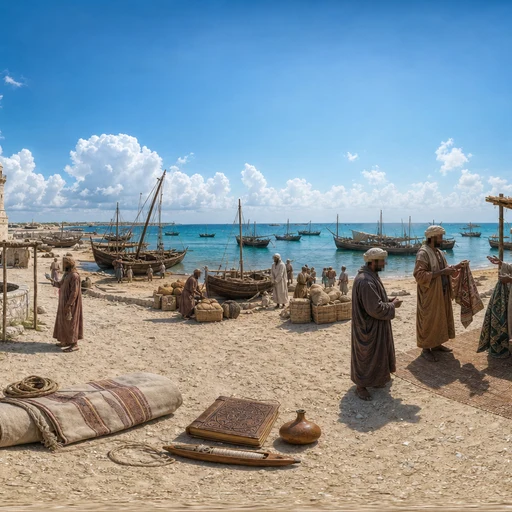
Lamu, on a low island close to the coast of what is now Kenya, is one of the oldest and best-preserved of the Swahili stone towns, the string of Muslim trading settlements that grew up along the East African coast from early Islamic times, from the Horn down toward the lands south of the equator. Along this coast an African people, the Swahili, in centuries of contact, trade and intermarriage with the Arab and Persian merchants who came down on the monsoon winds, formed a distinctive coastal civilisation, Islamic in faith and law, African in root, with its own Bantu language, Swahili, written in the Arabic script, and its own art and architecture of coral-stone. The stone towns were built of coral rag and lime: close-packed towns of flat-roofed houses, plain on the outside but cool and finely finished within and entered through massive wooden doors carved with intricate ornament, threaded by narrow shaded lanes too tight for wheeled traffic, where people and laden donkeys pass, and set with mosques and, often, a fort by the water. They lived by the sea and the monsoon trade, sending out mangrove poles, ivory and the goods of the African interior and taking in the cloth, beads and wares of Arabia, Persia, India and beyond, full members of the commercial and religious world of the Indian Ocean. Lamu is unusual in that it has been continuously inhabited down to the present, so that its old town survives as a living Swahili-Muslim community. This scene depicts the stone town of Lamu and its seafront. In keeping with the project's ethics any figure is anonymous and at a distance.
What you see
A close-packed town of flat-roofed coral-stone houses climbs back from a tropical seafront where dhows are drawn up and ride at anchor; narrow shaded lanes too tight for any cart run between the houses, walked by people and laden donkeys.
The houses are of white coral rag and lime, plain without but cool and finely finished within, entered through massive wooden doors carved with bands of intricate ornament; among them stand mosques with low minarets and an old fort by the water.
This is Lamu, one of the old Swahili stone towns of the East African coast, a Muslim trading settlement of the Indian Ocean where an African people, in long contact with the merchants of Arabia and Persia, formed a distinctive coastal Islamic civilisation.
The town lives by the sea and the monsoon: by the trade in mangrove poles, ivory and the goods of the interior, exchanged with the wider Muslim world, and by the dhows that come and go on the winds; its people speak Swahili and follow the way of Islam.
The town stands on a low island close to the green African shore, one of a chain of such ports strung down the coast from the Horn toward the lands south of the equator.
Lamu is an extant and continuously-inhabited Swahili town. The scene depicts the stone town and its seafront; no individual is shown by likeness.
Further reading & cross-references
Lamu old town (extant, inhabited Swahili town): The primary site. Used for the coral-stone houses, carved doors, mosques, fort and seafront. Confidence high.
Histories and archaeology of the Swahili coast and its stone towns: Used for the Swahili civilisation, the coral-stone architecture and the monsoon trade. Confidence high.
Studies of Swahili language, Islam and culture: Used for the African-Islamic character of the coast and the Swahili language in Arabic script. Confidence high.
The East African coast (geographic context): The island, the seafront and the tropical shore constrain the depiction; the precise date is representative.
Questions & answers
- Where is The Stone Town of Lamu?
- Lamu, an island town of the East African coast
- When did it happen?
- c. 772 AH / 1370 CE
- What is the story of The Stone Town of Lamu?
- Lamu, on a low island close to the coast of what is now Kenya, is one of the oldest and best-preserved of the Swahili stone towns, the string of Muslim trading settlements that grew up along the East African coast from early Islamic times, from the Horn down toward the lands south of the equator.…
Related places


Guess places like this in GeoSiyer
Drop into a 360° scene from Islamic history and pin where, and when, it happened.
Play GeoSiyer