The Massacre at Ma'arra
A town destroyed in the First Crusade, 1098 CE
492 AH / December 1098 CE
 Educational historical reconstruction
Where
Ma'arrat al-Nu'man, in northern Syria
35.6497, 36.6753 · View on OpenStreetMap
Background
Ma‘arrat al-Nu‘man was a market town on the inland routes of northern Syria. Crusaders captured it in December 1098 and massacred inhabitants. Latin narratives also report cannibalism during famine, although the accounts differ and not every writer was present. Exact casualty totals should not be treated as established by the picture. The town was home to al-Ma‘arri, who died in 1057, about forty-one years earlier. Damaged market structures, debris and a gate evoke the aftermath. The reconstruction conveys civilian loss without displaying the reported atrocities or claiming an exact street plan.
What you see
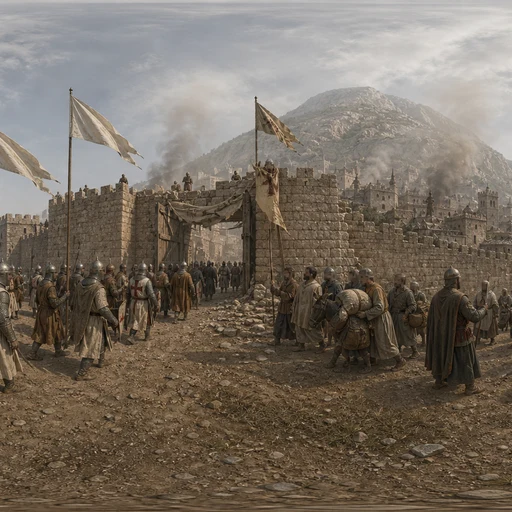
A modest walled town set among olive groves and fields on the inland road of northern Syria, between a great city to the north and the holy city far to the south; a provincial market town, not a mighty fortress.
Damaged market structures, debris and the town gate suggest the aftermath of a siege. The massacre is explained historically rather than enacted in the panorama.
This is Ma'arrat al-Nu'man in the winter of 1098, where the army of the First Crusade, after taking the town, put its Muslim inhabitants to the sword in their thousands, one of the worst atrocities of the whole Crusading invasion of Syria.
Latin accounts report cannibalism during the army’s famine. Their details and witness positions differ; the act is not depicted here.
Ma‘arra was the home of the poet al-Ma‘arri, who died in 1057, about forty-one years before the siege.
The massacre at Ma'arrat al-Nu'man in 1098 is recorded in both Muslim and Frankish chronicles. The scene is framed soberly; no individual is shown by likeness, and the violence is not graphically depicted.
Further reading & cross-references
TDV — Maarretünnu‘mân: Supports the inland setting and December 1098 sack; reported casualty totals require caution.
TDV — Ebü’l-Alâ el-Maarrî: Ma‘arra was the home of the poet al-Ma‘arri, who died in 1057, about forty-one years before the siege.
Jay Rubenstein — Cannibals and Crusaders (2008): Previously consulted article passages distinguish Latin reports and witness positions. Fulcher was not present at Ma‘arra; no blanket Arabic corroboration is asserted.
Questions & answers
- Where is The Massacre at Ma'arra?
- Ma'arrat al-Nu'man, in northern Syria
- When did it happen?
- 492 AH / December 1098 CE
- What is the story of The Massacre at Ma'arra?
- Ma‘arrat al-Nu‘man was a market town on the inland routes of northern Syria. Crusaders captured it in December 1098 and massacred inhabitants. Latin narratives also report cannibalism during famine, although the accounts differ and not every writer was present. Exact casualty totals should not be…
Related places




Guess places like this in GeoSiyer
Drop into a 360° scene from Islamic history and pin where, and when, it happened.
Play GeoSiyer