Malcolm X and Islam in America
After the hajj, Harlem, 1964
1384 AH / 1964 CE
 Educational historical reconstruction
Where
Harlem, New York City
40.8116, -73.9465 · View on OpenStreetMap
Background
In April 1964 the African-American leader Malcolm X made the pilgrimage to Makkah, and the journey changed him. He had risen to fame as the most powerful voice of the Nation of Islam, a heterodox movement that preached black separatism and an idiosyncratic doctrine far from mainstream Islam; but he had broken with it shortly before, and on the hajj, seeing Muslims of every race and colour worshipping together as equals, he embraced orthodox Sunni Islam, took the name El-Hajj Malik El-Shabazz, and wrote home that the experience had reshaped his understanding of race and brotherhood. He returned to Harlem, the historic heart of black America, to preach a more universal message rooted in Islam and human equality, founding the Muslim Mosque, Inc., before he was assassinated in February 1965. He became one of the most influential figures in the story of Islam in America, a bridge between the distinct experience of African-American Muslims, with their storefront mosques in the inner cities, and the global ummah he had encountered on the pilgrimage. This scene depicts that moment in Harlem in 1964, a converted storefront mosque among the brownstones, the folded white ihram of the returned pilgrim, Islam taking root in an American city.
What you see
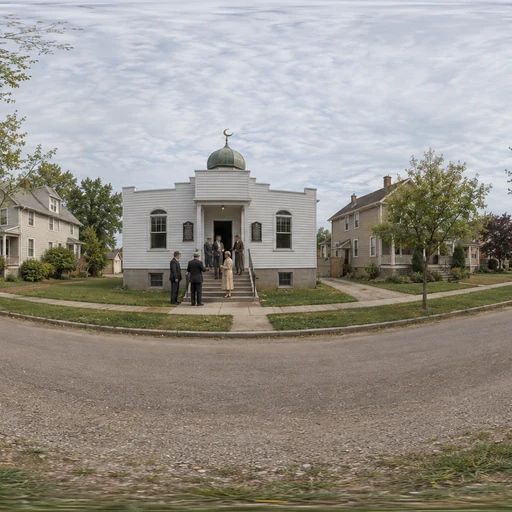
A street of tall brick row-houses, the brownstones of a dense northern American city, with fire escapes, stoops and a wide avenue. This is an inner-city neighbourhood of a great Western metropolis, not a Muslim-majority land.
A small mosque has been made in a converted shopfront at street level, marked by a crescent sign in the window; the place of worship is improvised into the urban fabric of a non-Muslim city.
A neatly folded set of plain white unsewn cloth, the ihram garments brought back from the pilgrimage, lies with a few books; their owner has lately returned from a journey to the holy city.
An American flag flies along the avenue beside the storefront mosque; the scene sets the practice of Islam squarely within an American city.
A storefront mosque and the white cloth of a returned pilgrim in an American inner city mark the deepening of Islam among African Americans and the turn of a famous leader, after his pilgrimage, toward the worldwide community of the faith.
Further reading & cross-references
The Autobiography of Malcolm X (with Alex Haley) and his Letter from Makkah (1964-1965): Malcolm X's own account of the hajj and its effect on him; the primary source for his turn to Sunni Islam and universal brotherhood. Confidence high.
Manning Marable, Malcolm X: A Life of Reinvention (2011): Standard modern biography. Used for the break with the Nation of Islam, the hajj, and the founding of the Muslim Mosque, Inc. Confidence high.
Histories of Islam among African Americans and in the United States: Used for the context of African-American Islam, the storefront mosques and the place of Malcolm X. Confidence high.
Photographs of 1960s Harlem (cross-reference): Period photographs of the brownstones and street life constrain the depiction; material detail only.
Questions & answers
- Where is Malcolm X and Islam in America?
- Harlem, New York City
- When did it happen?
- 1384 AH / 1964 CE
- What is the story of Malcolm X and Islam in America?
- In April 1964 the African-American leader Malcolm X made the pilgrimage to Makkah, and the journey changed him. He had risen to fame as the most powerful voice of the Nation of Islam, a heterodox movement that preached black separatism and an idiosyncratic doctrine far from mainstream Islam; but he…



Guess places like this in GeoSiyer
Drop into a 360° scene from Islamic history and pin where, and when, it happened.
Play GeoSiyer