The Court of Mali
Ibn Battuta at the court of Mansa Sulayman, c. 1352 CE
753 AH / c. 1352-1353 CE
 Educational historical reconstruction
Where
The capital of Mali, on the upper Niger (near Niani)
11.3833, -8.4333 · View on OpenStreetMap
Background
The empire of Mali, which arose in the thirteenth century in the grasslands of the western Sudan along the upper Niger, grew into the greatest of the medieval West African states and one of the wealthiest realms of its day, its riches founded on the goldfields of the south, on the trade in gold and salt and on the farming of the river lands, and its power reaching from the Atlantic to the bend of the Niger and the desert trading-cities. Its rulers, the mansas, were Muslims, and under them, especially the famous Mansa Musa whose pilgrimage to Makkah a generation before had astonished the world with its gold, Mali became a centre of Islam in the Sudan, its cities adorned with mosques and its scholars in contact with the wider Muslim world. About 1352-1353 the great Moroccan traveller Ibn Battuta crossed the desert and visited the empire in the reign of Mansa Sulayman, brother and successor of Mansa Musa, and his account is one of our chief sources for it. He described the royal court with its ceremony and its gold, the king's audiences and the homage of his subjects; and he praised, as the best of the people's qualities, their constancy in prayer and their teaching of the Qur'an to their children, and above all the security and justice of the realm, the safety of the roads, so that the traveller and the stranger had nothing to fear. Yet, a scrupulous Maliki faqih, he also recorded with disapproval certain local customs that seemed to him contrary to the law, judging the country by the standard of his own learning. His account preserves a vivid picture of a powerful, orderly and Muslim African empire at its height. This scene depicts the court of Mali; in keeping with the project's ethics any figure is anonymous and at a distance.
What you see
A great royal audience is held in the open before a domed pavilion: the king sits in state under a silken canopy, surrounded by armed guards, musicians and officers, while petitioners approach with elaborate ceremony, kneeling and casting dust upon their heads in homage.
The court glitters with gold, in the trappings of the guards, the ornaments of the courtiers and the wealth of the king; this is the empire whose gold, carried north across the desert, was famous through the whole world.
This is the court of the empire of Mali, the great Muslim kingdom of the West African savanna at the height of its power, visited by the traveller Ibn Battuta in the reign of Mansa Sulayman, who marvelled at its order, its justice and its devotion.
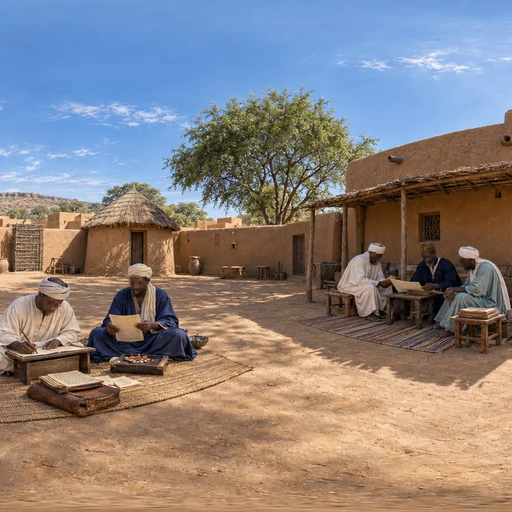
The land is the broad grassland of the western Sudan, watered by a great river, between the southern goldfields and the desert by which the caravans cross to the Maghrib; a country of farming, gold and trade.
The traveller notes the people's care for the prayer and the Friday mosque, their teaching of the Qur'an to their children, and above all the safety of the roads and the justice of the king, so that a man might travel without fear; yet he notes too customs that trouble him as a stranger.
Ibn Battuta's account of the empire of Mali is one of the chief sources for it. The scene depicts the royal court; no individual is shown by likeness.
Further reading & cross-references
Ibn Battuta, Rihla (the Travels, 14th c.), the account of Mali: The primary source. Used for the court, the ceremony, the justice and the customs of Mali. Confidence high for the account.
Arabic geographers and historians of the western Sudan (al-Umari, Ibn Khaldun): Used for the empire of Mali, its gold, its rulers and its place in the Muslim world. Confidence high.
Histories of the Mali empire and the trans-Saharan trade: Used for the goldfields, the caravan trade and the extent and power of Mali. Confidence high.
The upper Niger savanna and the debated site of the capital (geographic context): The capital's site (often placed at Niani) is debated; the grassland setting constrains the depiction.
Questions & answers
- Where is The Court of Mali?
- The capital of Mali, on the upper Niger (near Niani)
- When did it happen?
- 753 AH / c. 1352-1353 CE
- What is the story of The Court of Mali?
- The empire of Mali, which arose in the thirteenth century in the grasslands of the western Sudan along the upper Niger, grew into the greatest of the medieval West African states and one of the wealthiest realms of its day, its riches founded on the goldfields of the south, on the trade in gold and…
Related places



Guess places like this in GeoSiyer
Drop into a 360° scene from Islamic history and pin where, and when, it happened.
Play GeoSiyer