The Minaret of Jam
Building a Ghurid victory tower in the mountains of Ghor, c. 1193 CE
c. 590 AH / 1190s CE
 Educational historical reconstruction
Where
Jam, in the mountains of Ghor, in central Afghanistan
34.3964, 64.5158 · View on OpenStreetMap
Background
The Minaret of Jam is one of the most remarkable and most isolated monuments of the Islamic world: a tall, slender tower of baked brick, some sixty-three to sixty-five metres high, standing in a deep, bare gorge where a tributary meets the Hari Rud (Harirud) river in the mountains of Ghor, in the heart of what is now central Afghanistan, far from any city. It was raised in the 1190s by the Ghurids, a dynasty sprung from these very mountains who rose, on a movement of zeal and conquest, from obscure highland chiefs to rule a great empire that stretched from eastern Persia across Afghanistan and deep into northern India; it was the Ghurids and their commanders who carried Muslim power into the Indian heartland and founded the dominion from which the Delhi Sultanate would grow. The minaret is generally ascribed to the sultan Ghiyath al-Din Muhammad rahimahu Allah, whose name and titles are read in its inscriptions, and is thought to mark the site of the Ghurids' lost summer capital, Firuzkuh, sacked by the Mongols a generation later and never since certainly identified. The court history of the dynasty, the Tabaqat-i Nasiri of al-Juzjani rahimahu Allah, who served the Ghurids and their successors, preserves the memory of these sultans and their building and of Firuzkuh, though it does not describe the tower as such. The minaret's whole surface is sheathed in ornament worked in the brick itself and in turquoise glazed tile: interlacing geometric patterns and broad bands of Kufic and cursive inscription, including the whole of the Qur'anic chapter of Maryam (Mary), Surat Maryam, alongside the patron's name. It was conceived as a proclamation of faith and of victory raised in the wilderness, a masterpiece of the brick architecture of the eastern Muslim world, and it survives, isolated, eroded by the river and long endangered, as the chief witness to a vanished mountain empire. This scene depicts the tower while it is still being built: a builders' yard of moulded brick and glazed tile at its foot, a wooden lifting frame against the shaft, craftsmen laying the upper courses, and a party of riders coming up the valley toward the works. In keeping with the project's ethics any figure is anonymous and at a distance, and the panorama is a reconstruction of the building moment, not a record of the surviving ruin.
What you see
A tall, slender tower of baked brick climbs from the valley floor, its tapering shaft already banded from foot to summit with intricate geometric brickwork and inscription; the upper stage is still being raised, and the whole is far higher than any other structure in sight.
At the tower's foot is a builders' yard: a wooden lifting frame leans against the shaft, and crates and stacks of moulded brick and glazed tile wait beside kneeling craftsmen who are sorting and laying the courses by hand.
The site sits at the bottom of a gorge where a mountain river bends past it, hemmed in by steep, treeless, reddish peaks; a remote and dramatic place, hard to reach, with a thin line of trees marking the watercourse and no city anywhere in view.
This is the Minaret of Jam, raised in the 1190s by the Ghurids, the mountain dynasty of these uplands who rose to rule an empire reaching from eastern Persia into the heart of India; the tower is thought to stand at their lost summer capital, Firuzkuh.
The ornamental bands carry verses of the Qur'an worked into the very fabric of the tower, among them the whole of Surat Maryam (the chapter of Mary); turquoise glazed tile picks out an inscription naming the patron, the sultan Ghiyath al-Din Muhammad.
A small party of riders approaches along the riverside track toward the works, as patrons or a supply caravan might to a remote building site; the tower is rising as a proclamation of faith and victory set deliberately in the wilderness.
The dynasty whose monument this is carried Muslim power by conquest deep into northern India, founding the dominion from which the Delhi Sultanate would grow; yet their own heartland is this stark and solitary mountain country.
Primary sources
Surat Maryam (Qur'an, chapter 19), the inscribed chapter: The chapter of Mary, recorded as carried in full around the tower; cited as the principal Qur'anic text of the monument's epigraphic programme. Confidence high.
Further reading & cross-references
al-Juzjani, Tabaqat-i Nasiri (Ghurid court history, mid 13th c.): The principal Sunni Persian history of the Ghurid dynasty, written by a chronicler who served the Ghurids and their successors. Used for the sultans, the empire, the Indian conquests and the summer capital Firuzkuh. It records the dynasty and Firuzkuh but does not itself describe the tower. Confidence high for the dynasty, medium for the link to this exact site.
The Minaret of Jam (extant monument and its inscriptions): The primary material witness. Used for the tower, its baked-brick and turquoise-tile ornament, the patron inscription naming Ghiyath al-Din Muhammad, and the Qur'anic inscription bands including Surat Maryam. Confidence high.
Studies of eastern Islamic brick architecture and minarets: Used for the design, the inscription programme and the construction of the minaret, and for its place in the tradition of monumental brick towers of the eastern Muslim world. The depicted scaffolding and lifting gear are a plausible reconstruction, not documented detail. Confidence high for the monument, medium for the building method shown.
Archaeological and UNESCO survey of Jam and Ghor (geographic and material context): The remote river-bend site, the height of the tower, the river erosion and the identification debate over Firuzkuh. Non-Muslim cross-reference, used for date, place and material only. Confidence high for the site, medium for the Firuzkuh identification.
Questions & answers
- Where is The Minaret of Jam?
- Jam, in the mountains of Ghor, in central Afghanistan
- When did it happen?
- c. 590 AH / 1190s CE
- What is the story of The Minaret of Jam?
- The Minaret of Jam is one of the most remarkable and most isolated monuments of the Islamic world: a tall, slender tower of baked brick, some sixty-three to sixty-five metres high, standing in a deep, bare gorge where a tributary meets the Hari Rud (Harirud) river in the mountains of Ghor, in the…
Related places

Ghazni and the Road to India
417 AH / c. 1026 CE

After the Mongol Storm at Nishapur
618 AH / 1221 CE

The Mongol Storm at Bukhara
617 AH / 1220 CE
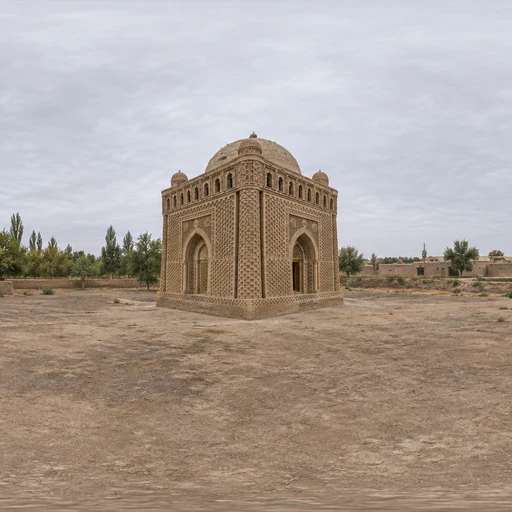
The Samanid Mausoleum at Bukhara
c. 300 AH / c. 914 CE

Mahmud of Ghazna's Indian Campaigns
Ghaznavid campaigns (388-421 AH / 998-1030 CE)

The Battle of Tarain
588 AH / 1192 CE
Guess places like this in GeoSiyer
Drop into a 360° scene from Islamic history and pin where, and when, it happened.
Play GeoSiyer