The Turn to Sunni Islam in America
Reordering the prayer in Chicago, c. 1976
1396 AH / c. 1976 CE
 Educational historical reconstruction
Where
Chicago, United States
41.8300, -87.6200 · View on OpenStreetMap
Background
When Elijah Muhammad, the long-time leader of the Nation of Islam, died in 1975, his son and successor Warith Deen Mohammed led the great majority of that large, mostly African-American movement out of its heterodox teachings and into mainstream Sunni Islam. The Nation of Islam, which had grown up in the cities of the United States from the 1930s, had preached a doctrine of black separatism and ideas, including claims about the divine, that placed it far outside orthodox Islam, even as it gave dignity, discipline and a Muslim identity to many African Americans, among them, for a time, Malcolm X, whose own earlier turn to Sunni Islam after his pilgrimage had pointed the way. From 1975 Warith Deen Mohammed set about a thorough reform: he taught the oneness of God and the finality of the Prophet Muhammad (peace and blessings be upon him), adopted the five pillars and the Sunni practice of prayer, reoriented the congregations to pray toward Makkah and realigned their rows, renamed the movement's temples as mosques and its followers as Muslims within the global community, and dissolved the old separate structure. It was one of the largest passages of African Americans into mainstream Islam in history, though a minority later revived the older Nation of Islam separately under another leader. This scene depicts that turn around 1976 in a converted storefront mosque in an American city, the new mihrab set in the wall, the prayer rows realigned toward the qibla, the community joining the worldwide practice of the faith.
What you see
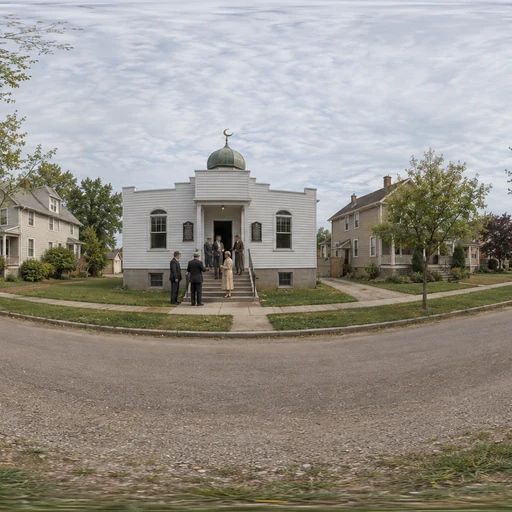
A wide avenue of brick storefronts and apartment blocks in a great American industrial city, with period 1970s cars at the kerb; this is an African-American neighbourhood of a northern United States metropolis.
A former meeting hall, a converted storefront, has been made into a mosque, with a new mihrab niche set into one wall to mark the prayer-direction toward Makkah.
The rows of worshippers have been turned and realigned to face the new mihrab and the qibla, rather than an older arrangement; the congregation is visibly reordering its prayer to the practice of mainstream Islam.
An American flag stands by the entrance among the worshippers; this is a community of American Muslims, rooted in the United States, aligning itself with the worldwide community of the faith.
A storefront congregation realigning its prayer toward Makkah and setting a mihrab in the wall marks the turn of a large African-American movement from a heterodox sect into mainstream Sunni Islam.
Further reading & cross-references
Studies of Warith Deen Mohammed and the transformation of the Nation of Islam (e.g. work by Edward E. Curtis IV): Standard academic accounts of the post-1975 reform that brought the movement into Sunni Islam. Used for the changes in doctrine and practice. Confidence high.
Histories of Islam among African Americans in the United States: Used for the background of the Nation of Islam, its place in African-American life, and the broader move toward Sunni Islam. Confidence high.
The Autobiography of Malcolm X and accounts of his earlier Sunni turn: Used for the precedent of Malcolm X's turn to Sunni Islam after his 1964 pilgrimage, which the later movement echoed. Confidence high.
Questions & answers
- Where is The Turn to Sunni Islam in America?
- Chicago, United States
- When did it happen?
- 1396 AH / c. 1976 CE
- What is the story of The Turn to Sunni Islam in America?
- When Elijah Muhammad, the long-time leader of the Nation of Islam, died in 1975, his son and successor Warith Deen Mohammed led the great majority of that large, mostly African-American movement out of its heterodox teachings and into mainstream Sunni Islam. The Nation of Islam, which had grown up…



Guess places like this in GeoSiyer
Drop into a 360° scene from Islamic history and pin where, and when, it happened.
Play GeoSiyer