The Occupation of Istanbul
The Ottoman capital under Allied control, 1920
1338 AH / c. 1920 CE
 Educational historical reconstruction
Where
Istanbul and the Bosphorus, under occupation
41.0150, 28.9870 · View on OpenStreetMap
Background
After the Ottoman Empire's defeat in the First World War and the Armistice of Mudros in 1918, Allied forces moved into the imperial capital, and on 16 March 1920 they formally occupied Istanbul. British, French and Italian warships filled the Bosphorus, foreign troops garrisoned the city and patrolled its streets, the parliament was dissolved and nationalist deputies and notables were arrested or deported, and the sultan-caliph Mehmed VI reigned only at the occupiers' sufferance. Soon afterward his government was made to sign the Treaty of Sevres, which would have partitioned even the Anatolian heartland among the Allies, the Greeks and others. The occupation of the capital was the lowest point of the long Ottoman collapse, a humiliation felt across the Muslim world for which Istanbul was the seat of the caliphate. But it had the opposite of its intended effect: it discredited the captive Istanbul government and drove the Turkish national resistance to gather in the Anatolian interior around Mustafa Kemal and the Grand National Assembly at Ankara, beginning the War of Independence that would, within three years, expel the occupiers, overturn the Treaty of Sevres, and end the sultanate. This scene depicts the occupied capital around 1920, Allied warships in the Bosphorus and foreign sentries on the quays, the ordinary life of the city continuing beneath them.
What you see
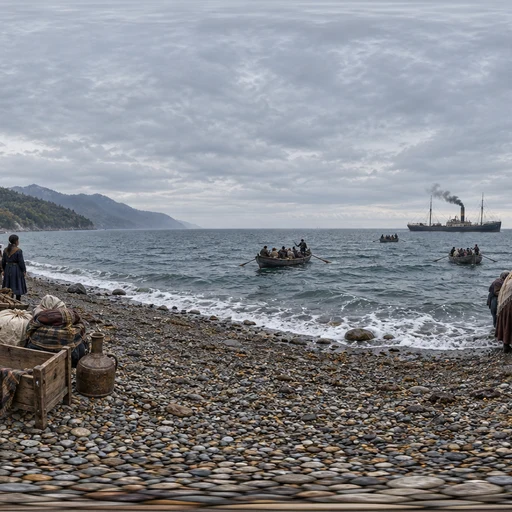
A great imperial city of domes and minarets lines a strait between two continents, ferries crossing beneath the hills. This is the Ottoman capital on the Bosphorus.
Foreign warships lie offshore while a checkpoint controls the waterfront. Their presence connects the street to Allied occupation.
Foreign soldiers in several different European uniforms stand sentry at the quays and public buildings and check those who pass; the city is held by an occupying army of more than one nation.
Trams and a crowded ferry landing carry on the ordinary life of an early-twentieth-century city beneath the warships, the daily round continuing under occupation.
Foreign fleets and garrisons holding the imperial capital itself, while the sultan-caliph governs only at their sufferance, marks the lowest point of the empire's collapse and the spur that drove the national resistance to gather in the interior.
Further reading & cross-references
Ottoman and Turkish accounts of the occupation of Istanbul (early 20th c.): Contemporary Ottoman press, memoirs and the records of the occupation; used for the events, the warships and the foreign garrison. Confidence high.
Nur Bilge Criss, Istanbul under Allied Occupation 1918-1923 (1999): The standard modern academic study of the occupation. Used for the chronology, the administration and the daily life of the occupied city. Confidence high.
Histories of the Turkish War of Independence and the Treaty of Sevres: Used for the wider context, the partition imposed at Sevres and the rise of the Ankara resistance. Confidence high.
Contemporary photographs of occupied Istanbul (cross-reference): Period photographs of Allied warships in the Bosphorus and foreign troops in the city constrain the depiction; material detail only.
Questions & answers
- Where is The Occupation of Istanbul?
- Istanbul and the Bosphorus, under occupation
- When did it happen?
- 1338 AH / c. 1920 CE
- What is the story of The Occupation of Istanbul?
- After the Ottoman Empire's defeat in the First World War and the Armistice of Mudros in 1918, Allied forces moved into the imperial capital, and on 16 March 1920 they formally occupied Istanbul. British, French and Italian warships filled the Bosphorus, foreign troops garrisoned the city and…


Guess places like this in GeoSiyer
Drop into a 360° scene from Islamic history and pin where, and when, it happened.
Play GeoSiyer