The Abandoned Camp before Vienna
Aftermath of the relief from the Kahlenberg, 1683
1094 AH / 1683 CE
 Educational historical reconstruction
Where
Ottoman siege lines outside Vienna, below the Kahlenberg
48.2500, 16.3400 · View on OpenStreetMap
Background
In the summer of 1683 (1094 AH) a large Ottoman army under the Grand Vizier Merzifonlu Kara Mustafa Pasha (rahimahu Allah) laid siege to Vienna, the Habsburg capital on the Danube and the farthest great objective of Ottoman expansion into Central Europe. The siege ran from mid-July into September, the Ottoman sappers driving mines under the bastions while the city held on under Count Ernst Rudiger von Starhemberg. On 12 September a relief army of Polish, Imperial, Saxon and Bavarian troops, with the Polish king Jan III Sobieski in overall command, assembled on the wooded heights of the Kahlenberg and the Wienerwald to the northwest and attacked downhill through the vineyards and forest. In the afternoon a massed charge, led by the Polish winged hussars, broke the Ottoman lines, and the besieging army abandoned its camp and fled, leaving tents, cannon, draught animals and stores behind; among the abandoned supplies, by a well-known tradition, were sacks of coffee beans that helped fix the drink in Viennese life. The relief of Vienna marked the high-water mark of the Ottoman advance into Europe and the start of a long retreat. It triggered the War of the Holy League (1683-1699), at the end of which the Treaty of Karlowitz in 1699 ceded most of Hungary and Transylvania, the first great territorial losses of the Ottoman state in Europe. Kara Mustafa Pasha was held responsible for the disaster and was executed at Belgrade in December 1683. This scene depicts the aftermath, the deserted Ottoman siege camp on the plain below the Kahlenberg with the city beyond and the relief cavalry still coming down off the heights, framed soberly as the turning of a tide rather than as a spectacle.
What you see
A great walled city sits on a plain beside a broad river, with wooded hills rising sharply to the northwest. This is a Central European capital on the Danube backed by forested heights, not a Mediterranean or Anatolian setting.
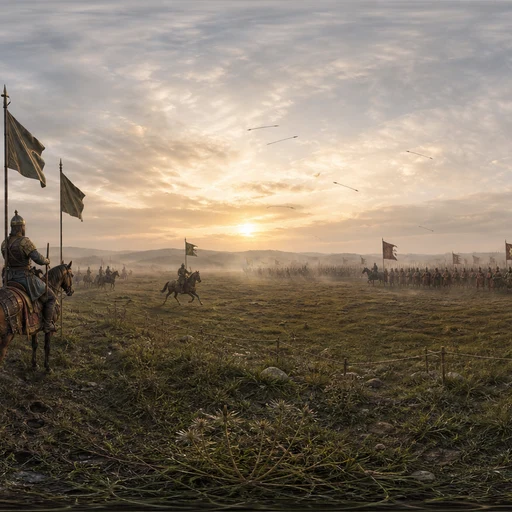
The foreground is an abandoned military camp: rows of collapsed and slashed tents, cold fire pits, and scattered baggage. An army has broken off a siege and fled in haste rather than struck camp in order.
Large round pavilion tents with appliqued cloth panels lie fallen among heavy bronze siege guns left in their earth emplacements. The tents and ordnance are Ottoman field equipment, abandoned where they stood.
Overturned supply carts, split sacks of grain and coffee beans, and deep muddy wheel-ruts cut across the ground. The litter and the ruts read as the wreck of a baggage train caught in a sudden retreat.
The city is defended by low, angled, earth-backed bastions and ravelins, the star-fort lines of seventeenth-century European fortification, with the scars of mines and saps dug toward them, not the high medieval towers of an earlier age.
A horsetail standard on a pole leans abandoned in the churned mud near a fallen command tent. This was the high-water mark of the Ottoman advance into Central Europe, the furthest the tide reached before it turned.
Down the wooded slope to the northwest, lines of relief cavalry are still descending. The blow that emptied this camp came as a charge off the forested heights above the city.
Further reading & cross-references
Silahdar Findiklili Mehmed Aga, Silahdar Tarihi (late 17th c.): Ottoman court chronicler and eyewitness of the campaign years. The key Ottoman narrative of the siege, the rout, the abandonment of the camp, and the aftermath including the execution of Kara Mustafa Pasha. Confidence high for the Ottoman account.
Defterdar Sari Mehmed Pasha, Zubdat al-Waqayi (early 18th c.): Ottoman financial official and historian; supports the campaign chronology and the scale of the material losses left in the camp.
Caroline Finkel, Osman's Dream: The History of the Ottoman Empire (2005): Standard modern single-volume Ottoman history. Used for the strategic framing of 1683 as a turning point, the War of the Holy League, and the Treaty of Karlowitz.
Thomas M. Barker, Double Eagle and Crescent: Vienna's Second Turkish Siege (1967): Detailed modern military study of the siege and relief. Used for the timeline of the assault from the Kahlenberg, the role of Sobieski and the winged hussars, and the abandonment of the camp.
John Stoye, The Siege of Vienna (1964, rev. 2007): Classic English narrative of the siege; used as a cross-check on the September chronology and the condition of the abandoned camp.
Extant Ottoman camp material and Vienna fortifications (museum and archaeological): Surviving Ottoman tents, standards and ordnance in Vienna and Krakow collections, and the recorded line of the seventeenth-century bastioned defences, constrain the depiction of the camp equipment and the city walls.
Questions & answers
- Where is The Abandoned Camp before Vienna?
- Ottoman siege lines outside Vienna, below the Kahlenberg
- When did it happen?
- 1094 AH / 1683 CE
- What is the story of The Abandoned Camp before Vienna?
- In the summer of 1683 (1094 AH) a large Ottoman army under the Grand Vizier Merzifonlu Kara Mustafa Pasha (rahimahu Allah) laid siege to Vienna, the Habsburg capital on the Danube and the farthest great objective of Ottoman expansion into Central Europe. The siege ran from mid-July into September,…




Guess places like this in GeoSiyer
Drop into a 360° scene from Islamic history and pin where, and when, it happened.
Play GeoSiyer