The Castle of Subayba
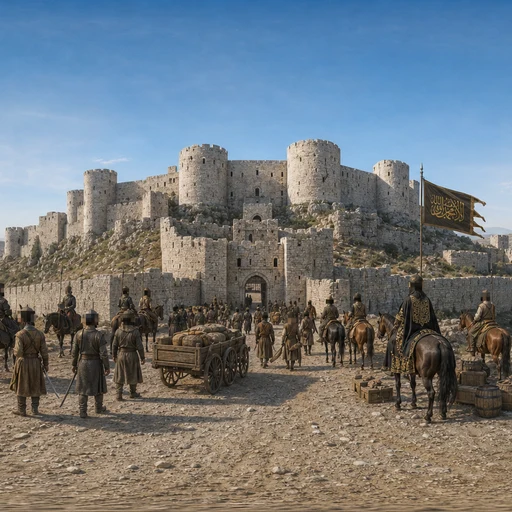
Inside an Ayyubid fortress on the road to Damascus, c. 1230 CE
c. 625-628 AH / 1228-1230 CE
 Educational historical reconstruction
Where
Qal'at al-Subayba, below Mount Hermon, above Banyas
33.2522, 35.7142 · View on OpenStreetMap
Background
Qal'at al-Subayba, the great fortress that later ages would wrongly call the castle of Nimrod, stands on a steep spur on the lower slopes of Mount Hermon (Jabal al-Shaykh), above the town and springs of Banyas, commanding the road that climbs from the coastal lowlands of the Galilee panhandle toward Damascus. It was built by the Ayyubids, the dynasty of Salah al-Din rahimahu Allah, in the early thirteenth century: the work is attributed above all to al-Aziz Uthman, an Ayyubid prince and son of al-Adil, who from about 1228 raised and greatly enlarged the castle to guard the inland road and to shelter Damascus against the Crusaders, who still held the coast and had lately, in the Fifth and Sixth Crusades, threatened the interior. It is a masterpiece of Ayyubid military architecture, a long fortress of massive, finely dressed and bossed stone with great projecting towers and a keep, and several of its towers carry carved Arabic building inscriptions naming the princes who built them, dating the work and invoking God, so that the fortress documents its own making; Ibn Shaddad and the Ayyubid chroniclers preserve the names and deeds of these princes of Damascus. This scene stands inside the bailey of the castle in its Ayyubid building: the cobbled court, the great keep with its arched gate, the bossed ashlar of the walls, a rock-cut cistern of still green water that caught the winter rain and snowmelt for the garrison, and beyond the curtain wall the deep valley falling away toward the distant ranges. Men of the garrison keep the gate and the court. Through the thirteenth century the castle was fought over, strengthened and rebuilt, and after 1260 the Mamluk sultan Baybars and his successors remodelled it on a still grander scale as the Mamluks drove the Crusaders from the coast; once the frontier wars were over it slowly lost its purpose and fell into the ruin in which it survives, one of the most impressive Muslim fortresses of the age. In keeping with the project's ethics any figure is anonymous and at a distance.
What you see
The view stands inside the bailey of a great stone castle, on cobbled paving, looking up at a tall keep whose round-arched gateway opens in a wall of massive, finely dressed blocks; the stones are laid in even courses, many with a smooth raised face inside a drafted margin, the bossed ashlar of skilled royal builders.
Beyond the curtain wall on the right the land falls away into a deep valley, with bare ridges and distant ranges fading toward the horizon; the castle rides a high spur on the lower slopes of a great mountain, far above the lowlands it guards.
A stone-lined cistern set into the courtyard holds a pool of still green water; cut into the living rock and the masonry, such tanks gathered the winter rain and snowmelt that let a mountain garrison hold out through a long siege.
This is Qal'at al-Subayba, raised by the Ayyubid princes of Damascus to guard the mountain road that climbs from the Frankish-held coast toward their inland capital, one key in the chain of fortresses of the long wars with the Crusaders.
Towers of this castle carry carved Arabic inscriptions that name the Ayyubid lord who built them, give the date and invoke God; the building records its own makers and the purpose for which it was raised.
Men of the garrison stand about the bailey, near the gate and the cistern; the fortress is a sentinel set to bar an enemy advancing inland and to shelter the country behind it, in an age when coast and interior changed hands in war after war.
The gateway and the climbing cobbled way mark the single guarded approach into the upper castle; everything that reached the keep, supplies, soldiers and messengers, had to pass beneath the watch of the towers.
Further reading & cross-references
Qal'at al-Subayba (extant fortress and its Ayyubid inscriptions): The primary monument. Used for the bailey, the keep and gateway, the bossed ashlar, the cistern and the building inscriptions. Confidence high.
Ibn Shaddad and the Ayyubid chroniclers of Syria: Used for the princes of Damascus, the attribution of the building and the strategic purpose against the Crusaders. Confidence medium to high.
Archaeological studies of the building of Subayba (M. Hartal and others): Used for the attribution to al-Aziz Uthman, the dating of the Ayyubid phase and the later Mamluk remodelling under Baybars. Confidence high.
Histories of Ayyubid Syria and the Crusader wars: Used for the strategic context, the road to Damascus, the Fifth and Sixth Crusades and the Mamluk takeover. Confidence high.
The setting below Mount Hermon (geographic context): The spur, the mountain, the deep valley and the springs of Banyas constrain the depiction.
Questions & answers
- Where is The Castle of Subayba?
- Qal'at al-Subayba, below Mount Hermon, above Banyas
- When did it happen?
- c. 625-628 AH / 1228-1230 CE
- What is the story of The Castle of Subayba?
- Qal'at al-Subayba, the great fortress that later ages would wrongly call the castle of Nimrod, stands on a steep spur on the lower slopes of Mount Hermon (Jabal al-Shaykh), above the town and springs of Banyas, commanding the road that climbs from the coastal lowlands of the Galilee panhandle…
Related places


Guess places like this in GeoSiyer
Drop into a 360° scene from Islamic history and pin where, and when, it happened.
Play GeoSiyer