The Beginnings of the Tablighi Jamaat
A grassroots revival in the Mewat villages, c. 1926
1345 AH / c. 1926 CE
 Educational historical reconstruction
Where
The Mewat region, south of Delhi
28.1000, 77.0000 · View on OpenStreetMap
Background
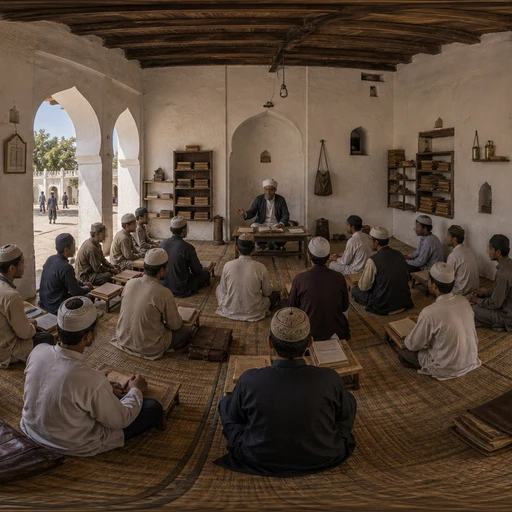
Around 1926, in the Mewat region of small farming villages south of Delhi, a Deobandi scholar named Maulana Muhammad Ilyas al-Kandhlawi (rahimahu Allah) began the quiet effort that would grow into the Tablighi Jamaat, one of the largest grassroots Islamic movements in the world. Distressed that the Muslim peasantry of Mewat, though Muslim in name, knew little of prayer or the basics of the faith and kept many non-Islamic customs, he concluded that scholars preaching from their madrasas and mosques were not enough; the people themselves had to be moved. His method was revival from below: ordinary Muslims, not only the learned, would form small groups and go out, khuruj, for set periods, travelling on foot to villages and mosques, living simply, and calling their fellow Muslims back to prayer and the essentials of the religion by gentle exhortation and personal example, then returning to their ordinary work. The movement was deliberately apolitical, avoided doctrinal disputes and any role in worldly affairs, and asked nothing of the state, focusing entirely on personal piety and practice. From the Mewat villages it spread quietly across India and, over the twentieth century, became a vast transnational movement with millions of participants and one of the largest annual gatherings in the Muslim world, all without ever becoming a formal organisation in the ordinary sense. This scene depicts its humble beginnings, a plain village mosque in Mewat with a study circle of ordinary villagers and the bundles of those preparing to go out.
What you see
Flat farmland of small fields and scattered villages stretches across a dry plain south of a great city, with low rocky ridges on the horizon. This is a poor rural district of the north Indian plain.
A small, plain village mosque of brick and plaster, with a modest courtyard, is the centre of the scene, an ordinary local mosque, not a grand madrasa or shrine.
A study circle of villagers, not just scholars, sits around a teacher learning the basics of prayer and the faith; the teaching is aimed at ordinary working Muslims, by the simplest means.
Some of the men have rolled bedding and small bundles ready, prepared to set out on foot in small groups to other villages; movement and personal calling, rather than buildings or books alone, are the method.
Ordinary villagers, not just learned men, gathering to call one another back to prayer and to go out to do the same elsewhere, marks the quiet birth of a grassroots revival built on personal effort and travel rather than institutions or politics.
Further reading & cross-references
Tablighi accounts of Muhammad Ilyas and the early movement, and the Faza'il literature: The movement's own biographies of Muhammad Ilyas and accounts of its origins and method; used for the founding, the khuruj method and the aims. Read from within the movement. Confidence high for the self-account.
Muhammad Khalid Masud (ed.), Travellers in Faith: Studies of the Tablighi Jama'at (2000): The standard modern academic volume on the movement. Used for the origins in Mewat, the method of khuruj, and the apolitical grassroots character. Confidence high.
Yoginder Sikand, The Origins and Development of the Tablighi Jama'at (2002): Modern study of the movement's beginnings in Mewat. Used for the social context and Muhammad Ilyas's method. Confidence high.
The rural Mewat landscape and village mosques (cross-reference): The farming villages and plain mosques of Mewat constrain the modest rural setting.
Questions & answers
- Where is The Beginnings of the Tablighi Jamaat?
- The Mewat region, south of Delhi
- When did it happen?
- 1345 AH / c. 1926 CE
- What is the story of The Beginnings of the Tablighi Jamaat?
- Around 1926, in the Mewat region of small farming villages south of Delhi, a Deobandi scholar named Maulana Muhammad Ilyas al-Kandhlawi (rahimahu Allah) began the quiet effort that would grow into the Tablighi Jamaat, one of the largest grassroots Islamic movements in the world. Distressed that the…
Related places


Guess places like this in GeoSiyer
Drop into a 360° scene from Islamic history and pin where, and when, it happened.
Play GeoSiyer