Uhud, The Archers Leave the Hill
The turning of the Battle of Uhud, 7 Shawwal 3 AH
3 AH / 625 CE
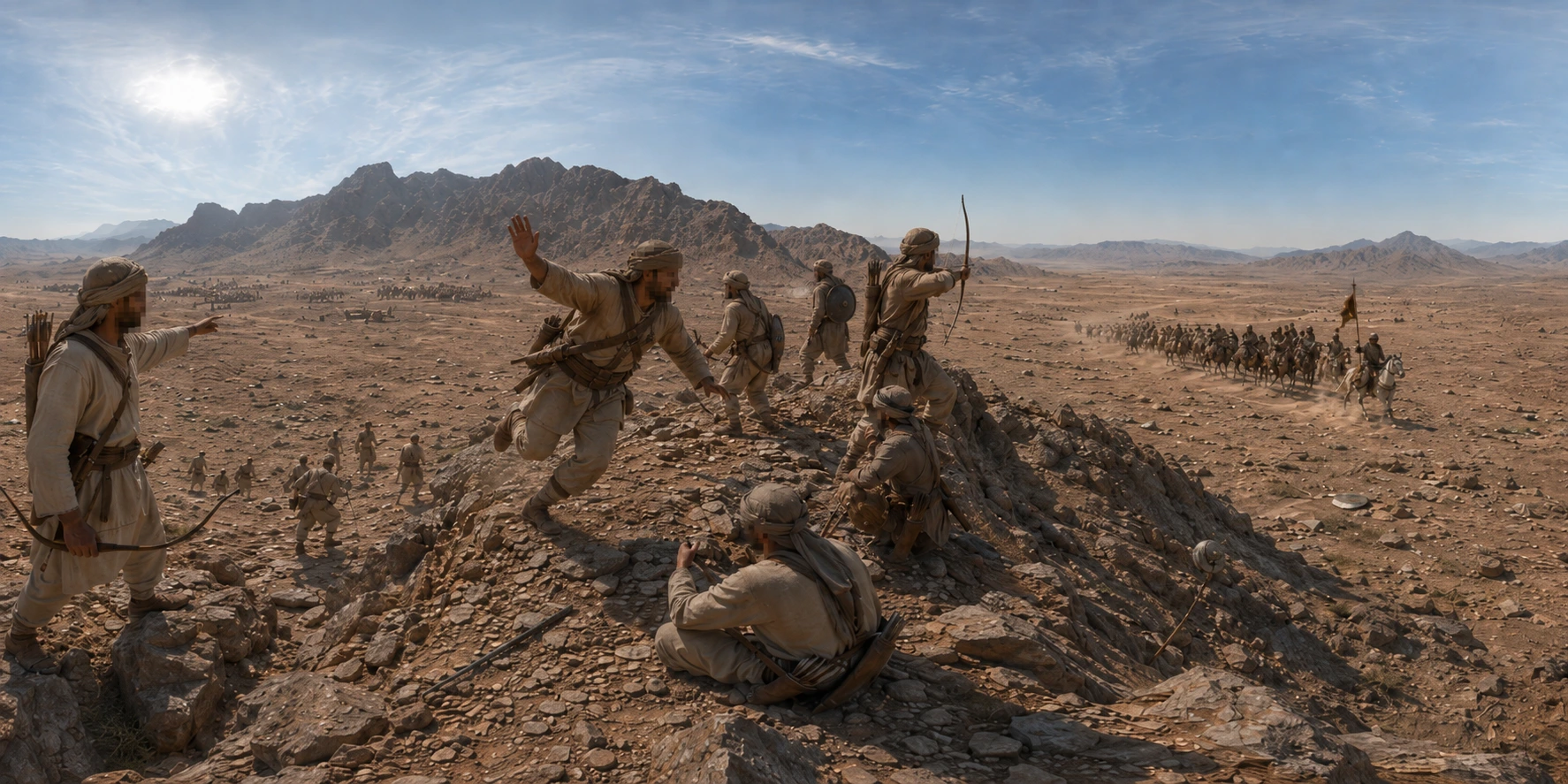 Educational historical reconstruction
Where
Jabal al-Rumat (Hill of the Archers), foot of Mount Uhud
24.5051, 39.6147 · View on OpenStreetMap
Background
On the morning of Saturday 7 Shawwal of the third year after the Hijrah, conventionally placed at 23 March 625 CE, a Quraysh army of approximately three thousand men, including a strong cavalry contingent, met the Muslim force of approximately seven hundred under the Prophet Muhammad (peace and blessings be upon him) on the battle plain at the southern foot of Jabal Uhud, the largest mountain immediately north of Madinah. The Muslim left flank rested on a small detached hillock called Jabal 'Aynayn, on which fifty archers had been stationed under the command of 'Abdullah ibn Jubayr with explicit standing orders to hold the position regardless of the apparent course of the battle. The opening engagement went well for the Madinian side: the Quraysh formation broke and began to retreat, and Quraysh baggage was abandoned on the plain. The archers, seeing the apparent victory and concerned about losing their share of the spoils, descended from the hill against their orders, a development recorded in detail by Ibn Ishaq, al-Waqidi, and al-Tabari. The Quraysh cavalry, commanded by the future Muslim general Khalid ibn al-Walid (still allied with Quraysh at this time), wheeled around the now-undefended hill and struck the Muslim rear, reversing the battle. Among the approximately seventy companions killed in the resulting fighting was Hamza ibn 'Abd al-Muttalib (radiyallahu 'anhu), paternal uncle of the Prophet (peace and blessings be upon him). The Prophet (peace and blessings be upon him) was himself wounded, a tooth chipped, his face cut, and was briefly believed by the Quraysh to have been killed. Despite the reverse the Muslim force was not destroyed; they withdrew up onto the slopes of Uhud where the Quraysh did not press a final assault, and the Quraysh army returned to Makkah without occupying Madinah. This scene depicts the precise moment of the pivot: the archers' positions on the hillock have just been vacated, the spoils gathering has begun below, and the Quraysh cavalry is visible coming around the unguarded flank.
What you see
A great red-brown mountain wall fills the northern skyline, the long shoulder of Jabal Uhud, the largest mountain immediately outside Madinah. The flat battle plain runs along the mountain's south face.
A small detached hillock, no more than thirty or forty metres high, sits at the south-west end of the plain near the mountain's foot, Jabal 'Aynayn, more often called Jabal al-Rumat, 'the hill of the archers'. The vantage point is on the slope of this hillock.
On the crest of the hillock, fewer than ten archers remain at their posts, bows still strung, faces turned outward toward the plain. The rest of the archers' positions on the slope are empty, equipment partly abandoned where their owners stood. Most of the unit has descended.
Below the hill, on the plain, groups of men in light cloth and leather are bent over abandoned baggage and dropped equipment, gathering spoils. The Quraysh formation that had occupied the plain at the start of the battle has broken; the spoils gathering is happening prematurely while the larger engagement is still resolving.
From the south, around the far end of the unguarded hillock, a tight, disciplined formation of mounted cavalry, perhaps two hundred horses, is wheeling at speed. The lead riders carry long lances couched, not raised. This is the Quraysh cavalry under Khalid ibn al-Walid, exploiting exactly the gap the abandoned archers' position has opened in the rear of the Muslim line.
Above the formation, the dust of the battle plain hangs in the morning air; the wind carries it slightly westward. The day is Saturday, 7 Shawwal of the third year after the Hijrah, the documented date corresponding to around 23 March 625 CE in the conventional reckoning.
On the abandoned slope, a quiver of arrows lies tipped on its side, a wooden bow leans unstrung against a rock, and the remains of a small palm-fibre shelter mark where one of the archers had been stationed through the morning. The equipment looks recently used and recently left.
The composition holds the strategic pivot of the battle in a single image, the hill that should have been held, the spoils that drew its defenders away, and the cavalry now coming around it. The narrative was preserved in the very name the hill carries to the present day.
Primary sources
Ibn Ishaq / Ibn Hisham, Sirat Rasul Allah (compiled 8th-9th c.): Foundational biographical compilation. Source for the placement of the archers under 'Abdullah ibn Jubayr on Jabal al-Rumat, the standing orders, the descent from the hill in pursuit of spoils, and the role of Khalid ibn al-Walid's cavalry in reversing the battle.
al-Waqidi, Kitab al-Maghazi (early 9th c.): The most militarily detailed early account. Provides exact numbers (3,000 Quraysh, ~700 Muslims, 50 archers, ~70 Muslim casualties), troop dispositions, and the precise sequence of the cavalry envelopment around Jabal al-Rumat.
Sahih al-Bukhari, Kitab al-Maghazi (9th c.): Hadith reports preserve eyewitness statements about the day, including the Prophet's injury and the death of Hamza. Important as cross-references on individual moments rather than the overall narrative.
al-Tabari, Tarikh al-Rusul wa-al-Muluk (early 10th c.): Cross-references the earlier transmitted material. Used for the conventional dating and for the placement of Uhud in the broader Madinah-Makkah conflict sequence between Badr (2 AH) and the Khandaq (5 AH).
Further reading & cross-references
W. Montgomery Watt, Muhammad at Medina (Oxford, 1956): Classic mid-twentieth-century academic English treatment. Used for the strategic framing of Uhud as a tactical reverse that nevertheless did not destroy the Muslim community at Madinah.
Martin Lings, Muhammad: His Life Based on the Earliest Sources (1983): Accessible English narrative drawn directly from Ibn Ishaq, al-Waqidi, and Bukhari. Used for clean prose rendering of the source material.
Standing topography of Uhud and Jabal al-Rumat (extant): Both Jabal Uhud (the great red mountain north of Madinah) and Jabal al-Rumat (the small detached hillock at its foot) survive. The position of the archers, the battle plain, and the route of the cavalry envelopment around the south-west of the hillock can all be reconstructed against the surviving topography. The name 'Hill of the Archers' is preserved in modern Arabic.
Questions & answers
- Where is Uhud, The Archers Leave the Hill?
- Jabal al-Rumat (Hill of the Archers), foot of Mount Uhud
- When did it happen?
- 3 AH / 625 CE
- What is the story of Uhud, The Archers Leave the Hill?
- On the morning of Saturday 7 Shawwal of the third year after the Hijrah, conventionally placed at 23 March 625 CE, a Quraysh army of approximately three thousand men, including a strong cavalry contingent, met the Muslim force of approximately seven hundred under the Prophet Muhammad (peace and…
Related places
The Trench of Madinah
5 AH / 627 CE
Khandaq, The Night of the Wind
5 AH / 627 CE

The First Eid Prayer-Ground
2 AH / 624 CE

Construction of the First Mosque at Madinah
1 AH / 622 CE

The Year of the Delegations at Madinah
9 AH / 630-631 CE, 'Year of the Delegations'

The Pairing of Emigrants and Helpers
1 AH / 622 CE
Guess places like this in GeoSiyer
Drop into a 360° scene from Islamic history and pin where, and when, it happened.
Play GeoSiyer