The Black Banners of Khurasan
The Abbasid revolution rises, 129-132 AH
Abbasid Revolution (129-132 AH / 747-750 CE)
 Educational historical reconstruction
Where
The oasis of Merv, Khurasan (modern Turkmenistan)
37.6619, 62.1903 · View on OpenStreetMap
Background
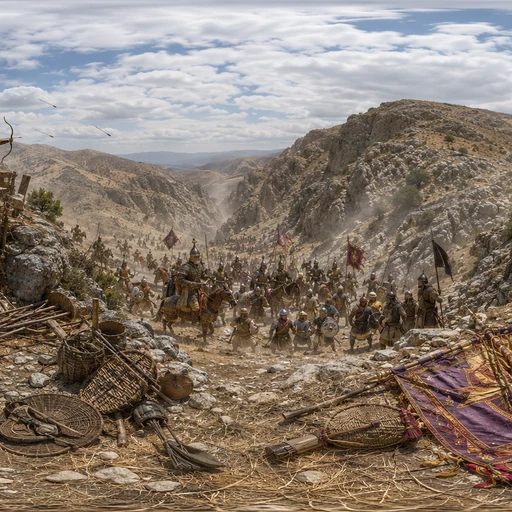
Between 129 and 132 AH (747-750 CE) a revolution that began in the far east of the Muslim world overthrew the Umayyad caliphate and brought the Abbasids to power. For three decades a clandestine movement (the da'wa) had spread through Khurasan, the great eastern province of mixed Arab settlers and Persian converts (mawali), calling for the caliphate to be given to a member of the family of the Prophet (ahl al-bayt) and channelling deep grievances against Umayyad rule: the social resentment of the mawali, the discontent of the Khurasani Arabs, and a widespread expectation of a deliverer. In 129 AH (747) the movement's organiser in Khurasan, Abu Muslim, raised the revolt openly near Merv and unfurled the black banners (al-rayat al-sud), a colour chosen in deliberate opposition to the white of the Umayyads, and bound up with the expectation of armies coming from the East. The rebels took Merv from the Umayyad governor Nasr ibn Sayyar, overran Khurasan, and then rolled westward across Iran. In 132 AH (750) the Abbasid army destroyed the last Umayyad caliph Marwan II at the Battle of the Great Zab, and Abu al-Abbas, called al-Saffah, was proclaimed the first Abbasid caliph at Kufa. The revolution shifted the centre of gravity of the Muslim world eastward, toward Iraq and Iran, and within a generation the Abbasids would found Baghdad. The Sunni historical tradition preserves the revolution above all in al-Tabari, with al-Baladhuri, al-Dinawari, and Ibn al-Athir; the movement's own perspective survives in the anonymous Akhbar al-Dawla al-Abbasiyya. (The hadith about black banners coming from Khurasan, which the movement invoked, are of contested authenticity and are best treated as an expectation that was exploited rather than as established prophecy.) This scene depicts the rising in the Khurasani homeland: the black banners raised over a gathering army on the oasis plain of Merv, the chains of qanat irrigation-shafts crossing the dry land, and the snow-capped ranges of the eastern Iranian world on the horizon, the moment the dynasty that would build Baghdad first took up arms, far to the east of the Damascus it was about to bring down.
What you see
Black banners are raised over the gathering, the rayat al-sud, a colour chosen in deliberate opposition to the white of the ruling house, and the emblem by which this revolution and the dynasty it would found became known.
A flat oasis plain of green cultivation against dry land, with snow-capped ranges of the eastern Iranian world standing far on the horizon, Khurasan, two thousand miles from Damascus, neither the Syrian steppe nor the Mediterranean shore.
Lines of low spaced mounds run across the dry ground, the access-shafts of qanats, the underground irrigation channels that water this land, a signature of the Iranian and Khurasani countryside rather than of Arabia or Syria.
An army is gathering rather than parading: a mixed force of Khurasani Arab settlers and Persian converts (mawali) drawn together by a movement's call, not the tribal levy of a single Arab clan, the social breadth that gave the rising its strength.
Behind the muster rise the mudbrick walls and oasis town of Merv, the great city of Khurasan and the base of the revolt, earthen fortification and round towers, the building idiom of Central Asia, not the dressed Roman stone of the west.
The movement's long-secret call is now in the open: the demand that the caliphate pass to the family of the Prophet (ahl al-bayt), carried on the expectation of deliverers coming from the East, a propaganda of grievance and hope, not a mere dynastic quarrel.
The roads out of the oasis run west, the axis along which the black banners would roll across Iran to the Zab and to Kufa over the next three years, carrying the centre of the Muslim world eastward toward Iraq.
Primary sources
al-Tabari, Tarikh al-Rusul wa-al-Muluk (early 10th c.): The principal Sunni narrative of the Abbasid revolution, the da'wa in Khurasan, Abu Muslim's rising, the fall of Merv, and the march west. The single richest source. Confidence high for the sequence.
al-Baladhuri, Ansab al-Ashraf (9th c.): Sunni genealogical-historical compilation. Used for the Abbasid family, the leadership of the movement, and the politics of the revolt. Confidence high.
Further reading & cross-references
al-Dinawari, al-Akhbar al-Tiwal (9th c.): Sunni historical narrative with strong coverage of the Iranian east. Used for the Khurasani setting and the course of the rising. Confidence medium-high.
Akhbar al-Dawla al-Abbasiyya (anonymous, early Abbasid): The movement's own account of its rise. Valuable for the self-understanding and propaganda of the da'wa, used as such rather than as a neutral record. Confidence medium.
Hadith of the black banners from Khurasan (contested authenticity): The reports of black banners coming from the East, which the movement invoked, are debated in the Sunni hadith tradition and widely judged weak or fabricated. Treated here as an apocalyptic expectation the movement exploited, not as established prophecy. Confidence low as prophecy; high that the movement used the motif.
Moshe Sharon, Black Banners from the East / Hugh Kennedy, The Early Abbasid Caliphate (modern): Modern non-confessional academic studies of the revolution. Used for the structure of the da'wa, the social composition of the movement, and the dating. Confidence high.
Questions & answers
- Where is The Black Banners of Khurasan?
- The oasis of Merv, Khurasan (modern Turkmenistan)
- When did it happen?
- Abbasid Revolution (129-132 AH / 747-750 CE)
- What is the story of The Black Banners of Khurasan?
- Between 129 and 132 AH (747-750 CE) a revolution that began in the far east of the Muslim world overthrew the Umayyad caliphate and brought the Abbasids to power. For three decades a clandestine movement (the da'wa) had spread through Khurasan, the great eastern province of mixed Arab settlers and…

The Paper-Makers of Samarqand
c. 143 AH / 760 CE

The Battle of Talas
Dhul Hijja 133 AH / July 751 CE
Nahavand, The Victory of Victories
c. 21 AH / 642 CE

Medical Learning at Jundishapur
c. 148 AH / 765 CE

The Conquest of Sindh at Daybul
92 AH / 711 CE

The Battle of the Camel
10 Jumada al-Akhira 36 AH / 7 December 656 CE
Guess places like this in GeoSiyer
Drop into a 360° scene from Islamic history and pin where, and when, it happened.
Play GeoSiyer