Harar, City of the Adal Sultanate
A market day at the gate of the walled Muslim city
957 AH / c. 1550 CE
 Educational historical reconstruction
Where
Harar, in the highlands of the Horn of Africa (modern eastern Ethiopia)
9.3111, 42.1278 · View on OpenStreetMap
Background
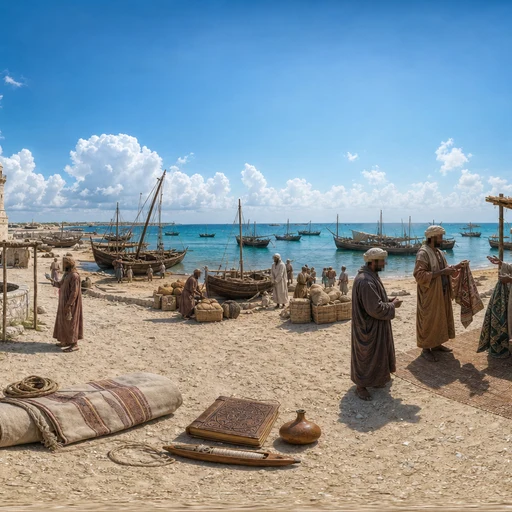
Harar is a compact walled city in the cool inland highlands of the eastern Horn of Africa, and by the mid-sixteenth century it was the capital and enduring heart of the Adal Sultanate, the Muslim power of the eastern Horn. Adal was first centred on the Red Sea port of Zeila, the old Muslim gateway of the Horn whose Islam reached back to the early hijra to Abyssinia and to the memory of the Negus for whom the Prophet (peace and blessings be upon him) prayed the absentee funeral prayer, recorded in Sahih al-Bukhari 1245 and Sahih Muslim 951. The Muslim kingdoms of this region are described by al-Maqrizi rahimahu Allah in his al-Ilmam bi-akhbar man bi-ard al-Habasha min muluk al-Islam. The sultanate moved its seat inland to Harar in about 1520 under Imam Ahmad ibn Ibrahim al-Ghazi rahimahu Allah, remembered in the Ethiopian sources as Gran, the left-handed, whose campaigns into the Christian highland kingdom of Ethiopia are chronicled in detail by Arab Faqih, Shihab al-Din Ahmad ibn Abd al-Qadir, in his Futuh al-Habasha. For a time those campaigns overran much of Christian Ethiopia, until the imam was defeated and killed in 1543 at Wayna Daga with the help of Portuguese gunmen sent to aid the Ethiopians. After his fall the sultanate contracted, and his successor by marriage, the Emir Nur ibn Mujahid rahimahu Allah, fortified Harar with the stout wall and gates, the Jugol, that still ring the old city, raised in the early 1550s against the Ethiopian and Oromo pressure of the day. Behind that wall Harar settled into its lasting character: a town famous for the extraordinary number of small mosques and saints' tombs packed among its lanes, counted a holy city of Islam in Africa and associated with the early shaykh Abadir, a centre of Sunni learning and of the caravan trade in cloth, coffee and the bar-salt called amole between the coast and the interior. This scene depicts not a battle but an ordinary peaceful market day at one of the city's gates around the mid-sixteenth century: the lime-washed mosque and its minaret, the gate in the rubble wall, the baskets of coffee and grain and the slabs of rock salt, the indigo cloth and the laden donkeys, and the whitewashed houses climbing the terraced highland slopes beyond. In keeping with the project's ethics any figures are anonymous and at a distance.
What you see
On the left stands a low whitewashed mosque with an arcaded porch where men sit on mats, beside a tall round minaret crowned by a balcony and a band of green; the plain, lime-washed prayer-house of a Muslim town, not a domed imperial mosque.
At the centre a wooden gate set in a rough wall of rubble stone, flanked by two round crenellated towers and reached by a short flight of steps; the city is girdled by a wall and entered only through such guarded gates.
At the gate market sit baskets of dark roasted-looking berries and grain and slabs of rose-pink rock salt; the berries are coffee, native to these hills, and the salt bars are amole, the bar-salt that served as money on the caravan routes of the Horn.
A length of indigo resist-dyed cloth hangs at a stall and laden donkeys wait by the thatch-roofed stands; this is a node on the caravan road that carried cloth, coffee and salt inland from the Red Sea port of Zeila and back to the coast.
Beyond the wall, whitewashed houses climb terraced green slopes under a high clear sky; the city sits in cool inland highlands, not on a hot coastal plain, on the Muslim frontier facing the Christian highland kingdom of Ethiopia.
A small whitewashed shrine with a twin-lobed tomb marker stands among the buildings; Harar is dense with the tombs of its saints and shaykhs, and is remembered as a holy city of Islam in the Horn, the city of the early shaykh Abadir.
This is Harar, capital of the Adal Sultanate, on an ordinary peaceful day; the great campaigns into Ethiopia under Imam Ahmad ibn Ibrahim al-Ghazi rahimahu Allah are over, and the sultanate has drawn back to live behind its new wall as a centre of trade and learning.
Primary sources
Sahih al-Bukhari 1245; Sahih Muslim 951 (the funeral prayer for the Negus): The Prophet (peace and blessings be upon him) prayed the absentee funeral prayer for the Negus of Abyssinia; the foundational hadith anchor for the deep Islamic memory of the Horn of Africa, not for Harar specifically.
Further reading & cross-references
Arab Faqih, Shihab al-Din Ahmad ibn Abd al-Qadir, Futuh al-Habasha (16th c.): The Arabic chronicle of the campaigns of Imam Ahmad ibn Ibrahim and the Adal Sultanate; the principal Muslim source for the wars, the realm and the move of the seat to Harar.
al-Maqrizi, al-Ilmam bi-akhbar man bi-ard al-Habasha min muluk al-Islam (early 15th c.): The Sunni Egyptian historian al-Maqrizi rahimahu Allah on the Muslim kingdoms of the Abyssinian region. Supports Adal and its predecessors as Muslim realms of the Horn; predates the Harar capital.
The Shaykh Abadir tradition (Fath Madinat Harar) and the saints of Harar: The local Harari tradition of the city's foundation and of its early shaykh Abadir Umar al-Rida; supports Harar's standing as a city of saints and shaykhs. Traditional local material.
Ethiopian royal chronicles and Portuguese accounts of the war (cross-reference): Used for the Christian Ethiopian side, the death of Imam Ahmad at Wayna Daga in 1543, and the Portuguese intervention. Non-Muslim cross-reference for the conflict.
Academic histories of Harar and the amole salt currency (non-confessional): Used for the dating of the Jugol wall under Emir Nur ibn Mujahid in the early 1550s, the coffee and caravan trade, and the bar-salt amole used as money in the Horn. Non-confessional cross-reference for material detail only.
The standing walled city of Harar Jugol (extant, material): The historic wall, the gates, the lanes, the lime-washed houses, the small mosques and the saints' tombs of Harar constrain the depiction of the city; the surviving fabric is the material witness.
Questions & answers
- Where is Harar, City of the Adal Sultanate?
- Harar, in the highlands of the Horn of Africa (modern eastern Ethiopia)
- When did it happen?
- 957 AH / c. 1550 CE
- What is the story of Harar, City of the Adal Sultanate?
- Harar is a compact walled city in the cool inland highlands of the eastern Horn of Africa, and by the mid-sixteenth century it was the capital and enduring heart of the Adal Sultanate, the Muslim power of the eastern Horn. Adal was first centred on the Red Sea port of Zeila, the old Muslim gateway…
Related places


Guess places like this in GeoSiyer
Drop into a 360° scene from Islamic history and pin where, and when, it happened.
Play GeoSiyer