The Founding of al-Qarawiyyin
Fatima al-Fihriyya's waqf mosque at Fes, 245 AH
245 AH / 859 CE
 Educational historical reconstruction
Where
Fes, capital of the Idrisid dynasty in al-Maghrib al-Aqsa
34.0648, -4.9734 · View on OpenStreetMap
Background
The mosque of al-Qarawiyyin in Fes, Jami' al-Qarawiyyin, was founded in 245 AH (859 CE) by Sayyida Fatima bint Muhammad al-Fihriyya (rahimaha Allah), a woman of Qayrawani descent who had inherited a substantial merchant fortune from her father and dedicated it in its entirety as waqf to raise a congregational mosque for the Adwat al-Qarawiyyin quarter of Fes, the quarter settled by emigrants from Qayrawan in Ifriqiya at the end of the 2nd century AH. In the same year her sister Maryam al-Fihriyya (rahimaha Allah) founded the mosque of al-Andalusiyyin for the quarter of the Andalusian emigrants on the opposite bank of the river. Fes itself had been founded by Idris II in the early 3rd century AH on the banks of the Wadi Fes in the foothills of the Middle Atlas, and laid out as two principal quarters of immigrant settlement, the Qayrawanis on the east bank and the Andalusians on the west. The Sunni Maghribi historical tradition (Ibn Abi Zar' al-Fasi's al-Anis al-Mutrib bi-Rawd al-Qirtas, al-Jaznai's Zahrat al-As fi Bina' Madinat Fas, with Ibn al-Athir and Ibn Khaldun for the wider context) records that Fatima al-Fihriyya (rahimaha Allah) remained in i'tikaf, spiritual retreat, fasting and praying for the qabul, the acceptance, of the work throughout the period of construction. The mosque was a place of teaching from the day of its foundation: students of the Maliki madhhab, the standard Sunni school of the Maghrib, and in time of the religious and the rational sciences, read with the shaykhs in the riwaqs of the mosque. Over the following centuries it became the principal centre of Sunni Maliki learning in the Maghrib, drawing students from across the Islamic world; among those associated with it in the tradition are Ibn Khaldun (rahimahu Allah), who studied there, and many of the great Maliki and Sufi scholars of the Maghrib. al-Qarawiyyin has been in continuous use as a mosque and a place of teaching from 245 AH to the present day, well over a thousand years, and is widely recognised as the oldest continuously operating institution of higher learning in the world. The fabric standing today is overwhelmingly later than the founding: the square stone minaret in its present form belongs to the mid-4th century AH (956 CE), the prayer hall was greatly enlarged and reworked under the Almoravid sultan 'Ali ibn Yusuf around 528 AH (1134 CE), and the green-tiled roofs, the carved-stucco and muqarnas ornament, the sahn pavilions, and the zellij all belong to the Almoravid, Marinid, Sa'di, and 'Alawi periods; only part of the original Idrisid plan survives within that later shell. This scene depicts the founding state of 245 AH while the mosque is still under construction: the column bases laid out across the sahn, masons dressing stone, a craftsmen's workshop preparing the minbar and the woodwork, and the well-head and the first arcades on the east bank of the Wadi Fes in the Adwat al-Qarawiyyin quarter.
What you see
A walled courtyard open to a bright dry sky, with bare hills rising close behind the rooftops, the green-gold scrub of the Middle Atlas foothills in late summer. This is no coastal or desert site but a river valley in the far west of the Maghrib, where Fes grew up on the banks of its small swift river half a century before.
A long white-plastered arcade of horseshoe arches frames the far side of the court, with a small square stone minaret rising beyond it. The plan is the standard early Maghribi-Andalusian congregational mosque: a wide lateral prayer hall of parallel aisles set against the qibla wall, opening onto an arcaded sahn. The work is sober and geometric, the austere idiom of the Idrisid Maghrib, with no glazed tile, no carved muqarnas, and no painted woodwork yet.
Across the open court the bases of the prayer-hall columns have been set out in a measured grid, low stub-walls and pier footings marking the aisles before the shafts and arches go up. Scaffolding of lashed timber stands at the corner, and cut blocks, beams, and lime are stacked across the ground. The mosque is mid-construction, not yet roofed over its plan.
In the foreground masons squat over dressed stone, working blocks square with mallet and point before they are carried to the rising walls. A round stone well-head stands at the centre of the yard, the water source for the lime mortar and for the ablutions of the finished mosque to come.
Under a timber-roofed portico to one side a workshop of craftsmen sits at low benches, shaping the carved wooden panels and fittings for the minbar and the mihrab screen, while an anonymous household patronage group reviews the plan table. The mosque is the endowment of Sayyida Fatima bint Muhammad al-Fihriyya (rahimaha Allah), a woman of Qayrawani descent who inherited a merchant fortune and gave it whole as waqf to raise a congregational mosque for her quarter.
This is the east bank of the Wadi Fes, the quarter called Adwat al-Qarawiyyin, the bank of the Qayrawanis, settled two generations earlier by emigrants from Qayrawan in Ifriqiya. In the same year, across the river, the patron's sister Maryam al-Fihriyya (rahimaha Allah) is raising the parallel mosque of al-Andalusiyyin for the quarter of the Andalusian emigrants.
From its first day the mosque is meant as a place of teaching as well as prayer, and within a century it will be among the great teaching mosques of the Sunni Maliki Maghrib. Kept in continuous use from 245 AH to the present, al-Qarawiyyin is reckoned among the oldest continuously operating institutions of learning in the world.
The founding is preserved in the Sunni Maghribi tradition: Ibn Abi Zar' al-Fasi's al-Anis al-Mutrib bi-Rawd al-Qirtas and al-Jaznai's Zahrat al-As fi Bina' Madinat Fas, with Ibn al-Athir and Ibn Khaldun for the wider Idrisid context. The date 245 AH is firm, and Fatima al-Fihriyya (rahimaha Allah) is named as the patron in every account.
Primary sources
Ibn al-Athir, al-Kamil fi al-Tarikh (early 13th c.): Sunni historical synthesis. Cross-reference for the dating and the wider Idrisid Maghribi context.
Further reading & cross-references
al-Qarawiyyin mosque-madrasa at Fes (extant, in continuous use): The mosque is in continuous use from 245 AH to the present day. Only part of the original Idrisid plan survives within the later Almoravid, Marinid, Sa'di, and 'Alawi extensions and restorations. The most authoritative material witness, with the scene reconstructive on the 245 AH founding state stripped of all later fabric.
Ibn Abi Zar' al-Fasi, al-Anis al-Mutrib bi-Rawd al-Qirtas (early 14th c.): The standard Sunni Maghribi topographical and dynastic history of Fes. Preserves the foundation narrative: the patron Fatima al-Fihriyya (rahimaha Allah), the date 245 AH, her i'tikaf during the construction, and the parallel founding by her sister Maryam (rahimaha Allah).
al-Jaznai (Abu al-Hasan 'Ali ibn 'Abd Allah), Zahrat al-As fi Bina' Madinat Fas (mid-14th c.): Sunni Maghribi topographical work specifically on Fes. The most concentrated source on the foundation of al-Qarawiyyin and the early history of the mosque and city.
Ibn Khaldun, al-Muqaddima and Tarikh (late 14th c.): Major Sunni Maliki historian (rahimahu Allah), who himself studied at al-Qarawiyyin. Treats the institution within the broader pattern of Maghribi religious institutions.
Ahmad ibn al-Qadi, Jadhwat al-Iqtibas (late 16th c.): Sunni Maghribi biographical compendium on the scholars of Fes. Used as a cross-reference on the scholarly tradition of the mosque.
K.A.C. Creswell and Henri Terrasse, La Mosquee d'al-Qaraouiyyin a Fes (Paris, 1968): Standard architectural study of the mosque, dating the standing fabric and separating the Idrisid founding plan from the Umayyad-period minaret and the later Almoravid, Marinid, Sa'di, and 'Alawi work. Non-confessional architectural reference for reconstructing the 245 AH founding state. Bloom is folded into this note for minaret chronology and the warning that the visible green-tiled upper stage is later than the 245 AH founding.
Questions & answers
- Where is The Founding of al-Qarawiyyin?
- Fes, capital of the Idrisid dynasty in al-Maghrib al-Aqsa
- When did it happen?
- 245 AH / 859 CE
- What is the story of The Founding of al-Qarawiyyin?
- The mosque of al-Qarawiyyin in Fes, Jami' al-Qarawiyyin, was founded in 245 AH (859 CE) by Sayyida Fatima bint Muhammad al-Fihriyya (rahimaha Allah), a woman of Qayrawani descent who had inherited a substantial merchant fortune from her father and dedicated it in its entirety as waqf to raise a…
Related places
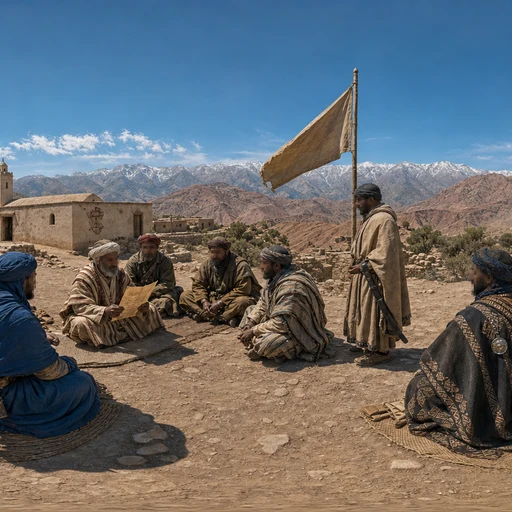
The Great Berber Revolt
Berber Revolt (122-124 AH / 740-742 CE)

Tariq Crosses to al-Andalus
92 AH / 711 CE

The Founding of the Emirate of Cordoba
138 AH / 756 CE

The Great Mosque of Cordoba Begun
170 AH / 785 CE

Madinat al-Zahra
begun 324 AH / c. 936 CE

The Battle of Balat al-Shuhada'
Ramadan 114 AH / October 732 CE
Guess places like this in GeoSiyer
Drop into a 360° scene from Islamic history and pin where, and when, it happened.
Play GeoSiyer