Aligarh: the Modernist Response
Sir Sayyid's Anglo-Oriental College in colonial India, 1875
1292 AH / 1875 CE
 Educational historical reconstruction
Where
Aligarh, northern India
27.9135, 78.0780 · View on OpenStreetMap
Background
In 1875 (1292 AH) Sir Sayyid Ahmad Khan (rahimahu Allah) founded the Muhammadan Anglo-Oriental College at Aligarh in northern India, the institution that gave its name to the Aligarh movement and the most influential expression of the Muslim modernist response to colonial rule. Where the scholars of Deoband had answered the loss of Muslim power by withdrawing into a self-funded network of traditional madrasas, Sir Sayyid concluded that the Muslims of India could only recover their standing by mastering the modern English education and the natural sciences that underpinned British power, and he set out to provide it in a form that kept faith and community at the centre. Modelled openly on the English colleges of Oxford and Cambridge, the Aligarh college taught mathematics, the sciences and English alongside Islamic studies, kept a mosque and a strongly Muslim communal life within its walls, and aimed to form a modern-educated leadership for the community. It grew into Aligarh Muslim University in 1920 and shaped Indian Muslim politics for generations, including the movement that would lead to Pakistan. Sir Sayyid was a controversial figure: his rationalist approach to the interpretation of the Qur'an and his political accommodation with the British were sharply criticised by many traditional ulama, and the Aligarh and Deoband responses are often set against each other as the two faces of the Muslim encounter with colonial modernity, the one engaging it, the other guarding against it. This scene depicts the new college around its founding, the European-style quadrangle, the science laboratory and the library, with the mosque and the Muslim students that gave it its character.
What you see
A college of brick ranges set around a wide quadrangle on the north Indian plain, built in a European collegiate manner with arcaded cloisters, a clock tower and a hall. This is a modern educational campus, not a traditional courtyard madrasa.
A science laboratory with benches, glassware and instruments, and a large reading library of printed books in English, Urdu, Persian and Arabic, show modern Western sciences taught alongside the religious curriculum.
Students in a mix of Western and Indian Muslim dress, sherwani coats and caps, move between lecture rooms, library and a mosque within the grounds. Modern learning and Muslim communal life are deliberately combined.
Timetables, examination papers in English and a portrait gallery of patrons mark an institution modelled on the English college, adapted for a Muslim community under colonial rule.
A Muslim college teaching modern science in English while keeping a mosque, Islamic studies and a strong communal ethos at its heart embodies a strategy of engaging colonial modernity rather than withdrawing from it, the counterpart to the revivalist madrasa.
Further reading & cross-references
Sir Sayyid Ahmad Khan, his speeches, the journal Tahdhib al-Akhlaq, and the college's records (later 19th c.): The founder's own writings on education and reform and the early college records; the aims and the curriculum of Aligarh, from within the movement. Confidence high for the programme, with the note that it was contested.
David Lelyveld, Aligarh's First Generation: Muslim Solidarity in British India (Princeton, 1978): The standard modern academic study of the Aligarh college and movement. Used for the founding, the model, and the communal ethos. Confidence high.
Christian W. Troll, Sayyid Ahmad Khan: A Reinterpretation of Muslim Theology (1978): Used for Sir Sayyid's modernist theology and the controversy it drew from traditional ulama. Confidence high.
The standing Aligarh Muslim University (extant): The college, now a university, survives; reviewers should depict the late-19th-century college and its early buildings, not the expanded modern campus.
Questions & answers
- Where is Aligarh: the Modernist Response?
- Aligarh, northern India
- When did it happen?
- 1292 AH / 1875 CE
- What is the story of Aligarh: the Modernist Response?
- In 1875 (1292 AH) Sir Sayyid Ahmad Khan (rahimahu Allah) founded the Muhammadan Anglo-Oriental College at Aligarh in northern India, the institution that gave its name to the Aligarh movement and the most influential expression of the Muslim modernist response to colonial rule. Where the scholars…
Related places

The Beginnings of the Tablighi Jamaat
1345 AH / c. 1926 CE
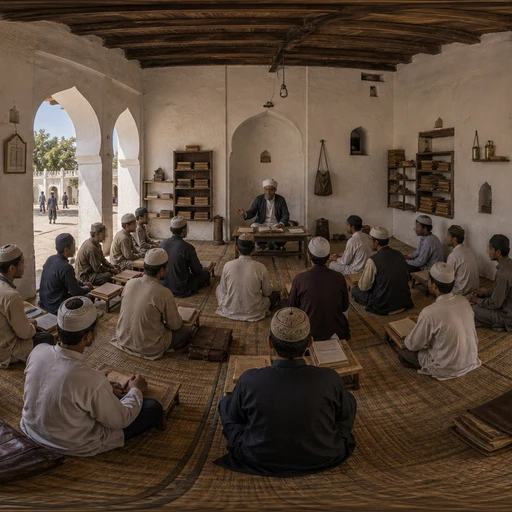
Deoband Style Classroom
c. 1900 CE

The Fall of Delhi and the End of the Mughals
1274-1275 AH / 1857-1858 CE
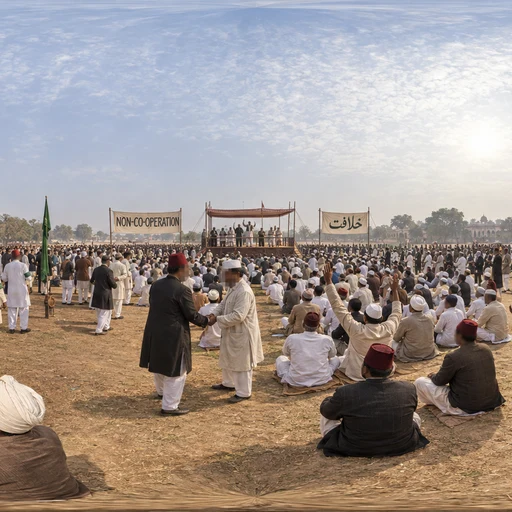
The Khilafat Movement
c. 1338 AH / 1920 CE

The Founding of Dar al-Ulum Deoband
1283 AH / 1866 CE
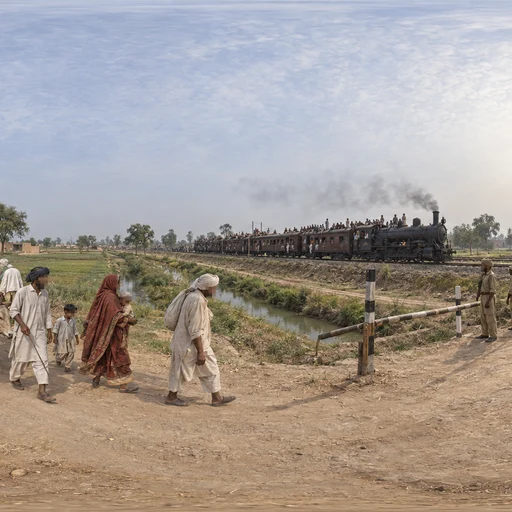
Partition and the Birth of Pakistan
1366 AH / 1947 CE
Guess places like this in GeoSiyer
Drop into a 360° scene from Islamic history and pin where, and when, it happened.
Play GeoSiyer