The Arab-Norman Art of Palermo
Muslim craft at a Christian court, c. 1140 CE
524-590 AH / c. 1130-1194 CE
 Educational historical reconstruction
Where
Palermo, in Sicily
38.1115, 13.3590 · View on OpenStreetMap
Background
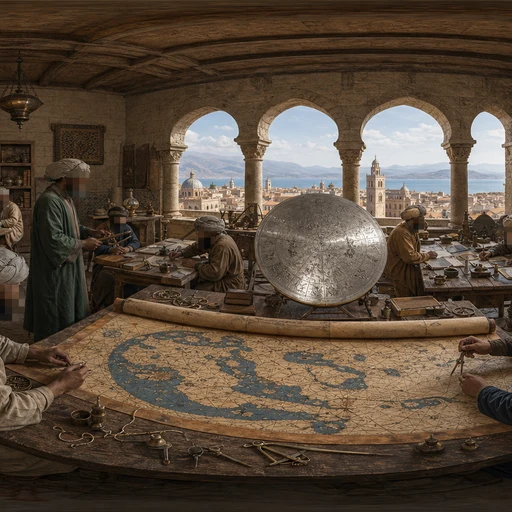
Sicily had been for over two centuries a land of Islam, ruled by Muslim emirs and filled with a Muslim, Arabic-speaking population and a flourishing Islamic culture, before it was conquered in the eleventh century by the Normans, the adventurer-knights from the north who made it a kingdom. The remarkable thing is what the Norman kings did with their inheritance. Instead of effacing the Islamic civilisation they had conquered, the kings of Sicily, above all Roger II and his successors in the twelfth century, embraced and patronised it: they kept Arabic as one of the languages of their court, their chancery and their coinage, employed Muslim officials, scholars (among them the geographer al-Idrisi), physicians and artists, lived in part in the luxurious manner of the Muslim East, and set the Arab craftsmen of the island to work for them. The result was the unique art known as Arab-Norman, in which Islamic, Byzantine Greek and Latin Western elements were fused as nowhere else. Its masterpieces survive in and around Palermo: above all the royal chapel, the Cappella Palatina, whose walls glitter with golden Byzantine mosaics but whose ceiling is a true Islamic muqarnas vault of carved and painted wood, hung with little scenes of courtly life; and the pleasure-palaces such as the Zisa, cool pavilions set amid gardens of citrus and running water in the manner of the palaces of the East. In these works the high craft of Muslim Sicily lived on, in the service of Christian kings, in one of the most striking meetings of civilisations in the medieval world. This scene depicts the Arab-Norman art of Palermo; in keeping with the project's ethics the historic figural mosaics are shown as the artistic record and any figure is anonymous and at a distance.
What you see
A royal hall whose ceiling is an astonishing honeycomb of carved and painted wood, true Islamic muqarnas vaulting hung with little painted scenes, set above walls sheathed in glittering gold mosaic; an Arab ceiling over a Greek-mosaicked hall, in a Latin king's chapel.
Elsewhere a cool pleasure-pavilion is set amid gardens of citrus and palm, with a fountain whose water runs in a carved channel through the hall, in the manner of the palaces of the Muslim East; an Arab garden-palace built for a Christian king.
This is the Arab-Norman art of Palermo, where, under the Norman kings who had taken Sicily from its Muslim rulers, Arab craftsmen, Byzantine mosaicists and Latin masters worked side by side to create a unique fusion of three civilisations, with Islamic art at its heart.
The kings kept Arabic as a language of their court and coinage, employed Muslim officials, scholars and artists, and dressed and lived in part in the manner of the East; in their workshops the high craft of Islamic Sicily lived on under new masters.
The island lies at the centre of the middle sea, lately a land of Muslim emirs and still full of Muslim people and Arabic culture, now ruled from this city by Norman kings.
The Arab-Norman monuments of Palermo are extant and celebrated. The scene depicts their architecture and ornament; no human figure of the historic mosaics is foregrounded as a devotional image.
Further reading & cross-references
The Arab-Norman monuments of Palermo (extant: the Cappella Palatina, the Zisa, and others): The primary monuments. Used for the muqarnas ceiling, the mosaics and the garden-palaces. Confidence high.
Histories of Norman Sicily and its Arab-Norman culture: Used for the Norman kings, their patronage of Arabic culture and the fusion of civilisations. Confidence high.
Studies of Islamic art in Sicily and the Arab-Norman style: Used for the role of Muslim craftsmen and the character of the art. Confidence high.
Medieval Palermo (material/geographic context): The city and the island setting constrain the depiction.
Questions & answers
- Where is The Arab-Norman Art of Palermo?
- Palermo, in Sicily
- When did it happen?
- 524-590 AH / c. 1130-1194 CE
- What is the story of The Arab-Norman Art of Palermo?
- Sicily had been for over two centuries a land of Islam, ruled by Muslim emirs and filled with a Muslim, Arabic-speaking population and a flourishing Islamic culture, before it was conquered in the eleventh century by the Normans, the adventurer-knights from the north who made it a kingdom. The…
Al-Idrisi's Map of the World
549 AH / 1154 CE

The Zaytuna of Tunis
628 AH / c. 1230 CE

The Aghlabid Basins of Kairouan
246 AH / c. 860 CE

The Great Mosque of Kairouan Renewed
Aghlabid renewal (221-248 AH / 836-862 CE)

The Expulsion of the Moriscos
1018-1023 AH / 1609-1614 CE

Ibn Battuta in Constantinople
733 AH / c. 1332 CE
Guess places like this in GeoSiyer
Drop into a 360° scene from Islamic history and pin where, and when, it happened.
Play GeoSiyer