The Banu Musa and the Ingenious Devices
The mechanical arts at Abbasid Baghdad, c. 850 CE
c. 236 AH / 850 CE
 Educational historical reconstruction
Where
Baghdad, the Abbasid capital on the Tigris
33.3152, 44.3661 · View on OpenStreetMap
Background
The three brothers known as the Banu Musa, the sons of Musa ibn Shakir, Muhammad, Ahmad and al-Hasan, were among the leading scholars and patrons of learning at the court of the Abbasid caliphs in ninth-century Baghdad, in the great age of science centred on the translation movement and the House of Wisdom. They worked in mathematics, astronomy and geometry and supported the gathering and translation of the books of the ancients; but they are best remembered for their Book of Ingenious Devices (Kitab al-Hiyal), in which they described some hundred machines and contrivances of remarkable subtlety. Most were vessels and fountains that poured, mixed or changed their flow seemingly of their own accord, lamps that trimmed their own wicks and replenished their own oil, and other automata, worked by valves, floats, siphons and other mechanisms hidden within them; among them are some of the earliest known devices of automatic control, in which a machine responds and adjusts itself without a hand to guide it. The work is a landmark in the history of mechanical engineering, in the tradition of the hiyal, the ingenious arts, that the Muslim world prized and that al-Jazari would carry further centuries later. This scene depicts a workshop of such devices in the brick city on the Tigris: the curious vessels and self-acting lamps, the hidden mechanisms, and the illustrated treatise that explains them. In keeping with the project's ethics any figures are anonymous and at a distance.
What you see
A workshop of curious vessels and machines: jars and fountains that pour, mix or change their flow as if by themselves, lamps that trim their own wicks and feed their own oil, and valves, floats and siphons hidden within them.
On the benches lie a treatise full of careful drawings explaining how each device is made and works, the apparatus of fine mechanics, automatic controls operating without a hand to guide them.
This is the world of the Banu Musa, three brothers, sons of Musa ibn Shakir, scholars and patrons at the court of the Abbasid caliphs, whose Book of Ingenious Devices described some hundred machines and is a landmark of the mechanical arts and of automatic control.
The setting is a house of learning in the great brick city on the Tigris, where the same circle of scholars gathered the books of the ancients, advanced mathematics and astronomy, and built and described machines.
The city is Baghdad in the ninth century, the capital of the Abbasid caliphate and the centre of the learning of the age.
The Banu Musa and their Book of Ingenious Devices (Kitab al-Hiyal) are recorded by the bibliographers and survive in the work itself. The scene depicts the workshop and the devices, with no individual shown by likeness.
Further reading & cross-references
The Banu Musa, Kitab al-Hiyal (Book of Ingenious Devices, 9th c.): The treatise itself, with its descriptions of the machines; the primary source.
Ibn al-Nadim, al-Fihrist, and the bibliographers on the Banu Musa: Used for the brothers, their place at the Abbasid court and their works in mathematics and mechanics.
Studies of medieval Islamic mechanical engineering and automatic control: Used for the significance of the devices and the hiyal tradition.
The setting of Abbasid Baghdad (material context): The brick city and the houses of learning constrain the depiction; the specific workshop is representative.
Questions & answers
- Where is The Banu Musa and the Ingenious Devices?
- Baghdad, the Abbasid capital on the Tigris
- When did it happen?
- c. 236 AH / 850 CE
- What is the story of The Banu Musa and the Ingenious Devices?
- The three brothers known as the Banu Musa, the sons of Musa ibn Shakir, Muhammad, Ahmad and al-Hasan, were among the leading scholars and patrons of learning at the court of the Abbasid caliphs in ninth-century Baghdad, in the great age of science centred on the translation movement and the House…
Related places

The House of Wisdom
c. 215 AH / 830 CE

The Mustansiriyya Madrasa
631 AH / 1234 CE

Tigris Shore After the Sack of Baghdad
656 AH / 1258 CE

The Mihna and the Stand of Imam Ahmad
The Mihna (218-234 AH / 833-848 CE)
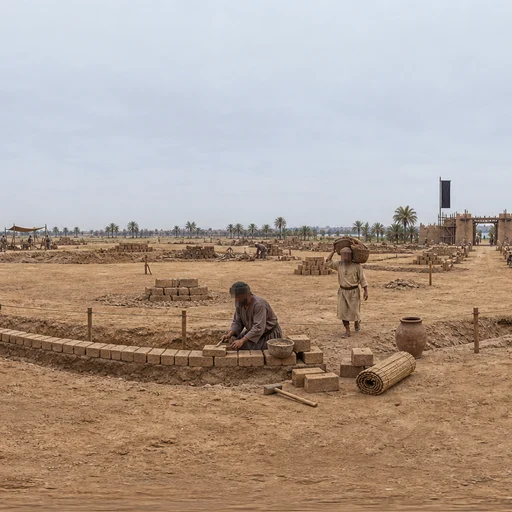
The Founding of the Round City of Baghdad
145 AH / 762 CE

The Fall of Ctesiphon
16-21 AH / 637-642 CE
Guess places like this in GeoSiyer
Drop into a 360° scene from Islamic history and pin where, and when, it happened.
Play GeoSiyer