The Battle of the Camel
The tragic first fitna among the Companions, outside Basra in 36 AH
10 Jumada al-Akhira 36 AH / 7 December 656 CE
 Educational historical reconstruction
Where
Plain of Khurayba outside Basra, southern Iraq
30.5667, 47.8167 · View on OpenStreetMap
Background
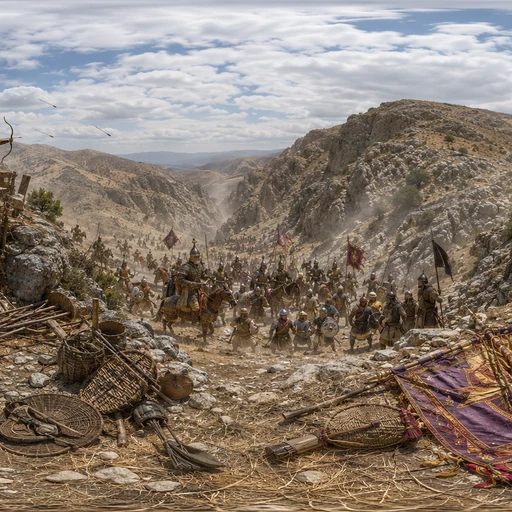
On the 10th of Jumada al-Akhira in the thirty-sixth year after the Hijrah, corresponding to 7 December 656 CE, the Battle of the Camel (Yawm al-Jamal) was fought on the plain of Khurayba outside the garrison city of Basra in southern Iraq. The engagement followed the assassination of the third caliph, 'Uthman ibn 'Affan (radiyallahu 'anhu), in Dhul Hijjah 35 AH and the subsequent recognition of 'Ali ibn Abi Talib (radiyallahu 'anhu) as the fourth caliph of the Khulafa' al-Rashidun. A party of Companions, Umm al-Mu'minin 'A'isha (radiyallahu 'anha), Talha ibn 'Ubayd Allah (radiyallahu 'anhu), and al-Zubayr ibn al-'Awwam (radiyallahu 'anhu), held the position that the prosecution of 'Uthman's (RA) killers must precede formal allegiance to the new caliph; 'Ali (RA) held that order had to be restored first, in stages. The two parties met outside Basra. The Sunni historical record (al-Tabari, Ibn Kathir, Ibn al-Athir, al-Dhahabi, al-Baladhuri) records extensive negotiations attempted by both sides to avert the engagement. The fighting, when it broke out, is recorded as having begun without the sanction of the principals on either side: the sources name a contingent of the qatalat 'Uthman (the killers of 'Uthman) embedded in 'Ali's (RA) army who feared their imminent prosecution and provoked combat at first light. The engagement was named for the camel of 'A'isha (RA), around which her supporters rallied; the camel was eventually felled to end the battle. Talha (RA) and al-Zubayr (RA), both of the Ten Promised Paradise, were killed on the day, the former by a stray arrow attributed by some sources to Marwan ibn al-Hakam from within their own ranks, the latter by Ibn Jurmuz after he had withdrawn from the field. 'A'isha (RA) was treated with the highest honour by 'Ali (RA), her howdah carried with respect from the field, and escorted with a guard of women in male disguise back to Madinah, where she remained until her death twenty-two years later. The Sunni position on the engagement, summarised by Imam al-Tahawi (d. 321 AH) in his standard creed al-'Aqida al-Tahawiyya, is kaff, restraint: 'we do not delve into what happened between them, and we hold our tongues from speaking ill of any of them, while loving them all.' All four named principals are revered as among the most beloved of the Prophet's (peace and blessings be upon him) Companions. This scene depicts the aftermath of the engagement, with the two camps still in position, the camel of 'A'isha (RA) at the centre of one, the white banner of the Caliph on the other, and the cloak-covered bodies of Talha (RA) and al-Zubayr (RA) in no man's land between them.
What you see
A flat alluvial plain at the head of the Persian Gulf, broad reed-marsh in the middle distance, a green river thread (the Tigris-Euphrates confluence into the Shatt al-Arab) visible to the east, and the early outlines of the garrison city of Basra (founded only twenty-two years earlier) to the south.
Two large encampments face one another across the plain. Both armies are Arab, both are Muslim, both carry the same plain banners, there are no Byzantine, no Sasanian, no foreign signs. The Sirah and the Sunni historical sources record this as a fitna among brothers, the first major internal conflict of the Ummah.
At the centre of one camp stands a large red-and-yellow camel bearing a covered howdah of curtained leather, the riding camel of 'A'isha (radiyallahu 'anha), mother of the believers, in whose presence the supporters of immediate retribution for the killing of 'Uthman ibn 'Affan (RA) had assembled. The camel is the visual focal point that would give the engagement its name in Sunni historical memory.
Across the plain, the opposing camp displays the white banner of the Caliph 'Ali ibn Abi Talib (radiyallahu 'anhu), the rightful fourth caliph of the Khulafa' al-Rashidun, who had advanced from Kufa to address the assembled force. The Sunni historical sources record the long negotiations attempted by both sides to avert the engagement.
Between the camps, in no man's land, the bodies of Talha ibn 'Ubayd Allah (radiyallahu 'anhu) and al-Zubayr ibn al-'Awwam (radiyallahu 'anhu), two of the Ten Promised Paradise (al-'ashara al-mubashshara bi'l-janna), lie covered with their cloaks. The scene depicts the engagement not as a battle scene but as the aftermath of a tragic event, both men named in the Sunni hadith corpus as among the most beloved of the Prophet's (peace and blessings be upon him) Companions, both killed in the same day.
Sunni tradition treats this engagement with kaff, restraint. All four named principals, 'A'isha (RA), 'Ali (RA), Talha (RA), and al-Zubayr (RA), are revered Companions, and the Sunni position is that all were doing ijtihad and the bloodshed was a calamity. The scene must read as grave, not partisan: neither side is glorified, neither is condemned.
The light is the soft late-autumn light of southern Iraq. The day in the Arabic calendar is the 10th of Jumada al-Akhira in the thirty-sixth year after the Hijrah, corresponding to early December 656 CE, five months after the assassination of 'Uthman (RA) and the commencement of 'Ali's (RA) caliphate.
The Sunni historical record of the engagement is preserved in the canonical histories (al-Tabari, Ibn Kathir's al-Bidaya wa al-Nihaya, Ibn al-Athir, al-Dhahabi). Imam al-Tahawi's al-'Aqida al-Tahawiyya, the standard Sunni creed, frames the position: we do not delve into what happened between the Companions, and we hold our tongues from speaking ill of any of them, while loving them all.
Primary sources
al-Tabari, Tarikh al-Rusul wa-al-Muluk (early 10th c.): The principal early Sunni historical narrative of the Battle of the Camel. Preserves the long sequence of negotiations, the named participants, the named beginning of the fighting by the qatalat 'Uthman contingent, and the careful treatment of 'A'isha (RA) by 'Ali (RA) at the end of the day.
Ibn Kathir, al-Bidaya wa al-Nihaya (14th c.): Standard major Sunni history. Synthesises the earlier sources with the Sunni position of kaff: presenting the historical record while explicitly noting that all parties are revered Companions and the bloodshed was a calamity.
Ibn al-Athir, al-Kamil fi al-Tarikh (early 13th c.): Sunni historical synthesis. Used for the broader chronology and the political consequences in the year following.
al-Dhahabi, Tarikh al-Islam and Siyar A'lam al-Nubala' (14th c.): Major Sunni historian and hadith critic. His biographical entries on 'A'isha (RA), 'Ali (RA), Talha (RA), and al-Zubayr (RA) preserve the events with careful isnad evaluation and the unambiguous reverence of all four as among the most revered of the Companions.
al-Baladhuri, Ansab al-Ashraf: Early Sunni historical-genealogical work. Confirms the broad sequence and provides additional named participants.
Imam Abu Ja'far al-Tahawi, al-'Aqida al-Tahawiyya (early 10th c.): The standard Sunni creed, framing the position on the disputes among the Companions: 'we do not delve into what happened between them, and we hold our tongues from speaking ill of any of them.' Direct theological framing of how the scene's content is to be read.
Further reading & cross-references
Ibn Taymiyya, Minhaj al-Sunna al-Nabawiyya: Major Sunni theological work treating the early caliphate and the disputes among the Companions, including the Battle of the Camel. Used as a reference for the rigorous Sunni framing of the event.
Questions & answers
- Where is The Battle of the Camel?
- Plain of Khurayba outside Basra, southern Iraq
- When did it happen?
- 10 Jumada al-Akhira 36 AH / 7 December 656 CE
- What is the story of The Battle of the Camel?
- On the 10th of Jumada al-Akhira in the thirty-sixth year after the Hijrah, corresponding to 7 December 656 CE, the Battle of the Camel (Yawm al-Jamal) was fought on the plain of Khurayba outside the garrison city of Basra in southern Iraq. The engagement followed the assassination of the third…
Related places



Guess places like this in GeoSiyer
Drop into a 360° scene from Islamic history and pin where, and when, it happened.
Play GeoSiyer