The Battle of Talas
The Abbasid army on the upper Talas river, Dhul Hijja 133 AH
Dhul Hijja 133 AH / July 751 CE
 Educational historical reconstruction
Where
Upper Talas river valley, on the western marches of Transoxiana (modern Kazakhstan-Kyrgyzstan border)
42.5167, 72.2333 · View on OpenStreetMap
Background
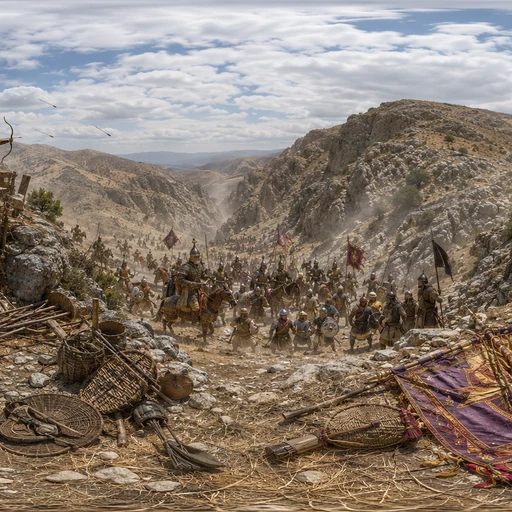
In Dhul Hijja 133 AH (July 751 CE), the army of the Abbasid caliphate under Ziyad ibn Salih al-Khuza'i (rahimahu Allah), governor of Samarqand under Abu Muslim al-Khurasani (the governor of Khurasan and the architect of the Abbasid revolution), met the expeditionary army of the Tang dynasty under General Gao Xianzhi on the upper Talas river in the highlands between the modern Kazakhstan-Kyrgyzstan border. The engagement was the climax of a generation of competition between the expanding Muslim presence in Transoxiana and the Tang westward expansion under the Anxi Protectorate in the Tarim basin. The Tang army included an allied contingent of Karluk Turks; on the fifth day of contact the Karluks defected to the Muslim side, the Tang line collapsed, and Gao Xianzhi withdrew with the remnant. The day marked the limit of Tang expansion into Central Asia and the consolidation of Muslim rule across Transoxiana and the eastern Iranian world. In the Sunni historical tradition the day is preserved as the establishment of Islam as the religion of the soil from which, within a generation, would come the great Sunni hadith scholars of the eastern Islamic world: Imam Muhammad ibn Isma'il al-Bukhari (rahimahu Allah) from Bukhara, Imam Muslim ibn al-Hajjaj (rahimahu Allah) from Nishapur, Imam Abu 'Isa al-Tirmidhi (rahimahu Allah) from Tirmidh on the Oxus, Imam al-Nasa'i (rahimahu Allah) from Nasa in Khurasan, Imam Ibn Majah (rahimahu Allah) from Qazwin, five of the six compilers of the Kutub al-Sittah, the foundational Sunni hadith collections. The Sunni tradition also preserves the story (al-Tha'alibi's Lata'if al-Ma'arif) that Tang craftsmen taken prisoner at Talas carried the technique of papermaking from China westward to Samarqand and from there to Baghdad, Cairo, and Cordoba, the foundation of the Sunni library culture of the next centuries. The date Dhul Hijja 133 AH (July 751 CE) is firm; the precise location is the upper Talas river valley on what is now the Kazakhstan-Kyrgyzstan border. This scene depicts the morning of the decisive day, with the two armies facing one another across the open ground.
What you see
A high-altitude river valley running east-west between snow-capped mountains in the heart of Central Asia. The Talas river runs swift and grey between green meadows; the air is thin and clear; the horizon to the south is the white-blue wall of the Tian Shan range, and beyond it the Karluk steppe extends north into open country.
On the open ground on the north bank of the river, two enormous armies face one another. To the south the army of the Abbasid caliphate under Ziyad ibn Salih al-Khuza'i (rahimahu Allah), governor of Samarqand under the Abbasid governor of Khurasan Abu Muslim, black banners, the Sunni Khurasani contingents, Arab cavalry, and a great body of Persian and Soghdian regulars. To the north the army of the Tang dynasty under General Gao Xianzhi, a Goguryeo-Korean career officer of the Tang frontier, silk banners, mailed infantry, mounted archers, and an allied contingent of Karluk Turks.
The black banners of the Abbasid army are the documented colours of the new dynasty (the banner colour by which the Abbasid revolution against the Umayyads had been known, al-rayat al-sud); plain undecorated, in sharp contrast to the patterned silk standards of the Tang. The cavalry carry the lance of the Khurasani regular and the curved Central Asian sabre.
On the fifth day of contact, the Karluk Turkic contingent allied to the Tang will defect to the Muslim side; the Tang line will collapse; the Abbasid army will take a great body of Tang prisoners and seize the western edge of the Tarim basin. The day will mark the limit of Tang expansion into Central Asia and the consolidation of Muslim Sunni rule across Transoxiana and the eastern Iranian world.
The day is the eastern counterpart of Balat al-Shuhada' in the west: the Sunni Abbasid frontier defined against the Christian Franks at one end and the Tang Chinese at the other. The Sunni sources record the day as the establishment of Islam as the religion of Transoxiana, the soil from which would come the great Sunni scholars of the next generation: Imam al-Bukhari from Bukhara, Imam Muslim from Nishapur, Imam al-Tirmidhi from Tirmidh, Imam al-Nasa'i from Nasa, all born in the decades after the day.
The light is the high silver light of high summer in Central Asia. The day in the Arabic calendar is Dhul Hijja of the 133rd year after the Hijrah, corresponding to July 751 CE. The engagement extended over five days; the decisive turn was on the fifth.
In the supply train of the Abbasid army, the prisoners taken from the Tang will include, according to the later Sunni geographical tradition (al-Tha'alibi's Lata'if al-Ma'arif), craftsmen who carried the technique of papermaking westward from China; this is the conventional Sunni-tradition account of the transmission of paper from the Tang to the Islamic world, which would within a generation displace parchment as the standard medium of the great Sunni libraries of Baghdad, Cairo, and Cordoba.
The engagement is preserved on the Muslim side principally by al-Tabari (Tarikh), Ibn al-Athir (al-Kamil fi al-Tarikh), al-Tha'alibi (Lata'if al-Ma'arif), and Ibn Khaldun. On the Chinese side, by the Old Book of Tang (Jiu Tangshu) and the New Book of Tang (Xin Tangshu). The two traditions agree on the date, the place, and the consequence.
Primary sources
al-Tabari, Tarikh al-Rusul wa-al-Muluk (early 10th c.): The principal early Sunni historical narrative. Preserves the Khurasani Abbasid account of the campaign, the defection of the Karluks, the rout of the Tang, and the consequences.
Ibn al-Athir, al-Kamil fi al-Tarikh (early 13th c.): Sunni historical synthesis. Synthesises al-Tabari and the lost Khurasani sources on the campaign.
Further reading & cross-references
al-Tha'alibi, Lata'if al-Ma'arif (early 11th c.): Sunni Nishapuri scholar. Preserves the tradition that the technique of papermaking was transmitted from the Tang prisoners taken at Talas to Samarqand and from there to the wider Islamic world.
Ibn Khaldun, Tarikh and al-Muqaddima (late 14th c.): Sunni historian. Treats the engagement within the broader pattern of the Abbasid eastward consolidation and the Muslim institutional reach into Transoxiana.
Jiu Tangshu (Old Book of Tang) and Xin Tangshu (New Book of Tang): Chinese imperial chronicles. Used as non-Muslim cross-references confirming the date, the place, the commander Gao Xianzhi, and the consequence. The engagement is preserved in the biographical entries on Gao Xianzhi.
Hugh Kennedy, The Great Arab Conquests (Da Capo, 2007): Modern non-confessional academic synthesis. Used for the strategic framing of the engagement and its place in the wider Abbasid eastern frontier.
Christopher I. Beckwith, Empires of the Silk Road (Princeton, 2009): Modern academic study of Central Asian history. Used as a non-confessional cross-reference on the wider context of Tang-Abbasid relations and the Karluk Turkic role.
Jonathan Bloom, Paper Before Print (Yale, 2001): Modern academic study of the transmission of papermaking from China to the Islamic world. Used as a non-confessional cross-reference on the consequences attributed to the engagement.
Questions & answers
- Where is The Battle of Talas?
- Upper Talas river valley, on the western marches of Transoxiana (modern Kazakhstan-Kyrgyzstan border)
- When did it happen?
- Dhul Hijja 133 AH / July 751 CE
- What is the story of The Battle of Talas?
- In Dhul Hijja 133 AH (July 751 CE), the army of the Abbasid caliphate under Ziyad ibn Salih al-Khuza'i (rahimahu Allah), governor of Samarqand under Abu Muslim al-Khurasani (the governor of Khurasan and the architect of the Abbasid revolution), met the expeditionary army of the Tang dynasty under…

The Paper-Makers of Samarqand
c. 143 AH / 760 CE

The Black Banners of Khurasan
Abbasid Revolution (129-132 AH / 747-750 CE)

The Conquest of Sindh at Daybul
92 AH / 711 CE

Ibn Fadlan among the Volga Bulgars
310 AH / 922 CE
Nahavand, The Victory of Victories
c. 21 AH / 642 CE

Medical Learning at Jundishapur
c. 148 AH / 765 CE
Guess places like this in GeoSiyer
Drop into a 360° scene from Islamic history and pin where, and when, it happened.
Play GeoSiyer