The Great Berber Revolt
The Maghrib rises against Umayyad rule, 122-124 AH
Berber Revolt (122-124 AH / 740-742 CE)
 Educational historical reconstruction
Where
A Berber village in the Atlas, the Maghrib
33.3000, -5.1000 · View on OpenStreetMap
Background
Between 122 and 124 AH (740-742 CE) the Berbers of the Maghrib rose in a great revolt against Umayyad rule that the dynasty never fully reversed. The Berbers (the Imazighen of North Africa) had embraced Islam and had been the backbone of the armies that carried it across the Maghrib and into al-Andalus; yet Arab governors continued to treat them as a subject people, taxing them heavily, levying the fifth (khums) upon Berber converts and even taking their children as though they were the spoils of war, despite their being Muslims. Against this injustice spread the egalitarian doctrines of the Kharijites, especially the Sufri current, which denied that Arabs held any precedence over other Muslims and gave the revolt an ideology as well as a grievance. The rising began around 122 AH in the far west, near Tangier, where Maysara al-Matghari was proclaimed leader. In 123 AH (741) the Berbers destroyed an Arab army of Syrian and Andalusi nobles in the engagement the sources call the Battle of the Nobles (Ghazwat al-Ashraf), and then routed the main Syrian army sent against them at Bagdoura on the Sebou river. The revolt swept across North Africa and crossed into al-Andalus, and though the Umayyads held Ifriqiya around Qayrawan, their grip on the far Maghrib was permanently broken, one of the strains that, together with the Abbasid revolution a few years later, would let an Umayyad survivor found an independent realm in Cordoba. The history is preserved by Ibn Abd al-Hakam and the later Maghribi historians Ibn Idhari and, above all, Ibn Khaldun, whose great history of the Berbers is the fullest account; al-Tabari and Ibn al-Athir give the eastern view. This scene depicts the revolt in an Atlas village: the Berber tribes gathered in assembly under their own standards around the well of a mountain settlement, the egalitarian rising of a converted people against the privilege of their rulers, while a beaten Umayyad column withdraws into the distance, the moment the Maghrib ceased to be governed from Damascus.
What you see
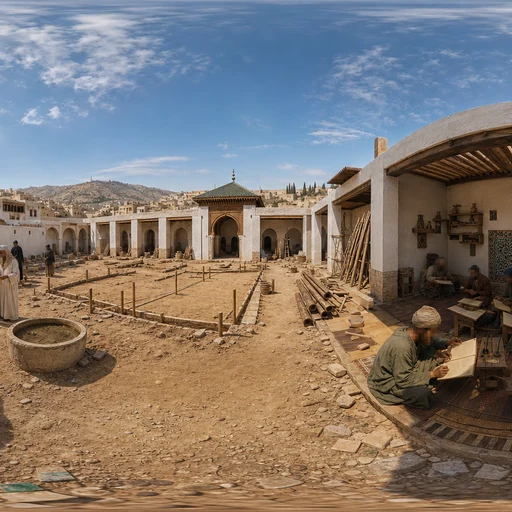
High, rugged mountains of bare rock and thin terraced fields ring a village of flat-roofed earthen houses, the Atlas of the Maghrib, the dry interior of North Africa, neither the Syrian steppe nor the Iberian coast nor the Nile.
The men are gathered in a tribal assembly, clans seated in council rather than drawn up in the ranks of a regular army, the egalitarian gathering of a rising, decisions taken in common, not the formation of a caliphal host under a single commander.
Their own standards are raised over the assembly, the banners of the Berber rebels, deliberately not the white of the house of Umayya, marking a people in arms against their rulers rather than fighting under them.
This is a revolt with a doctrine: the egalitarian teaching of the Kharijites, which denied that Arabs held any precedence over other Muslims, has spread among a converted people taxed and treated as a subject race, an ideological rising, not only a tribal one.
In the distance a beaten column of the caliph's army withdraws into the hills, Syrian and Andalusi troops falling back after a defeat, broken order and a retreat rather than a victory parade; the Maghrib slipping from Damascus's grasp.
At the heart of the village is its well, the scarce water of the mountains and the gathering-point of the settlement, the resource and the livelihood whose taxation and seizure were among the grievances that lit the revolt.
The tracks out of the valley run toward the lowlands and the coast, the lines along which the rising would spread across the Maghrib and cross the strait into al-Andalus over the next two years.
Primary sources
al-Tabari, Tarikh / Ibn al-Athir, al-Kamil fi al-Tarikh: Principal Sunni narrative histories. Give the eastern, caliphal view of the revolt and the dispatch and defeat of the Syrian armies. Confidence high for the dating and the campaigns.
Further reading & cross-references
Ibn Khaldun, Kitab al-Ibar (History of the Berbers) (late 14th c.): The great Sunni historian's history of the Berbers and North Africa, the fullest account of the revolt, its causes in Arab misgovernment, the Kharijite ideology, and the battles. The principal source. Confidence high; analytical and unusually attentive to social causes.
Ibn Idhari, al-Bayan al-Mughrib (early 14th c.): Major Sunni Maghribi history. Preserves the sequence of the revolt in North Africa and al-Andalus: Maysara, the Battle of the Nobles, Bagdoura, and the aftermath. Confidence high for the Maghribi narrative.
Ibn Abd al-Hakam, Futuh Misr wa-al-Maghrib (9th c.): Early Egyptian Sunni history of the conquest and early administration of North Africa. Used for the background grievances, taxation and treatment of the Berbers, that preceded the revolt. Confidence high for the early framework.
Sufri Kharijite doctrine (doctrinal context): The egalitarian Kharijite teaching that spread among the Berbers, denying Arab precedence over other Muslims, supplied the ideology of the revolt. Used to characterise the rising's outlook, as reported in the Sunni heresiographical and historical tradition. Confidence high for the doctrinal frame.
Michael Brett and Elizabeth Fentress, The Berbers (1996): Modern non-confessional academic synthesis. Used for the social and economic background of the revolt and its lasting effect on the Maghrib. Confidence high.
Questions & answers
- Where is The Great Berber Revolt?
- A Berber village in the Atlas, the Maghrib
- When did it happen?
- Berber Revolt (122-124 AH / 740-742 CE)
- What is the story of The Great Berber Revolt?
- Between 122 and 124 AH (740-742 CE) the Berbers of the Maghrib rose in a great revolt against Umayyad rule that the dynasty never fully reversed. The Berbers (the Imazighen of North Africa) had embraced Islam and had been the backbone of the armies that carried it across the Maghrib and into…
Related places


Guess places like this in GeoSiyer
Drop into a 360° scene from Islamic history and pin where, and when, it happened.
Play GeoSiyer