Conquest of Constantinople
Constantinople, late morning of 29 May 1453
857 AH / 1453 CE
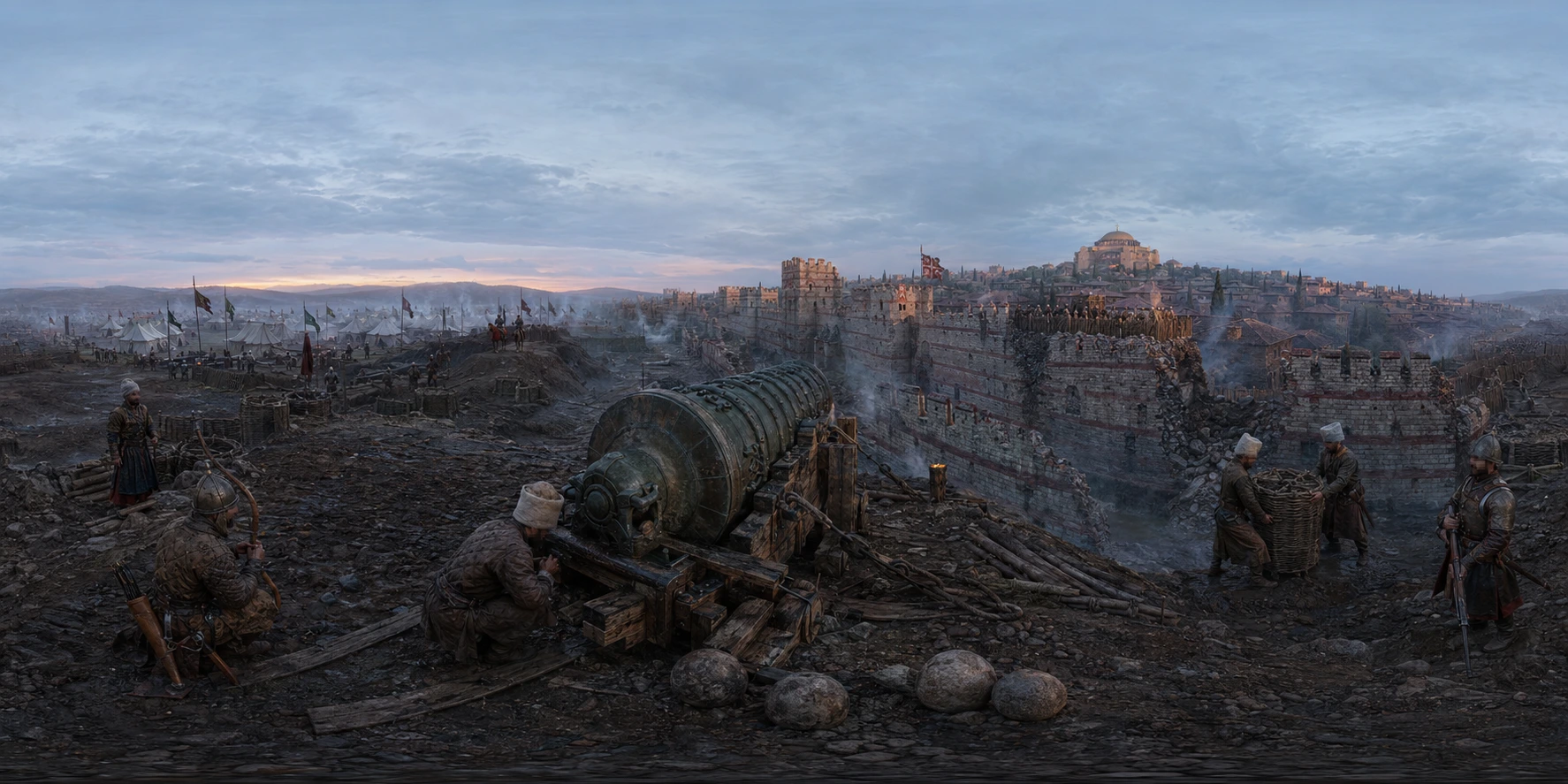 Educational historical reconstruction
Where
Mesoteichion section of the Theodosian land walls, Constantinople
41.0233, 28.9342 · View on OpenStreetMap
Background
On 29 May 1453, corresponding to 20 Jumada al-Awwal 857 AH, the Theodosian land walls of Constantinople were breached, the city fell to the Ottoman army of Sultan Mehmed II, and the Byzantine Empire, successor to the Roman Empire in the East, formally ended after 1,123 years. The siege had begun on 6 April. The defenders, fewer than 8,000 in total including approximately 700 Genoese under the condottiere Giovanni Giustiniani Longo, faced an Ottoman force most modern estimates place in the range of 80,000. The walls were the most formidable urban defense in the medieval Mediterranean, three lines of fortification (moat, outer wall, inner wall) stretching about 6.5 km from the Sea of Marmara to the Golden Horn, and had withstood every previous siege for over a millennium. The Ottoman bombardment, organized around enormous cast-bronze cannons supplied by the Hungarian gunfounder Orban (whose largest weapon was around 600 mm caliber and required dozens of oxen to move), focused on the Mesoteichion section in the middle of the line where the walls crossed the slight valley of the Lycus stream. After roughly six weeks of nearly continuous bombardment and several major night assaults, the breaches at the Mesoteichion were exploited on the morning of 29 May. Constantine XI Palaiologos, the last Byzantine emperor, was killed in the fighting at the wall; his body was reportedly never found in the manner expected of a sovereign. Giustiniani was mortally wounded and evacuated. Sultan Mehmed II entered the city later in the day; that afternoon he prayed in Hagia Sophia, which was immediately converted to a congregational mosque (the period of that conversion is depicted in our separate scene `hagia-sophia-conversion-1453`). The fall of Constantinople closed the Eastern Roman political tradition, accelerated the consolidation of Ottoman power across the eastern Mediterranean, and is conventionally treated as one of the dating boundaries between the Middle Ages and the early modern period in European historiography. This scene depicts the Mesoteichion at the moment of breach, with Ottoman troops entering and the silhouette of Hagia Sophia visible in the middle distance.
What you see
A massive triple-layer land defense, moat, outer wall, inner wall, stretched across an undulating terrain between two seas, with broad rectangular and pentagonal towers at regular intervals. This is the Theodosian wall system of Constantinople, originally completed in 413 CE under Theodosius II and continually maintained for over a thousand years until this morning.
In one section of the inner wall, two adjacent towers and the curtain between them have collapsed inward as a heap of brick, stone, and rubble. The breach exposes the city behind, a section in the middle of the long land-wall line, where the wall traces the slight valley of a small stream (the Lycus), the Mesoteichion section the defenders had identified as the weakest point and where the Ottoman attack was concentrated.
In the open ground outside the moat, sited on heavy timber platforms with banked earth recoil ramps, sit several enormous bronze cast cannons, barrels longer than a man and bores wide enough to take stone shot the size of a melon. The largest are documented at calibers of around 600 mm. This artillery, with the Hungarian gunfounder Orban's great bombard as its centerpiece, is the technological signature of the siege.
On the same approach ground, smaller-caliber bombards, mantlets, scaling ladders, and stacked stone shot lie in service order. The earth in front of the wall is pitted with shot craters from six weeks of nearly continuous bombardment, beginning 6 April.
Red Ottoman banners with white crescent and yellow Allah-Muhammad calligraphic forms, and the distinct red-and-white tugras of the sultanate, rise above formations of Janissaries and azabs at the approaches. No Crusader crosses, no Italian merchant city banners, no Latin double-headed eagle, the defenders are not the Genoese galleys or Venetian condottieri but the Greek-Roman garrison under Constantine XI and the small Genoese contingent under Giovanni Giustiniani.
Files of Janissary infantry are passing through the breach into the city behind, in disciplined order rather than disorganized rush, the siege has just ended, the resistance at this section has just been overcome, and the assault is converting into the entry into the city. A handful of defenders are visible on broken sections of the inner wall, fighting in retreat toward the inner city.
Beyond the breach, the silhouette of the city stretches inland, terracotta-roofed houses on a peninsula between two seas, with the broad bulk of a great domed building visible in the middle distance to the southeast. The dome is Justinian-era Byzantine, not yet flanked by minarets, this is Hagia Sophia, hours before the entry that will convert it to a congregational mosque.
The morning sun is high and the sky is clear of haze; the date in the Christian calendar is 29 May 1453, the date in the Hijri calendar 20 Jumada al-Awwal 857 AH. By tradition, when Sultan Mehmed II entered the city later that day, he reportedly recited the well-known hadith of Bishr al-Ghanawi: 'Verily, you shall conquer Constantinople; what an excellent commander her commander will be, and what an excellent army that army will be.'
Further reading & cross-references
Doukas, Historia Turco-Byzantina (mid 15th c.): Byzantine eyewitness-near-eyewitness account from the Greek side. Provides the most detailed narrative of the siege from inside the city, the death of Constantine XI, and the wounding and evacuation of Giustiniani. Pro-Byzantine in framing but factually careful.
Kritovoulos of Imbros, History of Mehmed the Conqueror (1453-1467): Greek author writing in the years immediately after the conquest for Mehmed II. Sympathetic to the sultan but factually detailed. Indispensable for the Ottoman command perspective, the artillery deployment, and the sultan's actions on the day of the breach.
Nicolò Barbaro, Diario dell'assedio di Constantinopoli (1453): Venetian ship's-surgeon's diary kept in the besieged city day by day from 1 April to 29 May 1453. Source for the daily bombardment rhythm, the assault attempts, and the morale and conditions of the defenders. Strongly anti-Genoese in tone but factually dense.
George Sphrantzes, Chronicon (mid 15th c.): Personal secretary and confidant of Constantine XI. The closest source to the imperial side and to the emperor's last days. Sober and short, but indispensable as a witness to the inner court.
Tursun Beg, Tarih-i Ebü'l-Feth (late 15th c.): Ottoman chancery official's account. The principal Ottoman court history of the siege and the conquest, including the entry into the city and the immediate conversion of Hagia Sophia. Supports the Ottoman side of the timeline.
Steven Runciman, The Fall of Constantinople 1453 (Cambridge, 1965): Classic modern English-language narrative synthesis. Used as the spine of the siege's chronology and for the careful weighing of casualty and troop-strength figures across the Greek, Latin, and Ottoman sources.
Roger Crowley, Constantinople: The Last Great Siege, 1453 (2005): Accessible modern narrative drawn from the same primary sources as Runciman. Confidence: high (used for color and detail, not as the dispositive source on contested points).
Marios Philippides and Walter Hanak, The Siege and the Fall of Constantinople in 1453: Historiography, Topography, and Military Studies (Ashgate, 2011): Definitive recent academic treatment. Used for the careful topographical reconstruction of the breach location at the Mesoteichion, the gun-platform positions, and the disposition of defending units along the wall line.
Standing fabric of the Theodosian Walls and Hagia Sophia (extant): Both monuments survive. The Theodosian walls are partly preserved as ruins along the modern Topkapı-Yedikule line, with the Mesoteichion section identifiable and the wall sequence (moat, outer wall, inner wall) visible to a survey. Hagia Sophia stands; its 1453 silhouette (Justinian dome without flanking minarets) is reconstructible from later Italian travelers' drawings and Ottoman miniatures.
Questions & answers
- Where is Conquest of Constantinople?
- Mesoteichion section of the Theodosian land walls, Constantinople
- When did it happen?
- 857 AH / 1453 CE
- What is the story of Conquest of Constantinople?
- On 29 May 1453, corresponding to 20 Jumada al-Awwal 857 AH, the Theodosian land walls of Constantinople were breached, the city fell to the Ottoman army of Sultan Mehmed II, and the Byzantine Empire, successor to the Roman Empire in the East, formally ended after 1,123 years. The siege had begun on…



Guess places like this in GeoSiyer
Drop into a 360° scene from Islamic history and pin where, and when, it happened.
Play GeoSiyer