The Founding of Dar al-Ulum Deoband
A madrasa to preserve Islamic learning under colonial rule, 1866
1283 AH / 1866 CE
 Educational historical reconstruction
Where
Deoband, northern India
29.6960, 77.6790 · View on OpenStreetMap
Background
In 1866 (1283 AH), nine years after the failed rebellion of 1857 and the final extinction of Muslim political power in India, a group of Sunni Hanafi scholars led by Muhammad Qasim Nanautawi and Rashid Ahmad Gangohi (rahimahumullah) founded the Dar al-Ulum at the small town of Deoband in northern India. The undertaking was deliberately humble: tradition records that teaching began under a pomegranate tree and in a corner of the town's Chhatta mosque, with a single teacher and a handful of students. Its founders' insight was institutional. Rather than depend on the patronage of a Muslim state, which no longer existed, or on the colonial government, the madrasa would be funded by the small regular donations of ordinary Muslims, and it would be organised on a new model: a fixed curriculum centred on the Qur'an, hadith and Hanafi jurisprudence, formal classes and annual examinations, a salaried faculty, a central library, residential students drawn from across the subcontinent, and a managing council. This design made the school resilient and reproducible, and a wide network of affiliated madrasas grew up on the Deoband pattern. The Deobandi movement that issued from it became one of the most influential currents of Sunni revivalism in South Asia and, through migration and missionary effort, far beyond it, shaping religious scholarship, law and identity for generations of Muslims. This scene depicts the modest beginning, the open courtyard, the teaching circle and the books, the unassuming birth of an institution that would prove remarkably durable.
What you see
A modest town on the flat, intensely cultivated plain of northern India, with brick-and-plaster buildings and green fields around it, far from any coast or mountain.
The setting is small and plain, a simple courtyard beside a town mosque, not a grand domed college; the institution is beginning in humble quarters.
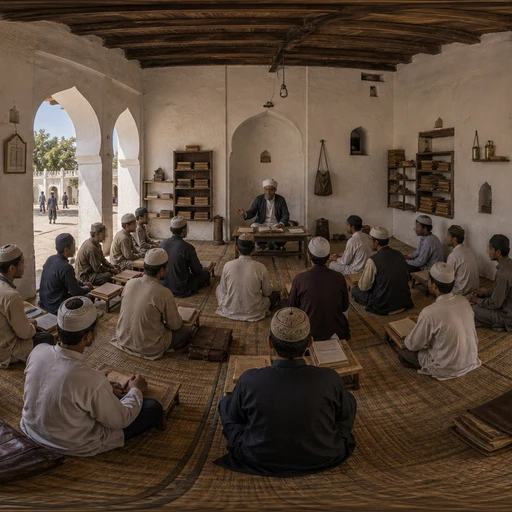
A teaching circle of turbaned scholars and students sits on mats over reading-stands and bound books, classes held in the open courtyard. The whole enterprise is built around the transmission of texts.
Manuscripts and printed Arabic and Persian books, registers of enrolled students, and a donations box show a formal school funded by ordinary people's gifts rather than by the colonial state.
A deliberately modest, self-funded madrasa, independent of the foreign government, founded to preserve religious learning and train scholars marks a community's strategy for survival under colonial rule through its own institutions.
Further reading & cross-references
Deoband's own histories and the writings of its founders (late 19th c.): The biographies and accounts of Nanautawi and Gangohi and the early madrasa, from within the tradition; the founding narrative, the curriculum and the funding model. Confidence high for the institution's self-account.
Barbara Daly Metcalf, Islamic Revival in British India: Deoband 1860-1900 (Princeton, 1982): The standard modern academic study of the Deobandi movement. Used for the founding, the institutional model, the public funding, and the place of Deoband in the Muslim response to colonial rule. Confidence high.
Muhammad Qasim Zaman, The Ulama in Contemporary Islam (2002): Used for the longer significance of the Deobandi model of the self-funded, network madrasa and the training of ulama. Confidence high.
The standing Dar al-Ulum Deoband (extant): The seminary survives and has grown; reviewers should depict the modest 1866 beginnings, not the large modern campus.
Questions & answers
- Where is The Founding of Dar al-Ulum Deoband?
- Deoband, northern India
- When did it happen?
- 1283 AH / 1866 CE
- What is the story of The Founding of Dar al-Ulum Deoband?
- In 1866 (1283 AH), nine years after the failed rebellion of 1857 and the final extinction of Muslim political power in India, a group of Sunni Hanafi scholars led by Muhammad Qasim Nanautawi and Rashid Ahmad Gangohi (rahimahumullah) founded the Dar al-Ulum at the small town of Deoband in northern…
Related places

The Fall of Delhi and the End of the Mughals
1274-1275 AH / 1857-1858 CE
The Khilafat Movement
c. 1338 AH / 1920 CE
Deoband Style Classroom
c. 1900 CE

The Beginnings of the Tablighi Jamaat
1345 AH / c. 1926 CE

Aligarh: the Modernist Response
1292 AH / 1875 CE
Partition and the Birth of Pakistan
1366 AH / 1947 CE
Guess places like this in GeoSiyer
Drop into a 360° scene from Islamic history and pin where, and when, it happened.
Play GeoSiyer