The Qutb Complex of Early Delhi
The first mosque and minaret of Muslim Delhi
587-602 AH / 1191-1206 CE
 Educational historical reconstruction
Where
Mehrauli, Delhi, northern India
28.5245, 77.1855 · View on OpenStreetMap
Background
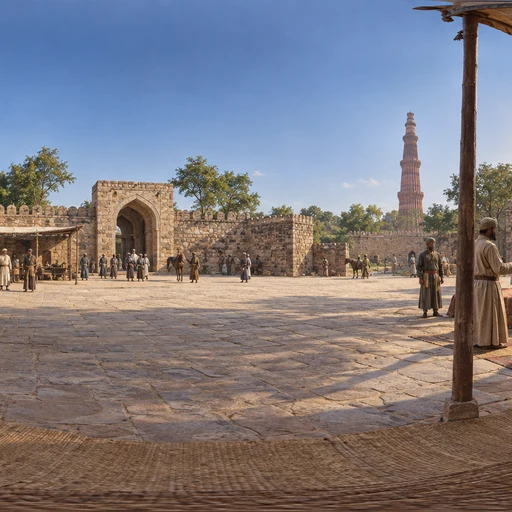
At the turn of the seventh century AH (around 1191-1206 CE) the Ghurid conquest of northern India established Muslim rule across the north of the subcontinent and founded what became the Delhi Sultanate. Muhammad of Ghor defeated the Rajput confederacy at the second battle of Tarain in 588 AH (1192), and his commander Qutb al-Din Aibak, a Turkic slave-general who would become the first sultan of Delhi, set about building the monuments of the new order at Mehrauli, near Delhi. The chief of these is the Qutb complex: the Quwwat al-Islam mosque, the first congregational mosque of Delhi, and beside it the Qutb Minar, a towering victory minaret of red sandstone begun under Aibak and carried up by his successor Iltutmish, ringed with bands of carved Qur'anic inscription. The buildings are a vivid record of conquest and of cultural meeting at once. The mosque's colonnades were built from spolia, carved columns and lintels taken from demolished temples and reused, their dense Indic carving still visible, and its great arched screen was raised by Indian masons in their own corbelled technique rather than as true arches, so that Islamic forms and inscriptions were realised through Indian stone-working. An ancient iron pillar, far older than the conquest, was kept standing in the courtyard. These first monuments of Muslim Delhi thus carry both the assertion of a new power and the deep imprint of the Indian world it had entered. The conquest and its buildings are recorded by the Persian historian Minhaj al-Siraj Juzjani in his Tabaqat-i Nasiri and by Hasan Nizami. This scene depicts the complex under construction: the rising red minaret, the great arched screen of the first mosque, the reused temple columns of its colonnades, the old iron pillar in the court, and the ridge country of Mehrauli around, the founding monuments of Muslim rule in northern India, sober in framing and attentive to the meeting of two architectural worlds.
What you see
A tall tapering tower of red sandstone is rising in stages, its shaft fluted and ringed with bands of carved Arabic inscription, a victory minaret under construction that will dominate the new Muslim capital of the north Indian plain.
Beside it stands a congregational mosque fronted by a great screen of high pointed and ogee-profiled arches in carved sandstone, the first Friday mosque of the city, its arches built up in corbelled courses in the Indian masons' technique rather than as true voussoir arches.
The colonnades of the mosque are made of spolia: richly carved columns and lintels reused from demolished temples, their dense Indic figural and floral carving still visible, set into the plan of a mosque, the architecture of conquest building with the stones of the conquered.
This is the work of the Ghurid conquest of northern India and the founding of the Delhi Sultanate, the beginning of centuries of Muslim rule across the north of the subcontinent, its first monuments raised at once as mosque and as victory monument.
In the mosque courtyard stands an ancient iron pillar, far older than the conquest, kept and incorporated rather than removed, a relic of the Indian past standing within the new Islamic enclosure.
The setting is the rocky ridge country of Mehrauli near Delhi on the north Indian plain, a village and fields nearby, the humid subcontinental interior rather than Iran or the Arab lands.
The craftsmen at work are Indian, cutting in the local technique and idiom under Muslim patrons, so that the buildings are a true meeting of Indian stone-working and the forms and inscriptions of Islam.
Further reading & cross-references
Minhaj al-Siraj Juzjani, Tabaqat-i Nasiri (13th c., Persian): The principal Persian Sunni history of the Ghurids and the early Delhi Sultanate. Source for the conquest, Qutb al-Din Aibak, and the founding of Muslim Delhi. Confidence high for the dynastic narrative.
Hasan Nizami, Taj al-Ma'athir (early 13th c., Persian): Court history of the early Delhi Sultanate. Used for the conquest and the early sultans. Panegyric in tone; used with appropriate caution. Confidence medium-high.
The Qutb complex at Mehrauli (extant fabric): Material evidence of the first order. The standing Qutb Minar, the Quwwat al-Islam mosque, the spolia columns with their temple carving, the corbelled arch screen, and the ancient iron pillar directly confirm the architecture the scene depicts. Confidence high.
Peter Jackson, The Delhi Sultanate: A Political and Military History (1999): Modern non-confessional academic study. Used for the chronology of the Ghurid conquest and the founding of the sultanate. Confidence high.
Finbarr Barry Flood, Objects of Translation (2009): Modern art-historical study of the Hindu-Muslim encounter in early Indian Islamic architecture. Used for the careful, non-polemical reading of the spolia and the corbelled screen as a cultural meeting. Confidence high.
Questions & answers
- Where is The Qutb Complex of Early Delhi?
- Mehrauli, Delhi, northern India
- When did it happen?
- 587-602 AH / 1191-1206 CE
- What is the story of The Qutb Complex of Early Delhi?
- At the turn of the seventh century AH (around 1191-1206 CE) the Ghurid conquest of northern India established Muslim rule across the north of the subcontinent and founded what became the Delhi Sultanate. Muhammad of Ghor defeated the Rajput confederacy at the second battle of Tarain in 588 AH…
Related places
The Court of Razia Sultan
c. 1236-1240 CE

The Battle of Tarain
588 AH / 1192 CE

Mahmud of Ghazna's Indian Campaigns
Ghaznavid campaigns (388-421 AH / 998-1030 CE)

The Migration to Daulatabad
727 AH / c. 1327 CE

The Khilji Reach into the Deccan
707 AH / c. 1307 CE

Ghazni and the Road to India
417 AH / c. 1026 CE
Guess places like this in GeoSiyer
Drop into a 360° scene from Islamic history and pin where, and when, it happened.
Play GeoSiyer