Umar's Diwan and the Hijri Calendar
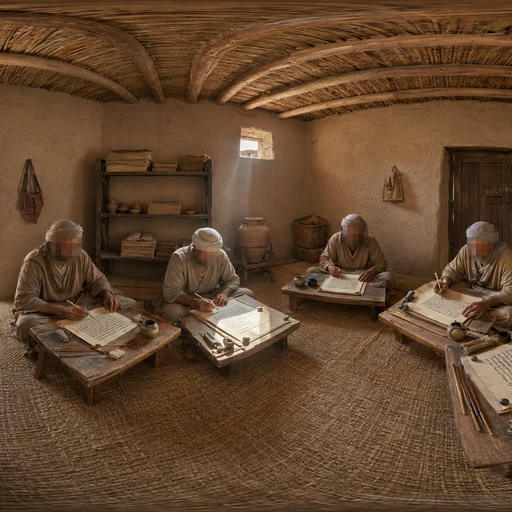
The administrative chamber at Madinah, c. 17 AH
c. 17 AH / 638 CE
 Educational historical reconstruction
Where
Madinah, the administrative heart of the caliphate
24.4686, 39.6142 · View on OpenStreetMap
Background
In the years after the great conquests, the second caliph Umar ibn al-Khattab (radiyallahu 'anhu, r. 13-23 AH / 634-644 CE) reshaped the young Muslim polity from a city-state into the administration of an empire, governed still from Madinah. Two of his most lasting institutions are gathered in this scene. The first is the Hijri calendar: in 17 AH (638 CE), faced with undated correspondence arriving from the new provinces, Umar (RA) convened his council and adopted a lunar era counted from the Prophet's emigration (peace and blessings be upon him) of 622 CE, with Muharram fixed as its first month, the dating system the Muslim world keeps to this day. The episode is preserved by al-Tabari, Ibn Sa'd, and the later astronomer al-Biruni (al-Athar al-Baqiya). The second is the diwan al-ata, the register of stipends: as the fifth (khums) and the tribute (fay') of Iraq, Syria, and Egypt poured into Madinah, Umar (RA) established, around 20 AH / 641 CE, a state roll that distributed annual payments to the Muslims ranked by precedence in Islam (sabiqa), the veterans of Badr and the earliest believers entered first, then by service and kinship to the Prophet (peace and blessings be upon him). al-Baladhuri (Futuh al-Buldan) and the Hanafi jurist Abu Yusuf (Kitab al-Kharaj) describe the registers, the named lists, and the disbursement. The coinage weighed out in this period was not yet Islamic in form: the Muslims still used the silver drachm of the Sasanians and the gold solidus of Byzantium, sometimes overstruck with brief Arabic phrases, a true Arabic epigraphic dinar would not appear until Abd al-Malik's reform some sixty years later. Umar's measures together, the calendar, the diwan, the kharaj land-tax, the amsar garrison cities, the office of the qadi, turned raw conquest into a governed state and set the administrative template the Umayyads and Abbasids would inherit. This scene depicts the administrative chamber at Madinah: scribes at their registers, the era newly fixed to the Hijra, scales and coin from three fallen empires waiting to be counted into the stipend rolls. No individual is the subject; the protagonists are the instruments of a state being born.
What you see
A plain mudbrick chamber with palm-trunk roof beams and reed matting on a beaten-earth floor, the unadorned building idiom of early Madinah, with no carved stone, no glazed tile, no dome or arch of the kind that later Umayyad and Abbasid administration would build.
Long parchment and papyrus rolls are spread on low desks, ruled into columns of names and numbers, the diwan al-ata, the register of stipends, each name entered by rank of precedence in Islam rather than by wealth or tribe alone.
A reckoning board fixes the months beginning with Muharram and counts the years from a single starting point, not a regnal year, not the Sasanian or Seleucid era, but a new lunar count taken from the Prophet's emigration (peace and blessings be upon him).
Balance scales and small heaps of coin wait to be weighed, silver drachms still bearing the bust and fire-altar of the defeated Sasanians and gold solidi of Byzantium, some overstruck with short Arabic phrases. There is as yet no purely Arabic epigraphic dinar; that reform lies two generations ahead.
The documents are written in an early Hijazi Arabic hand, angular and without the dotting and vowel-marking that later scribes would add, the chancery script of the first Muslim state before its tools were standardised.
Recipients wait in an orderly line to receive the annual ata: veterans of Badr and the earliest believers entered at the head of the roll, then later companions and their families, a disbursement of conquest revenue, not a market or a tax-collection.
Sealed sacks and ledgers newly arrived by caravan carry the fay and tribute of Iraq, Syria, and Egypt into a city that is still a modest oasis settlement, wealth from three fallen empires funnelling into mudbrick Madinah.
Primary sources
al-Baladhuri, Futuh al-Buldan (9th c.): Standard Sunni account of the conquests and their administration. Principal source for the establishment of the diwan al-ata, the ranking by precedence, and the distribution of the fay'. Supports the institutional detail; the exact stipend figures vary between reports.
al-Tabari, Tarikh al-Rusul wa-al-Muluk (early 10th c.): Principal Sunni historical narrative. Preserves the report of the council that fixed the Hijri era in 17 AH and the broader administrative reforms of Umar's caliphate. High for sequence; some chronological detail varies between transmitters.
Ibn Sa'd, al-Tabaqat al-Kubra (9th c.): Biographical compilation. Used for the council on the calendar and for the precedence-ranking (sabiqa) that ordered the stipend register. Confidence high for the framework.
Further reading & cross-references
Abu Yusuf, Kitab al-Kharaj (8th c.): Foundational Hanafi work on Islamic fiscal administration, addressed to the caliph Harun al-Rashid. Preserves the legal memory of Umar's (RA) land-tax and stipend system. Reliable for the shape of the institutions, written from a later jurist's vantage.
al-Biruni, al-Athar al-Baqiya (c. 1000): Sunni polymath's comparative study of calendars and eras. Establishes the deliberation over the starting point of the Muslim era and why the Hijra, rather than the birth or the first revelation, was chosen as year one.
Arab-Sasanian and Arab-Byzantine coinage (numismatic record): Material cross-reference. The surviving coins of the period are Sasanian-type silver drachms and Byzantine-type gold, sometimes bearing added Arabic, confirming that no independent Islamic coinage yet existed in Umar's time, the anachronism the panorama must avoid.
Hugh Kennedy, The Prophet and the Age of the Caliphates (modern synthesis): Non-confessional academic overview. Used for the modern reconstruction of how the diwan, the amsar, and the fiscal system actually functioned in the Rashidun decades.
Questions & answers
- Where is Umar's Diwan and the Hijri Calendar?
- Madinah, the administrative heart of the caliphate
- When did it happen?
- c. 17 AH / 638 CE
- What is the story of Umar's Diwan and the Hijri Calendar?
- In the years after the great conquests, the second caliph Umar ibn al-Khattab (radiyallahu 'anhu, r. 13-23 AH / 634-644 CE) reshaped the young Muslim polity from a city-state into the administration of an empire, governed still from Madinah. Two of his most lasting institutions are gathered in this…
Related places

The Saqifa of Banu Sa'idah
11 AH / 632 CE

The First Collection of the Qur'an
12 AH / 633 CE
The Standardization of the Mushaf
c. 30 AH / c. 650 CE

Ibn al-Zubayr Rebuilds the Kaaba
64 AH / 683 CE

After the Qarmatian Raid on Makkah
Dhul Hijja 317 AH / 930 CE

The Arbitration at Dumat al-Jandal
Ramadan 37 AH / February 658 CE
Guess places like this in GeoSiyer
Drop into a 360° scene from Islamic history and pin where, and when, it happened.
Play GeoSiyer