The Fall of Cordoba and Seville
The great Andalusi cities pass to Castile
633-646 AH / 1236-1248 CE
 Educational historical reconstruction
Where
Cordoba, on the Guadalquivir, al-Andalus
37.8790, -4.7794 · View on OpenStreetMap
Background
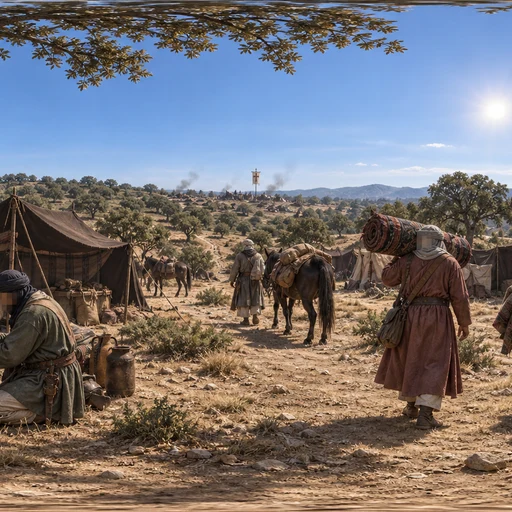
In the middle decades of the seventh century AH the heartland of al-Andalus fell to the Christian kingdom of Castile. After the great Almohad defeat at Las Navas de Tolosa in 609 AH (1212), Almohad power in Iberia collapsed into civil war and fragmentation, and the Christian kingdoms of the north advanced into the divided south. Cordoba, the ancient Umayyad capital and the seat of the greatest mosque of the Muslim West, was taken by Ferdinand III of Castile in 633 AH (1236); Seville, the largest city of al-Andalus, fell to the same king after a long siege in 646 AH (1248). With them went Jaen, Murcia, and the cities of the Guadalquivir valley. The conquerors did not as a rule destroy the great buildings: the Great Mosque of Cordoba was reconsecrated as a cathedral, a Christian altar set within its forest of double-tier red-and-white arches, and the call to prayer was replaced by bells; but the Muslim populations were in large part expelled or reduced to subjection, and columns of families left the conquered cities for the lands still under Muslim rule. The fall of Cordoba and Seville broke the back of Andalusi Islam as a great urban civilisation; of the once vast Muslim Spain, only the kingdom of Granada in the far south would survive, as a tributary Nasrid state, for another two and a half centuries. The loss is recorded with grief by the Andalusi and Maghribi historians Ibn Idhari, Ibn al-Khatib, and al-Maqqari, and from the other side by the Castilian chronicles. This scene depicts the change rather than a battle: the striped arches of the Great Mosque of Cordoba with a Christian altar set among them, a Castilian banner over the city and its river, and Muslim families departing into exile, the moment the heartland of al-Andalus passed out of Muslim hands. The framing is sober and grieving, a careful Muslim memory of a great loss.
What you see
The hall is the unmistakable forest of double-tier red-and-white horseshoe arches of the Great Mosque of Cordoba, but a Christian altar and cross have been set within it: the mosque is being reconsecrated as a cathedral, its purpose changed without its arches being torn down.
A Castilian banner flies over the city and from the tower that had been the minaret, the cross raised where the call to prayer once sounded, the mark of a great Andalusi capital passing into Christian hands.
Muslim families are leaving, carrying bundles and belongings, columns of people departing the city for the lands still under Muslim rule in the south, the displacement of a population as the city changes hands.
This is the harvest of the Reconquista in the generation after the great defeat in the mountains: Cordoba falls in 633 AH and Seville in 646 AH, and the heartland of al-Andalus is lost to the kingdom of Castile.
Around lies the Andalusi cityscape on its great river, the Guadalquivir and the long Roman bridge of Cordoba, the fabric of a Muslim city now under a new rule.
The bells of a cathedral now sound where the muezzin once called, and the great mosques of the conquered cities are turned to churches, the slow unmaking of the religious life of Andalusi Islam.
Only the kingdom of Granada in the far south would remain as the last Muslim state in Iberia, the long Andalusi centuries narrowing now to a single surviving realm.
Further reading & cross-references
Ibn Idhari, al-Bayan al-Mughrib (early 14th c.): Major Sunni Maghribi and Andalusi history. Used for the collapse of Almohad power and the fall of the Andalusi cities. Confidence high.
Ibn al-Khatib, A'mal al-A'lam (14th c.): Andalusi Sunni historian of Granada and al-Andalus. Used for the fall of the cities and the narrowing of Muslim Spain to Granada. Confidence high.
al-Maqqari, Nafh al-Tib (17th c.): The great later Sunni Andalusi compilation. Used for the memory of the lost cities and the lament over the loss of al-Andalus. Confidence medium-high as a compilation.
Castilian chronicles (Primera Cronica General and the chronicles of Ferdinand III): Christian sources from the conquering side. Non-Muslim cross-references confirming the dates and the course of the conquests of Cordoba (1236) and Seville (1248). Used for date and place, not religious framing. Confidence high.
L. P. Harvey, Islamic Spain, 1250 to 1500 (1990): Modern non-confessional academic study. Used for the fate of the Muslim populations after the conquests and the narrowing of al-Andalus to Granada. Confidence high.
Questions & answers
- Where is The Fall of Cordoba and Seville?
- Cordoba, on the Guadalquivir, al-Andalus
- When did it happen?
- 633-646 AH / 1236-1248 CE
- What is the story of The Fall of Cordoba and Seville?
- In the middle decades of the seventh century AH the heartland of al-Andalus fell to the Christian kingdom of Castile. After the great Almohad defeat at Las Navas de Tolosa in 609 AH (1212), Almohad power in Iberia collapsed into civil war and fragmentation, and the Christian kingdoms of the north…
Related places


Guess places like this in GeoSiyer
Drop into a 360° scene from Islamic history and pin where, and when, it happened.
Play GeoSiyer