The First Battle of Panipat
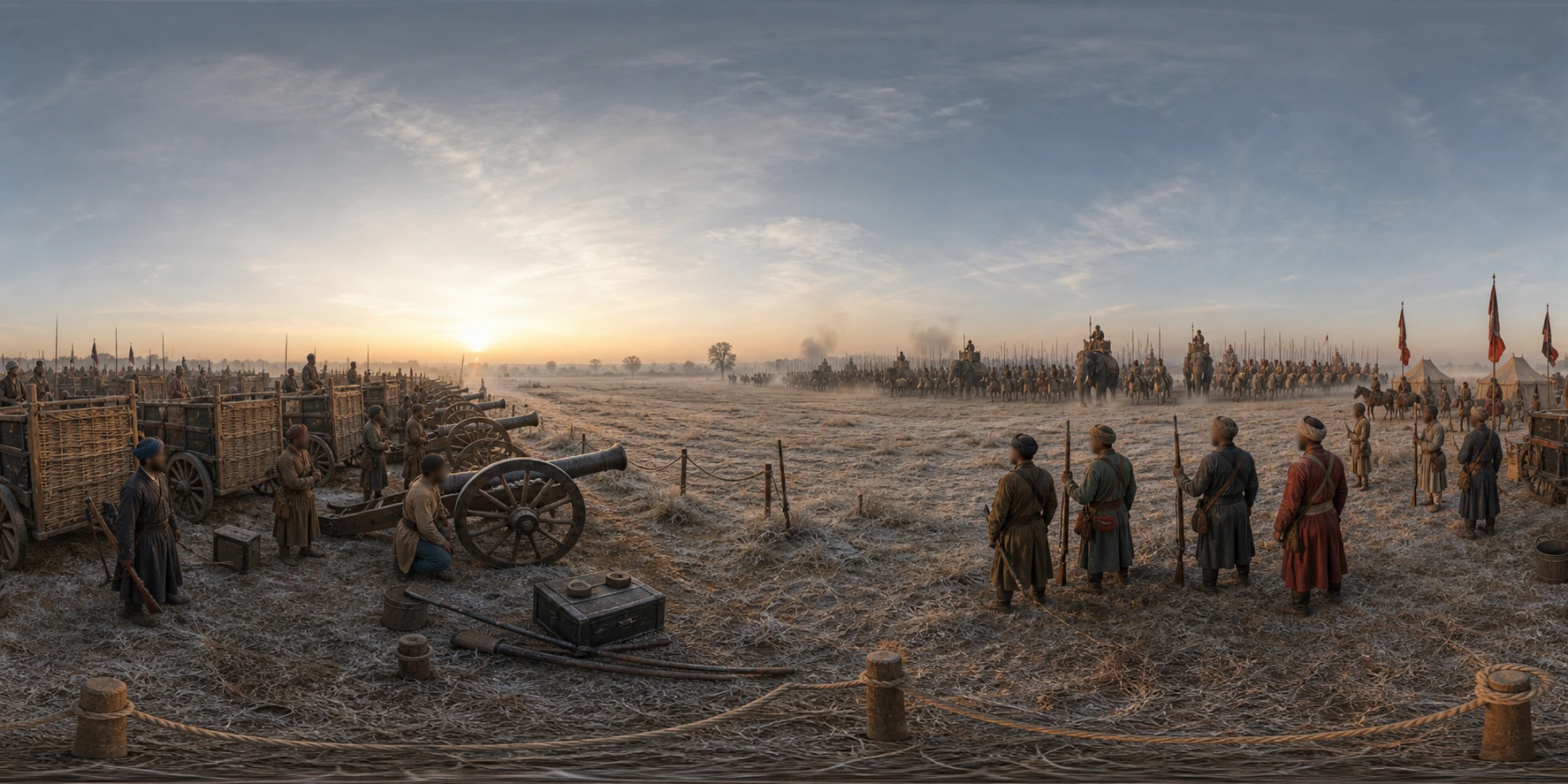
Babur's gun-line waits at dawn, 1526
932 AH / 1526 CE
 Educational historical reconstruction
Where
Battlefield of Panipat, north of Delhi
29.3900, 76.9700 · View on OpenStreetMap
Background
On 21 April 1526 (932 AH) on the plain of Panipat north of Delhi, Zahir al-Din Muhammad Babur (rahimahu Allah), a Timurid prince descended from Timur on his father's side and from Genghis Khan on his mother's, who had built a kingdom around Kabul, defeated the much larger army of Ibrahim Lodi, the Sultan of Delhi, and founded the empire later called the Mughal. Babur's force was perhaps a fifth or a sixth the size of the Lodi army, which is said to have numbered around a hundred thousand with many hundreds of war elephants; the figures are the traditional ones and should be read as approximate. Babur won by tactics and by gunpowder. He recounts in his Chagatai Turkic memoir, the Baburnama, how he drew up his centre behind a long line of carts lashed together with twisted hide ropes, a field laager he describes as the Anatolian or Ottoman manner, with gaps from which his master gunner Ustad Ali Quli served field cannon and ranks of matchlock men fired in volleys. He had waited several days for Ibrahim to attack, and on the morning of the battle the two hosts were arrayed against each other at first light. When the Lodi army came on, the guns and the noise threw its elephants into confusion, and Babur's horsemen swung wide around both wings in the tulughma, the flanking manoeuvre of the steppe, to shoot into the enemy rear. By midday the Lodi army was broken; Ibrahim Lodi was killed on the field, one of the very few Delhi sultans to die in battle, and Babur records that his head was brought to him. Babur occupied Delhi and Agra within days and had the khutba read in his name. The Baburnama is one of the great autobiographies of the pre-modern world, and the dynasty Babur founded here would rule much of the Indian subcontinent for over three centuries, until 1857. This scene does not show the fighting; it holds the hour before it, the cold dawn on the Panipat plain with Babur's chained carts, field cannon and matchlock men drawn up and waiting while the vast Lodi host is arrayed across the field.
What you see
The ground is a flat, frost-touched, cultivated plain stretching to a low sun on the horizon, the level alluvial land north of Delhi on the road into the heart of north India. It is neither hill country nor open desert, and a faint tree line and haze mark the far edge of the field.
A long line of carts is lashed together rope to rope into a barricade, their sides built up with wicker hurdles and gaps left between them. This is a field laager of wagons, a defensive gun-line borrowed from Ottoman and Central Asian practice, dug in to break a charge before it can land.
Set into a gap in the cart-line, a wheeled bronze field cannon points out across the plain, served by a crouching gunner, with a wooden powder chest on the ground beside it. Field artillery in the open like this was still a novelty on an Indian battlefield.
A knot of foot soldiers stands at rest beside the guns, holding tall matchlock muskets and lances upright and waiting. These are the matchlock men who will fire in volleys from behind the carts; here they are drawn up before the order, not yet shooting.
Across the plain a great host is arrayed in a long, dense line under raised lances and banners, far larger than the gun-line that faces it. The two armies are set in order at first light and the engagement has not yet opened; this is the stillness before the cannonade.
The soldiers nearest the carts wear long Central Asian robes, sashes and turbans of the Timurid style rather than Indo-Afghan Sultanate dress, marking this as an army come down from Kabul. A red-coated commander stands among them, identified by role and bearing rather than by face.
The light is the cold light of dawn, the sun barely clear of the horizon and the grass white with frost. The Baburnama records that the armies were drawn up and the fighting joined in the early morning, and it is that first hour that the scene holds.
Further reading & cross-references
Babur, Baburnama (Vaqi'at-i Baburi) (early 16th c.): Babur's own Chagatai Turkic memoir, an eyewitness participant account of the cart-line lashed with hide ropes, the artillery of Ustad Ali Quli, the matchlock volleys, the dawn array, the flanking manoeuvre and the death of Ibrahim Lodi. The primary source. Confidence high, with the usual caution that it is the victor's self-account.
Abu'l-Fazl, Akbarnama (late 16th c.): The official history of Babur's grandson Akbar, which recounts the foundation under Babur. Used as a later Mughal court confirmation of the battle narrative. Confidence medium for this earlier event.
Nizam al-Din Ahmad, Tabaqat-i Akbari (late 16th c.): Mughal administrative history; cross-check on the Lodi order of battle and the scale of the armies, which are given as round, traditional figures.
Stephen F. Dale, The Garden of the Eight Paradises: Babur and the Culture of Empire (Brill, 2004): Standard modern biography of Babur. Used for the analysis of the tactics, the size of the armies, and the significance of the gunpowder field-laager in India.
Iqtidar Alam Khan, Gunpowder and Firearms: Warfare in Medieval India (OUP, 2004): Used for the introduction of field artillery and matchlocks into Indian warfare and the technical role of the cart-line and volleys at Panipat.
William Irvine, The Army of the Indian Moghuls (1903): Older standard on Mughal military organisation; cross-reference on the construction of the cart-line, the artillery train and the matchlock infantry. Confidence medium.
Questions & answers
- Where is The First Battle of Panipat?
- Battlefield of Panipat, north of Delhi
- When did it happen?
- 932 AH / 1526 CE
- What is the story of The First Battle of Panipat?
- On 21 April 1526 (932 AH) on the plain of Panipat north of Delhi, Zahir al-Din Muhammad Babur (rahimahu Allah), a Timurid prince descended from Timur on his father's side and from Genghis Khan on his mother's, who had built a kingdom around Kabul, defeated the much larger army of Ibrahim Lodi, the…
Related places

The Third Battle of Panipat
1174 AH / 1761 CE

Timur's Sack of Delhi
801 AH / 1398 CE

Nader Shah's Sack of Delhi
1152 AH / 1739 CE

Akbar's House of Worship at Fatehpur Sikri
c. 983 AH / 1575 CE

The Taj Mahal under Construction
1041-1063 AH / 1632-1653 CE

The Badshahi Mosque and the Fatawa-i Alamgiri
1084 AH / 1673 CE
Guess places like this in GeoSiyer
Drop into a 360° scene from Islamic history and pin where, and when, it happened.
Play GeoSiyer