The First Siege of Vienna
The Ottoman tide turns back, 936 AH
936 AH / 1529 CE
 Educational historical reconstruction
Where
Vienna, on the Danube in Central Europe
48.2100, 16.3700 · View on OpenStreetMap
Background
In 936 AH (1529 CE) the Ottoman sultan Suleiman, called the Magnificent, led his army to the walls of Vienna, the deepest point the Ottoman advance ever reached into Central Europe, and was forced to turn back. Suleiman's reign was the height of Ottoman power: he had taken Belgrade and Rhodes and crushed the kingdom of Hungary at Mohacs in 932 AH (1526), and in 1529 he marched up the Danube against the Habsburg capital of Vienna, the gateway to the German lands. But the campaign reached the city late in the season. The long march from the south had worn down the army and slowed its supply, the heaviest siege guns had been left behind or bogged down on the muddy roads, and the autumn rains turned the siege works to flooded trenches. The defenders held, the assaults failed, and with winter coming on and his lines overstretched, Suleiman raised the siege and withdrew in October, abandoning much of his heavy equipment in the mud. The failure marked the limit of Ottoman expansion in this direction: although the Ottomans would remain a great power in Hungary and the Balkans for generations, Vienna would not be seriously threatened again until the second, also unsuccessful, siege of 1683. The campaign is recorded in the Ottoman campaign registers and histories of Suleiman's reign and, from the other side, by the German and Austrian accounts of the defence. This scene depicts not an assault but the withdrawal: a great walled city on the Danube under grey autumn skies, the vast Ottoman tent camp being struck, heavy cannon grounded in the mud, waterlogged siege trenches, and the army turning back south, the high-water mark of the Ottoman tide in Central Europe and the moment it began to recede. The framing is sober: the limit of an empire's reach, set by distance, season, and mud as much as by the walls that held.
What you see
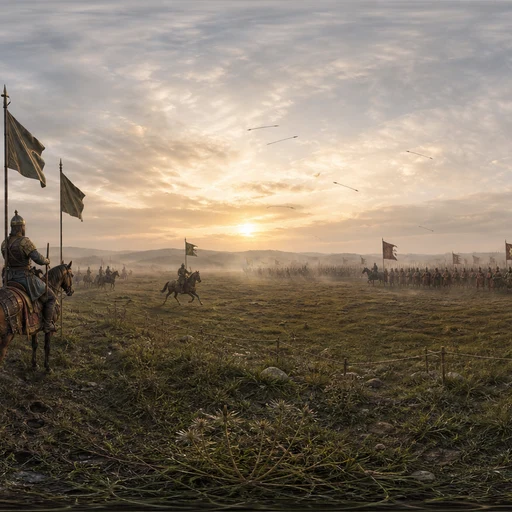
A great walled city on a broad river under grey autumn skies, set in the flat country of Central Europe far to the north and west of the Mediterranean world, cold and wet rather than dry and bright.
A vast Ottoman siege camp, a tent city of thousands stretched across the plain before the walls, is being struck and packed for withdrawal, the army pulling back rather than pressing the assault.
Heavy siege guns stand mired and grounded in the mud, too heavy to drag away through the wet, some left where they sank, the great artillery train bogged down by the autumn rains.
The siege trenches and approach saps dug toward the walls are waterlogged and collapsing, flooded by rain, the failed siege works of an assault that could not be carried before winter closed in.
This is the high-water mark of the Ottoman advance into Central Europe under their greatest sultan: the siege fails, the army withdraws, and the limit of the expansion is reached, not to be tried again here for more than a century and a half.
The walls, towers, and church spires of the great Central European city hold in the distance, a Habsburg capital that did not fall, its defences unbroken behind the receding camp.
The cold, wet northern autumn itself is part of the story, the rain and mud and the long supply line from the south defeating the siege as surely as the defenders behind the walls.
Further reading & cross-references
Ottoman campaign registers and histories of Suleiman's reign (16th c.): The Ottoman record of the 1529 campaign, including the official campaign diary tradition. Used for the march, the siege, and the withdrawal from the Ottoman side. Confidence high for the sequence; framed as a campaign rather than a defeat.
Kemalpashazade and later Ottoman chroniclers (16th c.): Ottoman histories of the reign of Suleiman. Used for the broader context of the Hungarian and Austrian campaigns. Confidence high for the Ottoman narrative.
Contemporary German and Austrian accounts of the defence of Vienna (16th c.): Non-Muslim cross-references from the defending side. Confirm the date, the siege, the role of the weather, and the withdrawal. Used for date and place, not religious framing. Confidence high.
Halil Inalcik, The Ottoman Empire: The Classical Age (modern): Standard modern non-confessional history. Used for the strategic context of Suleiman's European campaigns and the significance of the 1529 limit. Confidence high.
Rhoads Murphey, Ottoman Warfare 1500-1700 (1999): Modern non-confessional academic study of Ottoman logistics and campaigning. Used for the supply, season, and distance constraints that defeated the siege. Confidence high.
Questions & answers
- Where is The First Siege of Vienna?
- Vienna, on the Danube in Central Europe
- When did it happen?
- 936 AH / 1529 CE
- What is the story of The First Siege of Vienna?
- In 936 AH (1529 CE) the Ottoman sultan Suleiman, called the Magnificent, led his army to the walls of Vienna, the deepest point the Ottoman advance ever reached into Central Europe, and was forced to turn back. Suleiman's reign was the height of Ottoman power: he had taken Belgrade and Rhodes and…




Guess places like this in GeoSiyer
Drop into a 360° scene from Islamic history and pin where, and when, it happened.
Play GeoSiyer