The French Savants and al-Azhar
European instruments meet the scholars of Cairo, c. 1799
c. 1214 AH / 1799 CE
 Educational historical reconstruction
Where
al-Azhar and the French Institut, Cairo
30.0459, 31.2625 · View on OpenStreetMap
Background
After the French occupied Cairo in 1798, Napoleon's expedition to Egypt brought with it a corps of more than a hundred and fifty savants, scientists, engineers, mathematicians, naturalists and artists, who founded the Institut d'Egypte in the city in August 1798 and set to surveying the land, its monuments and its life, work that would eventually be published as the great Description de l'Egypte. Among the things they brought were printing presses furnished with Arabic as well as European type, the first presses to operate in Egypt, used at first to print the occupation's proclamations in Arabic. At the heart of Cairo stood al-Azhar, the venerable mosque and college that was the foremost seat of Sunni learning in the land and the centre of the city's scholarly and public life. The two learned worlds met: some of the French scholars engaged the shaykhs of al-Azhar and displayed their instruments, the telescope, the chemical apparatus, the press, and the Egyptian chronicler and scholar Abd al-Rahman al-Jabarti (rahimahu Allah), a learned man himself, recorded these encounters with a mixture of genuine curiosity at the science and sharp judgement of the occupiers. It would be a mistake to read the meeting as simple enlightenment arriving in a backward land, for al-Azhar was a living and sophisticated centre of learning in its own right; it is better seen as an early and uneasy collision of two scholarly traditions. The encounter cannot be separated from its violent setting: in October 1798 a great revolt broke out in Cairo, and the French bombarded the city and rode their cavalry into al-Azhar itself to crush it, a desecration of the mosque that al-Jabarti recorded with grief and anger. This scene depicts the meeting of the savants' instruments with the teaching circle of al-Azhar, the printed page beside the manuscript, under the shadow of the occupation.
What you see
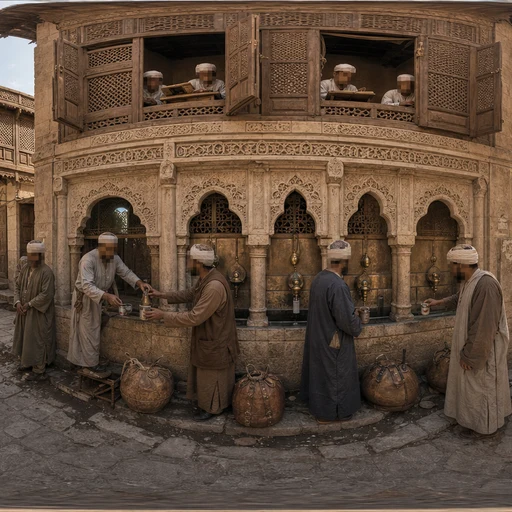
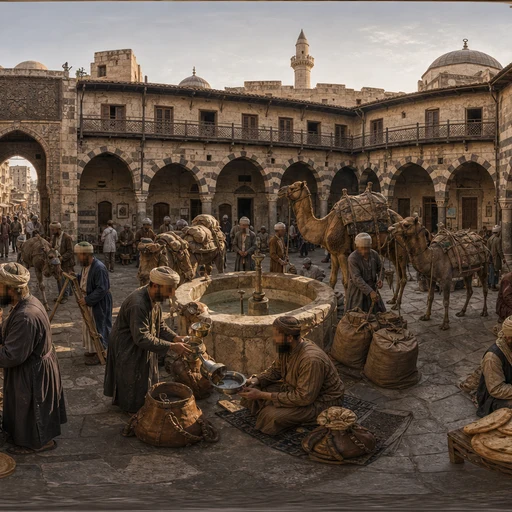
The setting is the arcaded courtyard of a great old mosque-college, with pointed-arch porticoes and a tall tiered stone minaret of Mamluk type. This is an ancient seat of Islamic learning in a major Egyptian city, not a new building.
A traditional teaching circle of turbaned scholars and students sits on mats around a teacher, with bound manuscripts open before them. This is the halqa, the long-established Islamic mode of instruction by recitation and commentary.
Set incongruously among the scholars are the instruments of foreign men in European coats: a wooden printing press, shallow trays of movable metal type including Arabic letters, and a brass telescope on a stand.
More apparatus is laid out, chemical glassware, an air pump, surveying instruments and large drawn maps, the equipment of a European scientific institute newly set up in the city.
Freshly printed Arabic sheets lie beside the handwritten books, the first products of a printing press at work in the country, the mechanical page set against the manuscript page.
Two worlds of knowledge are meeting, the handwritten scholarship of the mosque and the printed, instrument-based science of the newcomers, and the meeting takes place under a foreign occupation, with all the unease that carries.
Further reading & cross-references
Abd al-Rahman al-Jabarti, Aja'ib al-Athar and Tarikh Muddat al-Faransis bi-Misr (c. 1798-1825): The Egyptian chronicler's eyewitness account, including his visit to the French Institut, his description of the instruments and the press, and his record of the revolt and the entry into al-Azhar. The essential Muslim source. Confidence high.
Description de l'Egypte and the records of the Institut d'Egypte (early 19th c., non-Muslim cross-reference): The savants' own published survey and institute records. Used to confirm the founding of the Institut, the presses and instruments, and the scientific programme, not to frame the tone.
Juan Cole, Napoleon's Egypt: Invading the Middle East (Palgrave, 2007): Modern study using French and Arabic sources; the Institut, the encounters with the ulama, the revolt and the entry into al-Azhar. Confidence high.
Ibrahim Abu-Lughod, Arab Rediscovery of Europe (Princeton, 1963): Used cautiously for the longer-term framing of the encounter and its place in the later reform debates, with care not to overstate a simple awakening narrative.
Standing fabric of al-Azhar (extant): The mosque-college constrains the architectural setting: the courtyard, the riwaq arcades and the Mamluk and later minarets. Reviewers should keep the late-eighteenth-century state.
Questions & answers
- Where is The French Savants and al-Azhar?
- al-Azhar and the French Institut, Cairo
- When did it happen?
- c. 1214 AH / 1799 CE
- What is the story of The French Savants and al-Azhar?
- After the French occupied Cairo in 1798, Napoleon's expedition to Egypt brought with it a corps of more than a hundred and fifty savants, scientists, engineers, mathematicians, naturalists and artists, who founded the Institut d'Egypte in the city in August 1798 and set to surveying the land, its…
Related places




Guess places like this in GeoSiyer
Drop into a 360° scene from Islamic history and pin where, and when, it happened.
Play GeoSiyer