The Golden Horde Turns to Islam
Uzbeg Khan and the conversion at Sarai, c. 1313 CE
713 AH / c. 1313 CE
 Educational historical reconstruction
Where
Sarai, the capital of the Golden Horde, on the lower Volga
47.1800, 47.8600 · View on OpenStreetMap
Background
The Golden Horde was the Mongol khanate of the western steppe, the realm of the descendants of Jochi, eldest son of Chinggis Khan, which after the conquests ruled the Kipchak steppe and the Russian principalities from its capital, Sarai, on the lower course of the Volga. Its rulers and people were at first pagan, following the shamanism and the customs of the steppe, though Islam had long been present among the Muslim peoples and merchants of their lands. The decisive turn came under Uzbeg Khan (Ozbeg, reigned about 1313-1341), the most powerful of the khans of the Horde, who embraced Islam and made it the religion of the state, so that the western Mongols turned as a people to the faith. The Mamluk historians of Egypt, with whom Uzbeg kept a close alliance sealed by marriage and embassies, record the conversion; al-Umari in his Masalik al-Absar fi Mamalik al-Amsar gathers the reports of envoys on the khan, his armies and his Muslim realm, and the chroniclers of Cairo such as al-Nuwayri carry the same account. The fullest first-hand witness is the traveller Ibn Battuta, who reached Sarai and the moving court of the khan in the 1330s and describes in his Rihla a Muslim sovereign of great state, the prayers kept and the scholars honoured, amid the felt tents of the steppe. It was one of the great conversions of the age after the Mongol catastrophe, when the heirs of the conquerors became Muslims and patrons of the faith; from the Islam of the Golden Horde would descend the long Muslim presence of the Volga Tatars, the Crimea and the Kipchak steppe. This scene depicts the steppe court at Sarai as the turn to the faith is made: the assembly gathered on the grassland with tall standards and green banners raised over it, a low platform of fired brick being laid up under a timber canopy as a mosque rises at the heart of the camp, a round felt tent of the nomad ordu standing beside it, and far off on the horizon the faint skyline of the settled capital, with the merchants and scholars of the older Muslim lands received at low tables of goods and books. In keeping with the project's visual ethics the khan is not depicted by likeness; the scene is the court and the rising of the faith over it, the meeting of the steppe ordu and the new house of Islam.
What you see
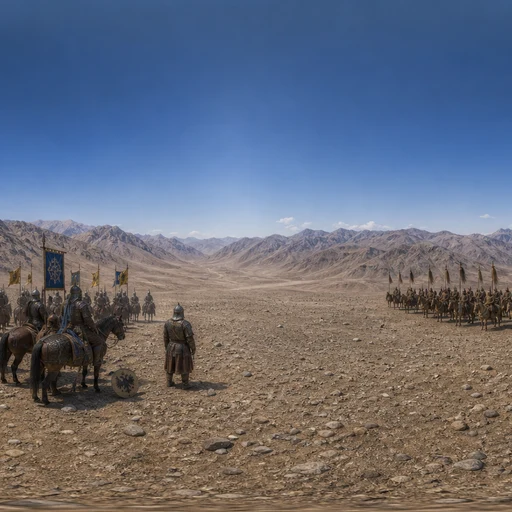
Open grassland steppe runs to the edge of a city under a low golden sun, far to the north of the old centres of Islam. This is the seat of a Mongol khanate of the western steppe, its capital set on the lower course of a great river, the Volga.
At the heart of the gathering a low platform of fired brick is being raised under a timber canopy, fresh courses stacked and laid by hand: a brick mosque going up at the heart of the steppe court. Far off on the right horizon a faint city skyline shows the capital itself, the settled place to which this nomad people is turning.
Above the gathering tall standards are raised on poles, among them green banners, the colour that marks a Muslim court. The people sit in assembly on the grass around them; this is the ordu of Uzbeg Khan, the ruler who made Islam the religion of the Golden Horde, with the faith now proclaimed over his steppe court.
A round felt tent of the steppe stands beside the brick mosque rising on its platform: the nomad ordu and the new house of Islam pitched together in one view. The western Mongols, once pagan shamanists, are taking up the faith as a people while still keeping the tents and standards of the steppe.
To one side scribes and traders sit at low tables spread with goods and bound books, the merchants and scholars of the older Muslim lands received at the court. The caravan trade of the steppe and the learning of Islam reach the Volga together.
Saddled horses and riders wait at the edge of the gathering, the mounts of a people of the steppe whose roads cross the Kipchak grassland from the Crimea to Khwarazm. The Horde's Islam tied it by these roads to the Mamluk sultanate of Egypt, with whom its khans kept close alliance.
The conversion of the Golden Horde under Uzbeg Khan (reigned about 1313-1341) is recorded by the Mamluk historians of Egypt, among them al-Umari in his Masalik al-Absar, and described at first hand by the traveller Ibn Battuta, who visited the khan's court and found a Muslim sovereign of great state amid the tents of the steppe.
Further reading & cross-references
Ibn Battuta, Rihla (14th c.): The Moroccan traveller reached Sarai and the moving court of Uzbeg Khan and describes the Muslim sovereign, his prayers and his scholars amid the tents of the steppe; the fullest first-hand Sunni witness to the scene.
al-Umari, Masalik al-Absar fi Mamalik al-Amsar (14th c.): The Mamluk encyclopaedist gathers envoys' reports on the khan, his armies and his Muslim realm; a near-contemporary Egyptian source for the conversion and the Horde's Islam.
Mamluk chroniclers of Cairo (e.g. al-Nuwayri, Ibn Taghribirdi): Used for the conversion under Uzbeg, the diplomatic and marriage alliance between the Horde and Mamluk Egypt and the establishing of Islam as the state religion.
Modern histories of the Golden Horde (academic): Used for the dynasty of Jochi, the capital Sarai and the chronology of the conversion. Non-confessional cross-reference.
Archaeology of Sarai on the lower Volga (material): The excavated remains of the Golden Horde capital, with their fired-brick mosques, baths and tiled wares, support a built city beside the steppe ordu; the capital shifted site over the 14th century, so the location stays regional.
Questions & answers
- Where is The Golden Horde Turns to Islam?
- Sarai, the capital of the Golden Horde, on the lower Volga
- When did it happen?
- 713 AH / c. 1313 CE
- What is the story of The Golden Horde Turns to Islam?
- The Golden Horde was the Mongol khanate of the western steppe, the realm of the descendants of Jochi, eldest son of Chinggis Khan, which after the conquests ruled the Kipchak steppe and the Russian principalities from its capital, Sarai, on the lower course of the Volga. Its rulers and people were…
Related places




Guess places like this in GeoSiyer
Drop into a 360° scene from Islamic history and pin where, and when, it happened.
Play GeoSiyer