The Great Mosque of Djenne
The mud-brick mosque of a Niger trading town, c. 1330
730 AH / c. 1330 CE
 Educational historical reconstruction
Where
Djenne, inland Niger delta
13.9054, -4.5550 · View on OpenStreetMap
Background
Djenne, on a rise above the floodplain of the inland Niger delta in what is now Mali, was one of the great trading and learning towns of the western Sudan, the southern terminus of trans-Saharan routes that carried gold, salt, cloth and books, and a twin in commerce and scholarship to Timbuktu downstream. The town's chronicle tradition, preserved in the seventeenth-century Tarikh al-Sudan of the Timbuktu scholar al-Sa'di (rahimahu Allah), records that a local king, Koi Konboro, embraced Islam and pulled down his palace to build the first great mosque on its site, an event placed by tradition in the centuries of the rise of Islam in the region, around the time the Mali Empire of Mansa Musa stood at its height in the early fourteenth century. The mosque belongs to the Sudano-Sahelian tradition of earthen architecture: it is built of sun-dried mud brick rendered in mud plaster, with massive tapering buttressed walls, a flat roof, tower-like buttresses on the qibla wall crowned with conical pinnacles and pale finials, and rows of projecting wooden toron beams that serve both as ornament and as the scaffolding for the communal re-plastering that the building needs each year after the rains. It must be said plainly that the famous mosque standing at Djenne today was rebuilt in 1907, and the exact form of the medieval mosque is not known from archaeology; what is secure is the long regional tradition of monumental earthen mosque-building of which this scene is a reconstruction. The scene depicts the adobe mosque at the heart of its Niger trading town in the Mali period, the market before it and the river beyond.
What you see
A town of flat-roofed earthen houses sits on a low rise above the floodplain of a great inland river delta, in open savannah south of the desert. This is the Sahel, the Sudanic belt of West Africa, not North Africa or Arabia.
The mosque is built entirely of sun-dried earth, mud bricks rendered in a smooth coat of mud plaster, with massive tapering walls and no stone or fired brick anywhere. Earth is the only building material.
Rows of wooden beams project from the walls in regular horizontal ranks. These toron of split palm are at once permanent scaffolding for the yearly re-plastering and a strong decorative rhythm, a feature unique to the mud architecture of the western Sudan.
The wall facing the prayer direction is dominated by tall engaged tower-buttresses rising like minarets, each capped with a conical pinnacle bearing a pale finial, traditionally an ostrich egg. Heavy buttresses and pilasters rib the other walls.
The roof is flat, pierced by small covered vent-holes capped with pottery, and the whole mass is rounded and sculptural rather than sharp-edged, the surfaces hand-modelled in earth.
An open market crowds the square before the mosque, with goods landed from river craft, salt, cloth, and produce. This is a trading town of the inland Niger, the mosque at the centre of its commercial and religious life.
Further reading & cross-references
Al-Sa'di, Tarikh al-Sudan (17th c., Timbuktu): The major Sunni West African chronicle, by a Timbuktu scholar. The source for Djenne's conversion under King Koi Konboro and the building of the first great mosque, and for the town's place in the trade and learning of the Niger. Records a tradition centuries after the event, so the date is uncertain.
Tarikh al-Fattash (attributed to Mahmud Kati and others, 16th-17th c.): A second West African chronicle of the Niger bend; supports the standing of Djenne as a trade and scholarly centre. Its transmission and authorship are debated, so used with caution as a cross-reference.
Ibn Battuta, Rihla (14th c.): The Moroccan traveller's account of his journey to the Mali Empire in the 1350s. Used for the contemporary picture of Islam, trade and town life in the western Sudan in the period, not for Djenne specifically.
Labelle Prussin, Hatumere: Islamic Design in West Africa (California, 1986): Standard study of Sudano-Sahelian earthen architecture. Used for the construction in mud brick, the toron beams, the buttress-towers and finials, and the annual re-plastering.
Roderick J. and Susan Keech McIntosh, archaeology of Jenne-jeno (excavations, 1977 onward): The archaeology of the ancient town site near Djenne, establishing its antiquity and urban character. Used for the setting; it does not recover the medieval mosque itself.
Standing Great Mosque of Djenne (extant, rebuilt 1907) and the living Sudano-Sahelian tradition: The present mosque and the wider tradition of earthen mosque-building constrain the appearance. Critically, the standing mosque dates to 1907 and the medieval form is not archaeologically known; this scene reconstructs the regional type, not the specific lost building.
Questions & answers
- Where is The Great Mosque of Djenne?
- Djenne, inland Niger delta
- When did it happen?
- 730 AH / c. 1330 CE
- What is the story of The Great Mosque of Djenne?
- Djenne, on a rise above the floodplain of the inland Niger delta in what is now Mali, was one of the great trading and learning towns of the western Sudan, the southern terminus of trans-Saharan routes that carried gold, salt, cloth and books, and a twin in commerce and scholarship to Timbuktu…
Related places


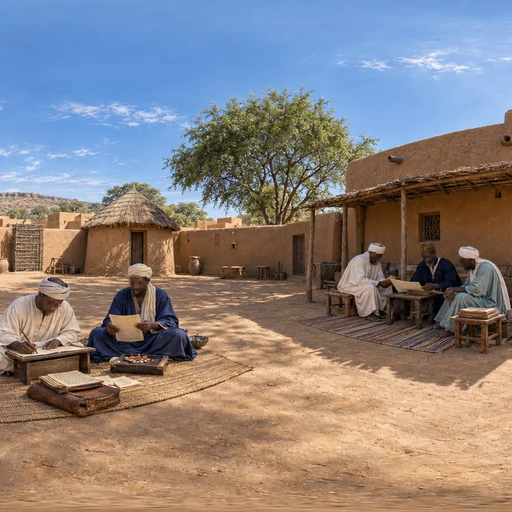

Guess places like this in GeoSiyer
Drop into a 360° scene from Islamic history and pin where, and when, it happened.
Play GeoSiyer