The Great Mosque of Xi'an
Islam in the Chinese manner, 1384 CE
786 AH / c. 1384 CE
 Educational historical reconstruction
Where
Xi'an, in central China
34.2658, 108.9389 · View on OpenStreetMap
Background
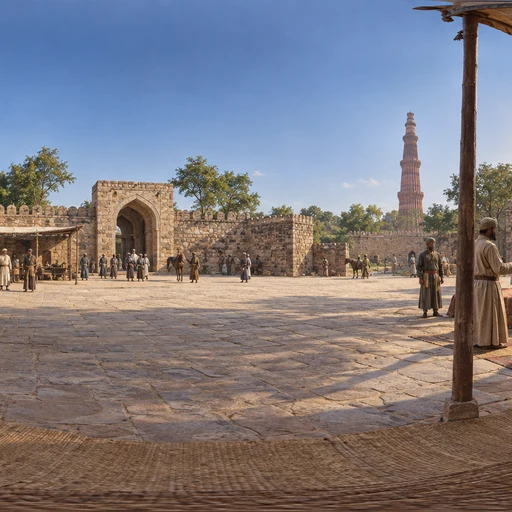
The Great Mosque of Xi'an, in the ancient imperial city that was the eastern terminus of the Silk Road, is one of the oldest and largest mosques in China and one of the most striking examples anywhere of the way Islam, carried into a great and confident civilisation, took root by clothing itself in the native architecture rather than by overturning it. Islam had come to China very early, by the Silk Road across Central Asia and by the sea-route to the southern ports, brought by Arab and Persian merchants and envoys from the time of the early caliphs, and over the centuries a settled Chinese Muslim people, later called the Hui, grew up, Chinese in language and much of their culture, Muslim in faith. The Great Mosque of Xi'an, whose present buildings are largely of the Ming dynasty and are often dated to about 1384 though the community and its mosque are older, is built entirely in the Chinese manner: not as a single domed structure but as a sequence of walled garden-courtyards set one behind another along a central axis, entered through ornamental wooden gateways and pavilions, with timber prayer-halls under the great sweeping tiled roofs and upturned eaves of Chinese architecture, and, in place of a minaret, a tower in the form of a pagoda from which the call to prayer is given. Yet within these Chinese forms the building is unmistakably a mosque: its great prayer-hall is turned to face the west, toward Makkah, its wall set with a mihrab, and Arabic inscriptions of the Qur'an and the names of God are woven in among the Chinese ornament. It is a monument to the long presence of Islam in China and to the genius by which the faith made itself at home in a civilisation utterly unlike that of its birth. This scene depicts the courtyards and halls of the Great Mosque of Xi'an. In keeping with the project's ethics any figure is anonymous and at a distance.
What you see
A mosque laid out not as a single domed building but as a series of garden-courtyards one behind another, entered through ornamental wooden gateways, exactly in the manner of a Chinese temple, with timber halls under sweeping tiled roofs and upturned eaves.
In place of a tall minaret stands a tower like a Chinese pagoda, from which the call to prayer is given; yet the great wooden prayer-hall at the far end is turned to face the west, toward Makkah, and its wall holds a mihrab and Arabic inscriptions among the Chinese ornament.
This is the Great Mosque of Xi'an, one of the oldest and largest mosques in China, the house of worship of a Chinese Muslim community whose roots reach back to the merchants and envoys who came by the Silk Road and the sea centuries before.
The mosque shows how Islam took root in China not by overturning the native culture but by clothing itself in it: the faith of the Qur'an and the qibla housed within the forms of Chinese architecture, the work of Chinese Muslim builders.
The city was an ancient imperial capital of China and the eastern end of the Silk Road, the gateway by which much of Islam and its trade had entered the Chinese world.
The Great Mosque of Xi'an is an extant and active mosque. The scene depicts its courtyards and halls; no individual is shown by likeness.
Further reading & cross-references
The Great Mosque of Xi'an (extant, active mosque): The primary monument. Used for the courtyards, the pagoda-minaret, the prayer-hall and the mihrab. Confidence high.
Histories of Islam in China and the Hui Muslims: Used for the early coming of Islam by Silk Road and sea and the Chinese Muslim community. Confidence high.
Studies of Chinese Islamic architecture: Used for the temple-courtyard plan, the pagoda-minaret and the fusion of Chinese form with Islamic function. Confidence high.
Xi'an and the Silk Road (material/geographic context): The imperial city and the Silk Road terminus constrain the depiction.
Questions & answers
- Where is The Great Mosque of Xi'an?
- Xi'an, in central China
- When did it happen?
- 786 AH / c. 1384 CE
- What is the story of The Great Mosque of Xi'an?
- The Great Mosque of Xi'an, in the ancient imperial city that was the eastern terminus of the Silk Road, is one of the oldest and largest mosques in China and one of the most striking examples anywhere of the way Islam, carried into a great and confident civilisation, took root by clothing itself in…
Related places




Guess places like this in GeoSiyer
Drop into a 360° scene from Islamic history and pin where, and when, it happened.
Play GeoSiyer