The Iranian Constitutional Revolution
Tehran and the first Majlis, 1906
1324 AH / c. 1906 CE
 Educational historical reconstruction
Where
Tehran, beneath the Alborz
35.7000, 51.4200 · View on OpenStreetMap
Background
Between 1905 and 1911 Persia passed through the Constitutional Revolution, a popular movement against the autocracy of the Qajar shahs and against the foreign concessions and debts through which European powers had gained a grip on the country. An unusual coalition drove it: the merchants of the bazaar, reformist intellectuals, and a large part of the Shia clergy, who lent the movement decisive weight, though other clerics opposed it. Through mass protests, strikes that closed the bazaars, and the taking of sanctuary in mosques and foreign legations, the movement forced the shah in 1906 to grant a constitution and to convene Persia's first elected national assembly, the Majlis, which set about writing laws and curbing royal power. The revolution was a landmark, one of the first constitutional movements in the Muslim world and a precursor of the constitutional and national struggles that would follow across the region, and it bound together, uneasily, the ideas of representative government and of a politics rooted in Islam. Its gains were fragile: the shah and his Russian backers bombarded the Majlis in 1908, civil conflict followed, and the constitutional order was repeatedly suspended in the decades after, but the idea of a constitution and a parliament had entered Persian political life for good. This scene depicts the constitutional movement in Tehran around 1906, the crowds of merchants and clergy with their petitions, the lion-and-sun banners, the new assembly building by the bazaar, beneath the Alborz.
What you see
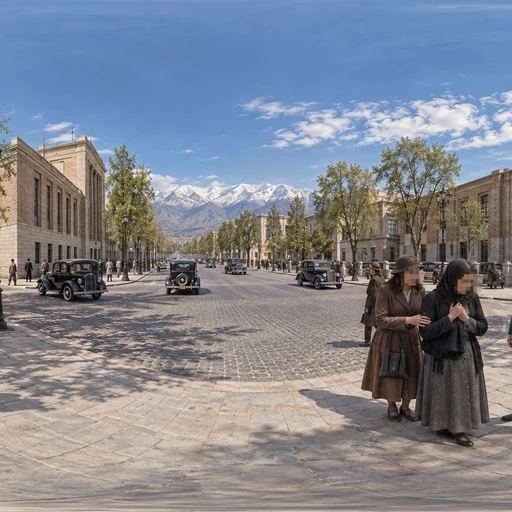
A city of brick and plaster spreads on a high plain at the foot of a long snow-capped range. This is a plateau capital beneath a great wall of mountains, the Alborz above the Persian capital.
Flags bearing a lion holding a sword before a rising sun fly over the crowd; this is the old royal emblem of Persia, not a republican or modern banner.
A great crowd of merchants, turbaned scholars and townsfolk gathers before a public building, holding up petitions and documents; this is a political mobilisation pressing demands on a monarchy, not a religious festival or a market.
A new assembly building is the focus of the gathering, with the covered lanes of a great bazaar nearby; the merchants of the bazaar and the clergy are visibly central to the movement.
Crowds and clerics and merchants massing to demand a constitution and an elected assembly from a shah mark the birth of constitutional and national politics in Persia, a movement watched across the Muslim world.
Further reading & cross-references
Histories of the Iranian Constitutional Revolution (e.g. Janet Afary, The Iranian Constitutional Revolution): Standard modern academic history. Used for the coalition, the events of 1905-1911, the granting of the constitution and the first Majlis. Framed historically, no confessional source. Confidence high.
Ervand Abrahamian, A History of Modern Iran (2008): Used for the political context of late Qajar Persia, the foreign concessions, and the constitutional movement. Confidence high.
Contemporary Persian accounts and documents of the constitutional movement: Used for the role of the bazaar and the clergy and the demands of the movement. Confidence medium to high.
Records of Tehran and the first Majlis building (cross-reference): Period photographs and records constrain the depiction of the city, the bazaar and the assembly. Confidence medium.
Questions & answers
- Where is The Iranian Constitutional Revolution?
- Tehran, beneath the Alborz
- When did it happen?
- 1324 AH / c. 1906 CE
- What is the story of The Iranian Constitutional Revolution?
- Between 1905 and 1911 Persia passed through the Constitutional Revolution, a popular movement against the autocracy of the Qajar shahs and against the foreign concessions and debts through which European powers had gained a grip on the country. An unusual coalition drove it: the merchants of the…
Related places



Guess places like this in GeoSiyer
Drop into a 360° scene from Islamic history and pin where, and when, it happened.
Play GeoSiyer