The Mevlevi Sema at Konya
The lodge of the followers of Rumi, c. 1300 CE
c. 700 AH / c. 1300 CE
 Educational historical reconstruction
Where
Konya, the Mevlevi lodge, central Anatolia
37.8716, 32.5047 · View on OpenStreetMap
Background
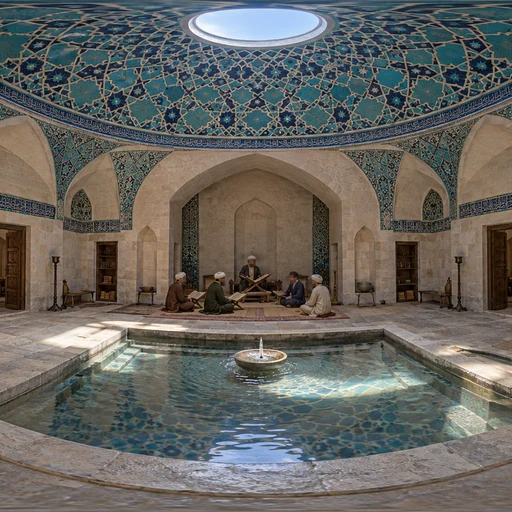
Konya, on the high plateau of central Anatolia, had been the capital of the Seljuk sultanate of Rum, a meeting-place of Persian, Turkish and Islamic learning, and it was there that the great poet and teacher Jalal al-Din Rumi, known to the Turks as Mevlana, our master, lived, taught and died in 1273. Around his memory and teaching there grew the Mevlevi order (the Mawlawiyya), one of the most influential of the Sufi orders, organised in the decades after his death by his son Sultan Walad and his successors. The order is best known for its distinctive ceremony, the sema: in a round ceremonial hall the dervishes, in long white robes that stand for the shroud and tall camel-hair caps that stand for the tombstone, turn slowly and steadily in a circling movement, one hand raised to receive from heaven and one lowered to give to the earth, while the breathy lament of the reed flute, the ney, the drum and the chanted poetry of Rumi fill the hall. The Mevlevi understand the sema not as a dance for its own sake but as a form of the remembrance of God, dhikr, given a particular shape, a turning of the whole person toward the divine. The heart of the order is the lodge at Konya, crowned by the famous fluted dome of brilliant green tile that rises over the tomb of Rumi. This scene depicts the lodge and the ceremony around the year 1300, as the young order took shape: the green dome of the master's tomb, the round hall, the turning dervishes and the sound of the ney, in the city on the Anatolian plateau. In keeping with the project's ethics the founder is not shown by likeness; the dervishes of the ceremony are depicted at a respectful distance.
What you see
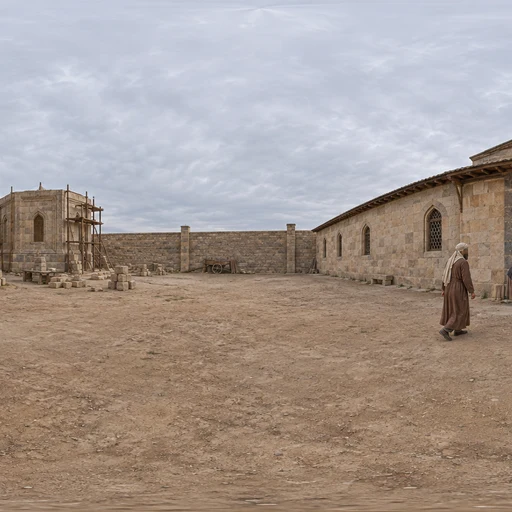
A Sufi lodge in an Anatolian city, and over its heart a fluted dome of brilliant green tile rising above the tomb of the master; the green dome is the mark of the place.
Within a round ceremonial hall, dervishes in long white robes and tall camel-hair caps turn slowly in a circling dance, one hand raised to heaven and one lowered to earth; this is the sema, the turning remembrance of the order.
A reed flute, the ney, sounds the music of the ceremony, its breathy lament the sound most bound to this order; with it the drum and the chanted poetry of the founder.
This is the lodge of the Mevlevi, the order that grew around the great poet and teacher Jalal al-Din Rumi, called Mevlana, at Konya; their turning sema is a form of the remembrance of God (dhikr) given a distinctive ceremonial shape.
The city lies on the high plateau of central Anatolia, in the country that had been the heart of the Seljuk sultanate of Rum, where Persian, Turkish and Islamic learning met.
Rumi died at Konya in 1273; the Mevlevi order and its sema were organised by his son and successors in the following decades. The dervishes may be depicted in the ceremony; the founder is not shown by likeness.
Further reading & cross-references
The life and works of Jalal al-Din Rumi (the Mathnawi and the Divan): Used for Rumi at Konya, his death in 1273 and the teaching around which the order grew.
Histories of the Mevlevi order and its founding (Sultan Walad and successors): Used for the organisation of the order and the sema in the decades after Rumi, and the lodge at Konya.
Accounts of the sema ceremony and its symbolism (white robe, cap, the ney, the turning as dhikr): Used for the form and meaning of the ceremony.
The Mevlana lodge and green dome at Konya (extant, material): The standing lodge, the green-tiled fluted dome over Rumi's tomb and the ceremonial hall constrain the depiction; the present complex has later Ottoman additions.
Questions & answers
- Where is The Mevlevi Sema at Konya?
- Konya, the Mevlevi lodge, central Anatolia
- When did it happen?
- c. 700 AH / c. 1300 CE
- What is the story of The Mevlevi Sema at Konya?
- Konya, on the high plateau of central Anatolia, had been the capital of the Seljuk sultanate of Rum, a meeting-place of Persian, Turkish and Islamic learning, and it was there that the great poet and teacher Jalal al-Din Rumi, known to the Turks as Mevlana, our master, lived, taught and died in…



Guess places like this in GeoSiyer
Drop into a 360° scene from Islamic history and pin where, and when, it happened.
Play GeoSiyer